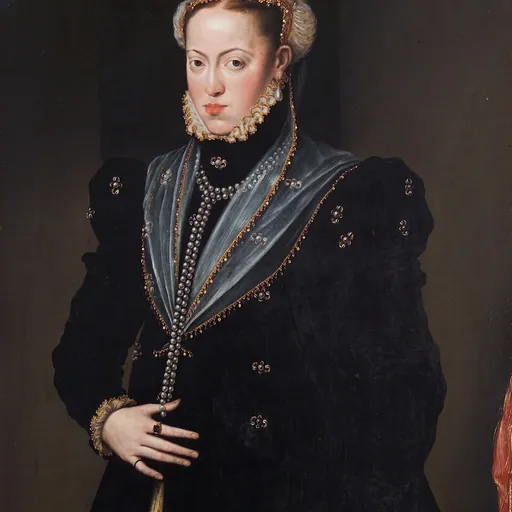
Maria of Austria, Holy Roman Empress
Holy Roman empress
About Maria of Austria, Holy Roman Empress
Lived 1528 – 1603 (aged 74). Maria of Austria, Holy Roman Empress was a Spanish queen regnant.
Maria of Austria or Maria of Spain (21 June 1528 – 26 February 1603), also known as Isabel, was the empress consort and queen consort of Maximilian II, Holy Roman Emperor, King of Bohemia and Hungary. She served as regent of Spain in the absence of her father Emperor Charles V from 1548 until 1551 and was one of the most powerful empresses of the Holy Roman Empire.
Early life Maria was born in Madrid, Spain to Charles V, Holy Roman Emperor and King of Spain, and Isabella of Portugal. She grew up mostly in Toledo and Valladolid with her siblings, Philip and Joanna. They built a strong family bond despite their father's regular absences. Maria and her brother, Philip, shared similar strong personal views and policies which they retained during the rest of their lives.
As Regent of Spain On 15 September 1548, aged twenty, Maria married her first cousin Archduke Maximilian. Despite Maria's commitment to Habsburg Spain and her strong Catholic manners, the marriage was a happy one. The couple had sixteen children in just nineteen years, but only nine of them lived to adulthood.
While her father was occupied with German affairs, Maria and Maximilian acted as regents of Spain during the absence of Prince Philip from 1548 to 1550 and from 1550 she did so alone. Maria stayed at the Spanish court until August 1551, and in 1552, the couple moved to live at the court of Maximilian's father in Vienna.
As Holy Roman Empress In 1564, her husband succeeded his father Ferdinand I at his death, as Holy Roman Emperor, King of Bohemia, and King of Hungary. He ruled these domains until his death in 1576. Maria became Empress and Queen.
Maria was a devout Catholic and frequently disagreed with her religiously ambiguous husband about his religious tolerance.
During her life in Austria, Maria was reportedly ill at ease in a country which was not entirely Catholic, and she surrounded herself with a circle of strictly Catholic courtiers, many of whom she had brought with her from Spain. Her court was organized by her Spanish chief lady-in-waiting Maria de Requenes in a Spanish manner, and among her favorite companions was her Spanish lady-in-waiting Margarita de Cardona.
As Holy Roman Empress Dowager In 1576, Maximilian died. Maria remained at the Imperial Court for six years after his death. She had great influence over her sons, the future emperors Rudolf II and Matthias.
Maria returned to Spain in 1582, taking her youngest surviving child Archduchess Margaret with her, who was promised to marry Philip II of Spain, who had lost his fourth wife, her oldest daughter, Archduchess Anna in 1580.
Margaret finally refused and took the veil as a Poor Clare. Commenting that she was very happy to live in "a country without heretics", Maria then influenced quite a number of events in the Spanish Court until she eventually settled in the Convent of Las Descalzas Reales in Madrid, where she lived until her death in 1603.
She was the patron of the noted Spanish composer Tomás Luis de Victoria, and the great Requiem Mass he wrote in 1603 for her funeral is considered among the best and most refined of his works. Maria exerted some influence together with Queen Margaret, the wife of her grandson/nephew, Philip III of Spain. Margaret, the sister of the future Ferdinand II, Holy Roman Emperor, would be one of three women at Philip's court who would apply considerable influence over the king. Margaret was considered by contemporaries to be extremely pious – in some cases, excessively pious, and too influenced by the Church, and 'astute and very skillful' in her political dealings, although 'melancholic' and unhappy over the influence of the Duke of Lerma over her husband at court.
Maria, the Austrian representative to the Spanish court – and Margaret of the Cross, Maria's daughter – along with Queen Margaret, were a powerful Catholic and pro-Austrian faction in the court of Philip III of Spain.
Issue Maria was constantly pregnant during much of her marriage, giving birth almost once (and sometimes twice) a year: Anna (2 November 1549 – 26 October 1580), married her uncle Philip II of Spain Ferdinand (28 March 1551 – 16 June 1552), died in early childhood Rudolf II (18 July 1552 – 20 January 1612), emperor Ernest (15 June 1553 – 12 February 1595), served as governor of the Habsburg Netherlands Elisabeth (5 July 1554 – 22 January 1592), married Charles IX of France Maria (27 July 1555 – 28 June 1556), died in infancy Matthias (24 February 1557 – 20 March 1619), emperor A stillborn son (born and died 20 October 1557) Maximilian (12 October 1558 – 2 November 1618), served as grandmaster of the Teutonic Order and administrator of Prussia Albert (15 November 1559 – 13 July 1621), served as governor of the Habsburg Netherlands Wenceslaus (9 March 1561 – 22 September 1578) Frederick (21 June 1562 – 25 January 1563), died in infancy Maria (19 February 1564 – 26 March 1564), died in infancy Charles (26 September 1565 – 23 May 1566), died in infancy Margaret (25 January 1567 – 5 July 1633), a nun Eleanor (4 November 1568 – 12 March 1580), died in childhood
Only five of Maria's children were still alive at the time of her death.
Don’t just read it —
keep it.
Full-length biographies made to live with: read them, listen on the way to work, watch them tonight.
- E-book
- Audio
- Video
Instant download · yours to keep · every purchase keeps this site free
Important facts
Family & relationships
People in Maria of Austria, Holy Roman Empress's life
Named in this biography and alive at the same time
Related people
Same field, nearest in time
Contemporaries
People whose lives overlapped Maria of Austria, Holy Roman Empress's
Frequently asked questions
Who was Maria of Austria, Holy Roman Empress?
Holy Roman empress (1528-1603)
When was Maria of Austria, Holy Roman Empress born?
Maria of Austria, Holy Roman Empress was born on 21 June 1528 in Madrid.
When did Maria of Austria, Holy Roman Empress die?
Maria of Austria, Holy Roman Empress died on 26 February 1603 in Convent of Las Descalzas Reales.
What was Maria of Austria, Holy Roman Empress's occupation?
Maria of Austria, Holy Roman Empress was a queen regnant.
What nationality was Maria of Austria, Holy Roman Empress?
Maria of Austria, Holy Roman Empress was Spanish.
Sources & further reading
· Wikipedia: Maria of Austria, Holy Roman Empress
· DBpedia: Maria of Austria, Holy Roman Empress
Cite this page
APA: Biography.guide. (2026). Maria of Austria, Holy Roman Empress. https://biography.guide/maria-of-austria-holy-roman-empress/
MLA: "Maria of Austria, Holy Roman Empress." Biography.guide, https://biography.guide/maria-of-austria-holy-roman-empress/.
Chicago: "Maria of Austria, Holy Roman Empress." Biography.guide. https://biography.guide/maria-of-austria-holy-roman-empress/.
Data last updated: 2026-09-29 · Spot an error? Report a correction.
Portrait: Wikimedia Commons · author & licence
Page generated 2026-10-05 04:14 UTC