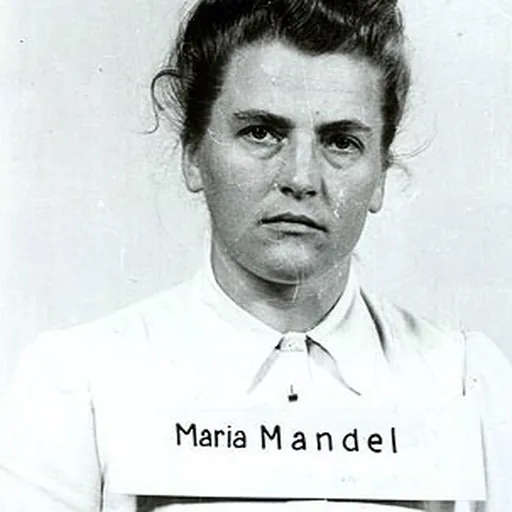
Maria Mandl
Austrian Holocaust perpetrator and convicted war criminal
About Maria Mandl
Lived 1912 – 1948 (aged 36). Maria Mandl was an Austrian prison officer, torturer and politician.
Maria Mandl (, ; sometimes erroneously spelled Mandel; 10 January 1912 – 24 January 1948) was an Austrian-born Holocaust perpetrator and convicted war criminal. From 1942 until her arrest in 1945, she served as the (camp leader) at the Auschwitz II-Birkenau concentration camp. She also held positions at the Lichtenburg and Ravensbrück camps as (overseer) and (head overseer), respectively.
Mandl was born in Münzkirchen, Austria-Hungary, into a middle-class Catholic family affiliated with the Christian Social Party (CSP). Following the annexation of Austria by Nazi Germany in 1938, she moved to Munich and found work as an at the Lichtenburg concentration camp. There, she subjected prisoners to fatal beatings and floggings. In 1939, she was transferred to Ravensbrück, where she was promoted to . She oversaw the training program for prospective and worked alongside Dorothea Binz in the camp's punishment block. Mandl's final promotion came in 1942, when she was transferred to Auschwitz II-Birkenau and given the position of under the command of Rudolf Höss. As the Red Army advanced toward the Auschwitz complex in late 1944, Mandl was transferred to the Mettenheim camp. In May 1945, as the United States Air Force invaded and bombed the area, Mandl fled with her lover, Walter Adolf Langleist, and a Jewish prisoner known as Mose. After evading arrest for three months, Mandl and Langleist were apprehended by the American military police in August 1945 at Langleist's home in Hof.
Mandl was convicted of crimes against humanity at the Auschwitz trial in Kraków in December 1947. Based on the number of death lists she signed, it is believed that she had been complicit in the deaths of approximately 500,000 prisoners during her tenure at Birkenau. In January 1948, she was executed by hanging at the age of thirty-six. Her last words were "" ("Poland lives").
Early life
Maria Mandl was born at 10:00 pm on 10 January 1912 in Münzkirchen, Austria-Hungary, into a middle-class Catholic family. She was raised on a farm, which was regarded by locals as the largest in the municipality, and had three older siblings: Georg, Anna, and Aloisia. Her father, Franz Mandl, was a shoemaker who worked out of his own shop and was opposed to the Nazi Party, instead supporting the Christian Social Party (CSP). In the 2014 documentary Pechmarie: The Life of Maria Mandl, former Münzkirchen mayor Martin Zauner described the Mandls as "a good, Catholic family" who were "definitely against the Third Reich".
On 20 July 1924, at the age of twelve, Mandl was withdrawn from school without completing an exit exam to help on the family farm. In 1927, she was admitted to a Catholic boarding school in Neuhaus am Inn, from which she graduated. That same year, she was hired at the local post office and became engaged to a soldier.
After Nazi Germany annexed Austria in 1938, Mandl's engagement ended, and she lost her job at the post office. As a Third Reich soldier, her fiancé believed that her family's affiliation with the CSP could harm his reputation and affect his chances of finding employment in the civil service in the future. Mandl had been fired from her job for similar reasons; her family was openly opposed to the Third Reich, and she herself had no allegiance to the Nazi Party.
Mandl began working at the camp on 15 October. She completed a training program structured around Nazi ideology and took a twenty-question exam on geography, history, and dates significant to the Nazi Party. During her first three months as , she was under the supervision of an experienced guard. According to testimonies from survivors Emilie Neu and Lina Haag, Mandl subjected prisoners to whippings, beatings, and strenuous exercises—a practice referred to as "sport" in both victim and perpetrator accounts. In one incident, Mandl struck a prisoner repeatedly with a metal key until she lost consciousness, then dragged her across the camp and put her in a solitary cell. Another survivor, unnamed, recalled an encounter with Mandl when the woman was still new. The survivor had told the latter that she was "too pretty to play supervisor," to which Mandl replied, "No I swore the oath to the , I'm staying". In the summer of 1939, she trained Hermine Braunsteiner, who later described Mandl as having been "very strict" and "unfavorable" during her training, recalling instances Mandl hit prisoners.
In early 1940, Mandl, along with Dorothea Binz, as the latter had been unable to maintain "brutality and structure" within the camp.
Auschwitz II-Birkenau (1942–1944)
In October 1942, Mandl was sent to Auschwitz II-Birkenau, where she succeeded Langefeld in rank for the second time upon being promoted to the position of . She resided in on-camp housing, with gynecologist Carl Clauberg as her neighbor. In this position, her only superior was Rudolf Höss, who regarded her highly. On 27 March 1944, he gave her a salary increase of 100 as well as control of all the female subcamps in the Auschwitz complex, including Hindenburg O.S., Lichtewerden, and Rajsko. During this period, Mandl promoted Irma Grese to the position of and appointed Therese Brandl as her secretary. In November, Mandl was awarded the War Merit Cross, Second Class.
The cruelty Mandl had subjected prisoners to in Lichtenburg and Ravensbrück continued. At Birkenau, when new prisoners arrived, she used a cane to extract expensive items and jewelry hidden in women's vaginas. She took these items back with her to Münzkirchen when visiting her family and kept them hidden inside a drawer. According to survivor Anita Lasker-Wallfisch, Mandl would stand in front of the camp's front gate whilst prisoners were lined up. If a prisoner made eye contact with her, they were removed from the line and killed. She also tested prisoners returning from outside work details by holding a cane fifty centimeters above the ground and forcing every person to jump over it. Those who succeeded were allowed to proceed to roll call, while those who failed were sent to the gas chamber. Moreover, survivor Regina Lebensfeldová-Hofstädterová, who had been a typist in the camp's political department, stated that Mandl referred to prisoners as (dung beetles). Over the next two years, Mandl signed death lists on a weekly basis and partook in selections alongside SS doctors.
Mandl provided care to a select few children in Birkenau, giving them extra food and engaging them in activities like dancing and singing. Survivor Ella Lingens-Reiner has attested to this, having recalled witnessing two children leaving Mandl's office with cookies and chocolate. Lingens-Reiner has also stated that Mandl once asked a pregnant German prisoner to give her the child after its birth, because she herself was not able to have children. During the winter season, members of the orchestra were not required to stand outside for roll calls and were instead counted inside their barracks. They were also allowed to shower daily and were given proper bedding, as well as tables to eat on. By the end of June, the orchestra had grown to twenty members, and by 1944, it had reached its peak of forty-two.
Mandl was imprisoned at the Dachau concentration camp, where she was interrogated by Americans, whom she described as "violent but smart". On 11 July 1946, she was transferred to Polish custody on grounds of the London Agreement and her disproportionate cruelty towards Polish prisoners. For the remainder of her life, Mandl was incarcerated at Montelupich Prison, where she shared a cell with Brandl. That September, Mandl was tried and convicted by Poland's Supreme National Tribunal. She would only plead guilty on 5 March 1947 after confessing to have signed most death lists during her time at Birkenau. On 22 December 1947, she was found guilty of crimes against humanity and sentenced to death by hanging, one of forty defendants and one of only four women in what would become known as the Auschwitz trial. Based on the number of lists signed with her name, Mandl is believed to have been complicit in the deaths of approximately 500,000 people. She also sought forgiveness from anti-Communist activist Stanisława Rachwałowa, who was formerly imprisoned in Auschwitz and later incarcerated in Montelupich upon being sentenced to death by communist authorities. Her mother died in 1944 and had attended Mass every day, where she "prayed for her daughter's eternal soul". The Mandl family's tomb in Münzkirchen does not have Maria's name engraved.
In November 1975, Mandl's death certificate was recovered. Issued by the District Court of Ried im Innkreis, the document claimed that she had died in a concentration camp as a prisoner and regarded her as a "victim of National Socialism". Lawyer and the Austrian Mauthausen Committee demanded for corrections to be made. It was not until April 2017 that the Ried im Innkreis regional court amended the certificate to reflect Mandl's role in the Holocaust.
Don’t just read it —
keep it.
Full-length biographies made to live with: read them, listen on the way to work, watch them tonight.
- E-book
- Audio
- Video
Instant download · yours to keep · every purchase keeps this site free
Important facts
People in Maria Mandl's life
Named in this biography and alive at the same time





Related people
Same field, nearest in time




Contemporaries
People whose lives overlapped Maria Mandl's






Frequently asked questions
Who was Maria Mandl?
Austrian Holocaust perpetrator and convicted war criminal (1912–1948)
When was Maria Mandl born?
Maria Mandl was born on 10 January 1912 in Münzkirchen.
When did Maria Mandl die?
Maria Mandl died on 24 January 1948 in Kraków.
What was Maria Mandl's occupation?
Maria Mandl was a prison officer, torturer and politician.
What nationality was Maria Mandl?
Maria Mandl was Austrian.
Sources & further reading
Cite this page
APA: Biography.guide. (2026). Maria Mandl. https://biography.guide/maria-mandl/
MLA: "Maria Mandl." Biography.guide, https://biography.guide/maria-mandl/.
Chicago: "Maria Mandl." Biography.guide. https://biography.guide/maria-mandl/.
Data last updated: 2026-09-22 · Spot an error? Report a correction.
Portrait: Wikimedia Commons · author & licence
Page generated 2026-09-27 05:02 UTC