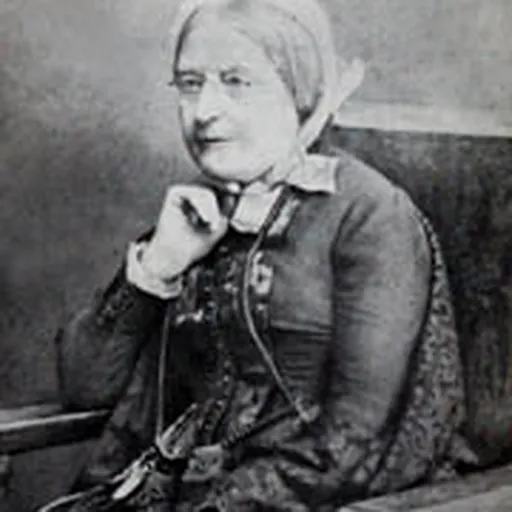
About Maria Georgina Grey
Lived 1816 – 1906 (aged 90). Maria Georgina Grey was a British pedagogue, writer and educationist.
Maria Georgina Grey (née Shirreff; 7 March 1816 – 19 September 1906), also known as Mrs William Grey, was a British educationist and writer who promoted women's education and was one of the founders of the organisation that became the Girls' Day School Trust. The college she founded was named in her honour the Maria Grey Training College.
Biography
Family Maria Georgina Shirreff was born on 7 March 1816 in Blackheath, London. She was the third daughter of Admiral William Henry and Elizabeth Anne Shirreff. Out of her three sisters, Caroline (b. 1812), Emily (b. 1814), and Katherine (b. 1818), Maria was very close to her elder sister Emily Shirreff, who would later become her collaborator in her writings and campaigns. She also had two brothers who both died at an early age.
In 1828, Maria and Emily joined a boarding school in Paris, which later influenced scenes in Maria's second novel Love’s Sacrifice in 1868. A year later they were removed from the school due to Emily's poor health and after their father was appointed captain of the port of Gibraltar in 1831 he did not think it was necessary to appoint another governess. Though their formal education was at an end, Maria and Emily continued to improve themselves by travelling extensively and became expert linguists through their visits to France, Spain and Italy, reading books from their father's extensive library, and became acquainted with many intellectuals of the age through their father's contacts.
In 1834 Mrs Shirreff brought her daughters back to England, and Maria and Emily began to write together. They first produced Letters from Spain and Barbary, published in 1835.
In 1841 Maria married her cousin, William Thomas Grey, a wine merchant who was the son of author Maria Grey and nephew of former prime minister Earl Grey. Their treatise on women's education, Thoughts on Self Culture Address to Women, was published in 1850 funded by Maria's husband.
Activities Maria's husband died in 1864, and she began to take an active role in public life and joined Emily in the movement for the improving of education for girls. Maria saw the election as a turning point in her career leading her and Emily to work more toward the improvement of Women's Education.
Maria and Emily were also suffragists and in 1870 Maria published a booklet Is the Exercise of the Suffrage unfeminine?. Maria demanded the girls should receive an education which would prepare them for their increased civil responsibilities. The scheme received great support and Maria gave a second paper to the Social Science Association's annual congress in Leeds later the same year. As a result, Maria and Emily set up a provisional committee named the National Union of the Improving the Education of Women of All Classes (later shortened to the Women's Education Union). The Union aimed 1871 to establish good and cheap day schools for all classes above the level of elementary education. Maria and Emily were very active in the Union, and Emily acted as the organizing secretary of the Union until 1879. Maria also encouraged the GPDSC to set up teaching training Departments to train the next generation of teachers. Maria retired from the Council of the GPDSC in 1890 and was made a vice-president of the organisation.
In 1878 Maria also helped found a teacher training college with The Teachers' Training and Registration Society. In 1976 the college merged with Borough Road College to form the West London Institute of Higher Education, which is now part of Brunel University.
Later life and death
Maria continued to give speeches and write through the 1880s. By 1890 she became too ill to be active and for last 15 years of her life, Maria lived in strict retirement due to ill health. Despite her ill health and Emily's death in 1897 she wrote her Last Words to Girls on Life in School and after School in 1889. She died on 19 September 1906, at 41 Stanhope Gardens, Kensington, London, the house in which she had lived with Emily.
Don’t just read it —
keep it.
Full-length biographies made to live with: read them, listen on the way to work, watch them tonight.
- E-book
- Audio
- Video
Instant download · yours to keep · every purchase keeps this site free
Important facts
People in Maria Georgina Grey's life
Named in this biography and alive at the same time



Related people
Same field, nearest in time


Contemporaries
People whose lives overlapped Maria Georgina Grey's




Frequently asked questions
Who was Maria Georgina Grey?
British college founder and writer (1816-1906)
When was Maria Georgina Grey born?
Maria Georgina Grey was born on 7 March 1816 in Blackheath.
When did Maria Georgina Grey die?
Maria Georgina Grey died on 19 September 1906 in Kensington.
What was Maria Georgina Grey's occupation?
Maria Georgina Grey was a pedagogue, writer and educationist.
What nationality was Maria Georgina Grey?
Maria Georgina Grey was British.
Sources & further reading
· Wikipedia: Maria Georgina Grey
· DBpedia: Maria Georgina Grey
Cite this page
APA: Biography.guide. (2026). Maria Georgina Grey. https://biography.guide/maria-georgina-grey/
MLA: "Maria Georgina Grey." Biography.guide, https://biography.guide/maria-georgina-grey/.
Chicago: "Maria Georgina Grey." Biography.guide. https://biography.guide/maria-georgina-grey/.
Data last updated: 2026-09-24 · Spot an error? Report a correction.
Portrait: Wikimedia Commons · author & licence
Page generated 2026-09-27 05:08 UTC