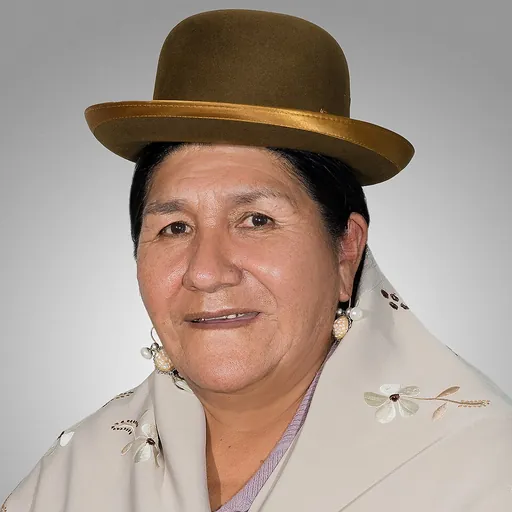
About María Alanoca
Born 1960. María Alanoca is a Bolivian politician and trade unionist.
María Alanoca Tinta (born 2 December 1960) is a Bolivian politician and trade unionist serving as a member of the Chamber of Deputies from La Paz, representing circumscription 10 since 2020. A member of the Movement for Socialism, she represented the same department as a substitute alongside Wilfredo Calani from 2010 to 2015.
Raised in the Los Andes Province of rural La Paz Department, Alanoca spent her youth employed as a in the mines of Sud Yungas Province. She settled in El Alto at age 17, working as a street vendor in the city's commercial district, an area dominated by the informal sector of the economy. An affiliate of the merchants' guilds representing El Alto's small traders, she served as general secretary of the union overseeing the district in the mid-1990s.
Alanoca was a founding member of a local branch of the Movement for Socialism in El Alto and held a seat on its directorate in 2000. Having served once before in the Chamber of Deputies as a substitute from 2010 to 2015, she was elected in 2019 and again in 2020 to her own seat representing circumscription 10 of El Alto in the lower chamber. A staunch supporter of party leader Evo Morales, she aligns with the wing of the Movement for Socialism in parliament, which distanced itself from the incumbent government of Luis Arce and operates in semi-opposition.
Early life and career
Background and early life María Alanoca was born on 2 December 1960 in Chipamaya, a rural settlement in the Los Andes Province of central La Paz Department. She was raised in an impoverished Aymara household alongside seven siblings to parents employed in the mining industry. Her father was a laborer at Bolsa Negra Mine in the distant village of Lambate, located in the Irupana Municipality of Sud Yungas Province.
Alanoca began working the mines of provincial La Paz Department at the age of 12; a time when the presence of female laborers was exceedingly rare and considered tabooeven prohibited on some sites for fear of "bad luck". She made a modest wage as a , pulverizing rocks and sifting through the resulting pulp in search of valuable ores.
Career and trade unionism Fleeing poverty, Alanoca settled in El Alto at the age of 17, accompanying a trend of migration among inhabitants of the Altiplano out of the countryside and into the fast-urbanizing city. El Alto grew at an accelerated pace throughout the 1970s to '90s, bolstered by the arrival of mineworkers dismissed following the by the early 2000s, "entire neighborhoods [were] made up of ex-miners."
She set up shop as a street vendor, selling condiments to the market-goers of , the city's bustling commercial district. As with most small traders in the informal sector, an affiliation with the numerous guilds representing El Alto's merchants followed shortly thereafter. By the mid-1990s, Alanoca had risen to the post of general secretary of La Ceja's vendors' guild, representing one of the more populous areas of the city.
Chamber of Deputies
Election
Alanoca was a founding member of the Movement for Socialism (MAS) in circumscription 10 of El Alto, the district encompassing the city's north-central zones: 16 de Julio, Germán Busch, Ingenio, and Tunari, the Alto Lima, Los Andes, and Puerto Mejillones , as well as the northern reaches nearing the foothills of Huayna Potosí. She served on the party's local branch directorate in 2000 alongside other regional leadersincluding Vladimir Alarcón, who later represented the then-13th district in the Constituent Assembly.
Through her affiliation with the MAS, Alanoca spent a brief stint in parliament as a substitute for Wilfredo Calani from 2010 to 2015. Absent from the 2014 ballot, she returned to contest circumscription 10 in the Chamber of Deputies in the 2019 election as a representative of the guild sector, a constituency for whom the MAS commonly reserved a substantive quota on its parliamentary lists. She won her race,[§] but the wider election resultsmired in allegations of fraudwere annulled. In the unrest that followedmuch of which centered in El AltoAlanoca played an active role in pro-government mobilizations and was among the protesters who occupied El Alto International Airport to deny opposition leader Luis Fernando Camacho entry into La Paz.
Re-nominated in 2020, Alanoca's campaign hit a new stumbling block late into the race after the Supreme Electoral Tribunal disqualified her candidacy amid complaints that she was not a resident of the constituency she was running in. Nevertheless, Alanoca was restored to the ballot on appeal, and she ultimately won the race in a landslide, accompanying a general citywide MAS sweep.[§]
Tenure Alanoca identifies with the wing of her party within the majority MAS caucus: the bench of legislators closest aligned with former president and party leader Evo Moralesas opposed to a newer group affiliated with incumbent Luis Arce. Although largely ideologically aligned, a growing schism over conflicting factional loyalties led many in the wing to act in increased opposition to the Arce administration.
For her part, Alanoca was a vocal critic of those outside her camp and was no stranger to public spats with colleagues she considered "traitor" to the partyeven as her own substitute, Zacarías Laura, aligned himself with the . Alanoca voted in favor of censuring Arce's justice minister, Iván Lima, and was one of thirty-two MAS legislators who aligned with the opposition to censure Government Minister Eduardo del Castillo. Arce's move to re-appoint del Castillo after his ouster by parliament led Alanoca to call for the president's impeachment.
In legislation, Alanoca backed social policy in favor of the elderly and disenfranchised youth. Between 2020 and 2022, she presented three bills proposing expanded access to finance for senior citizens living in poor health or extreme poverty; the creation of state-sponsored scholarships for children and adolescents orphaned during the COVID-19 pandemic; and the establishment of a national sex offender registry accessible by the public.
alt=María Alanoca reads through documents while sitting at her office.
Commission assignments Territorial Organization of the State and Autonomies Commission Departmental Autonomies Committee (Secretary: –) Rural Native Indigenous Autonomies Committee (–present) Social Policy Commission Social Welfare and Protection Committee (–)
Electoral history + Year Office Party Votes Result . Total % . 2009 Substitute deputy Movement for Socialism 1,099,259 80.28% 1st 2019 Deputy Movement for Socialism 67,423 51.7% 1st 2020 Movement for Socialism 108,967 75.68% 1st Source: Plurinational Electoral Organ Electoral Atlas
Don’t just read it —
keep it.
Full-length biographies made to live with: read them, listen on the way to work, watch them tonight.
- E-book
- Audio
- Video
Instant download · yours to keep · every purchase keeps this site free
Important facts
People in María Alanoca's life
Named in this biography and alive at the same time
Related people
Same field, nearest in time




Contemporaries
People whose lives overlapped María Alanoca's



Frequently asked questions
Who is María Alanoca?
Bolivian politician
When was María Alanoca born?
María Alanoca was born on 2 December 1960 in Los Andes Province.
What is María Alanoca's occupation?
María Alanoca is a politician and trade unionist.
What nationality is María Alanoca?
María Alanoca is Bolivian.
Sources & further reading
Cite this page
APA: Biography.guide. (2026). María Alanoca. https://biography.guide/maria-alanoca/
MLA: "María Alanoca." Biography.guide, https://biography.guide/maria-alanoca/.
Chicago: "María Alanoca." Biography.guide. https://biography.guide/maria-alanoca/.
Data last updated: 2026-09-21 · Spot an error? Report a correction.
Portrait: Wikimedia Commons · author & licence
Page generated 2026-09-27 05:01 UTC