
About Margaret Guido
Lived 1912 – 1994 (aged 82). Margaret Guido was a British archaeologist, prehistorian and historian.
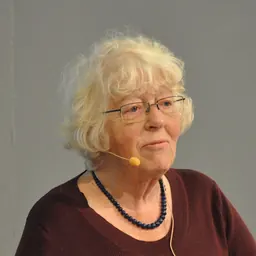
Cecily Margaret Guido, (née Preston; 5 August 1912 – 8 September 1994), also known as Peggy Piggott, was an English archaeologist, prehistorian, and finds specialist. Her career in British archaeology spanned sixty years, and she is recognised for her field methods, her field-leading research into prehistoric settlements (hillforts and roundhouses), burial traditions, and artefact studies (particularly Iron Age to Anglo-Saxon glass beads), as well as her high-quality and rapid publication, contributing more than 50 articles and books to her field between the 1930s and 1990s.
Early life and education
Guido was born Cecily Margaret Preston on 5 August 1912 in Beckenham, Kent. She was the daughter of Elsie Marie Fidgeon – whose father was of independent means – and Arthur Gurney Preston, a Cambridge-educated engineer and wealthy ironmaster, who is also recorded as of independent means at the time of her birth. The family home was a twenty-room mansion, Wood Lodge, in West Wickham, on the line of a Roman road. Her mother "ran away" from the family home when Peggy was five, and this was followed by divorce proceedings which started in 1918. Following the completion of the divorce in 1920, her mother married the co-respondent of the divorce (i.e. the other party in accusations of adultery), Surgeon Captain Percival James Bodington, a British Army medical officer. In 1935, she was photographed working on the Whitehawk Camp ceramics with E. Cecil Curwen. From 1935 to 1936, Guido studied archaeology at the Institute of Archaeology in London, where she was awarded a postgraduate diploma in Western European Prehistory. It was here that she met her first husband, Stuart Piggott, whom she married on 12 November 1936.
Career
Early interests
Guido began her archaeological career by working on the Early Iron Age. She began by writing up the rescue excavation of an Early Iron Age site at Southcote (Berkshire), which appeared in the Proceedings of the Prehistoric Society in 1937, and publishing the pottery from Iron Age Theale the following year. In 1938–39, she worked on The Prehistoric Society's first research excavation at the Early Iron Age type-site of Little Woodbury (Wiltshire). She worked here with Gerhard Bersu, who seems to have been as great an influence on Guido as the Wheelers. In 1939, Guido published a further Early Iron Age site at Langton Matravers (Dorset), greatly enhancing knowledge of a period that by then had only just begun to be elucidated.
Guido was a skilled excavator and heavily involved in the high-profile excavation of the Anglo-Saxon boat burial at Sutton Hoo (in 1939) with Charles Phillips.
During the 1940s, she was at the height of her productivity, producing an average of two publications each year – often for the national journal Proceedings of the Prehistoric Society, as well as for notable regional societies. At this time, she published on several important Bronze Age monument types including Bronze Age enclosures (Wiltshire), including the well-known hilltop enclosure site of Ram's Hill (Berkshire) and stone circles (Dorset), including the excavation of eighteen barrows (Hampshire and Wiltshire), as well as others on Crichel and Launceston Downs (Dorset). In her upland excavations of Hownam Rings (in 1948), Hayhope Knowe (in 1949), and Bonchester Hill (in 1950) – each site published in the same year it was excavated – she tested and refined the CBA model, providing a relative chronological framework for later prehistoric settlement in southern Scotland. In the days before the application of radiocarbon dating to archaeological material, this was a huge leap forward for prehistoric studies.
The late 1940s and early 1950s marks Guido as one of the most important British prehistorians. In this period, she excavated no less than six hillforts, and it was her work in the field of hillfort studies which is considered some of her most influential. Hownam Rings (1948) in particular became the type-site for hillfort development, known as the Hownam Paradigm, remaining valid to this day. Guido worked with her husband on her sixth hillfort excavation: the site of Braidwood Fort (1951–55).
Roundhouse excavations
Beyond elucidating relative settlement chronologies, Guido's reconstruction drawing of the Hayhope roundhouse was to become the modern standard. Although Little Woodbury had been successful in exposing an Early Iron Age roundhouse, the report had been remarkably inconclusive with respect to its reconstruction. Guido simplified this in line with the earlier Northumbrian work of Wake and Kilbride-Jones, which went on to influence Brewster at Staple Howe. The Hayhope-Hownam excavations also suggested the potential for a typology of prehistoric houses – as later undertaken by Richard Feachem and George Jobey, both greatly influenced by Guido's work. On the strength of her contribution to British prehistory, Guido became an elected Fellow of the Society of Antiquaries of London in 1944, at the age of 32.
1950s and 1960s
By the early 1950s, Guido was already working towards what we now consider an understanding of everyday life in prehistory: recording the positions of finds on plans and considering ritual deposits. It is in the work of Guido that we see the advent of modern settlement studies, through her excavation strategy and her work on hillforts and roundhouses. She then moved to Sicily, briefly reverting to her maiden name of Preston. She used it in the translation that she and her second husband Luigi Guido made of Bernabo Brea's Sicily before the Greeks (1957). In the 1960s and early 1970s, she produced four guidebooks on Italian archaeology: on Sardinia (1963), Syracuse (1965), Sicily (1967), and on southern Italy as a whole (1972); at Longbridge Deverill with Eve Machin (in 1982–83), to assess plough damage. In 1984, she was elected to the position of Vice President of the Wiltshire Archaeological and Natural History Society.
Personal life On 12 November 1936, Margaret married the archaeologist Stuart Piggott (1910–1996); they had met while students at the Institute of Archaeology in London. Two years later, her husband had a psychotic breakdown and she spent six months caring for him while he was strapped to his bed. At the end of this period, he left her and moved back to Sicily. She never heard from him again. In her final years, Margaret regularly visited her former husband, Stuart Piggott, who had retired to Wantage. In 1987, Piggott had joined Margaret in shared tenure as President of the Wiltshire Archaeological and Natural History Society – offices they each held until their deaths.
Guido is given a prominent role in a 2007 novel on the subject of the Sutton Hoo excavation, The Dig, written by her nephew, John Preston. She is portrayed by Lily James in the film adaptation of the same name, released on Netflix in January 2021.
Selected works
Piggott, C. M. and Seaby, W. A. (1937). Early Iron Age site at Southcote, Reading. Proceedings of the Prehistoric Society 3, 43–57. Piggott, C. M. (1938). A Middle Bronze Age barrow and Deverel-Rimbury urnfield at Latch Farm, Christchurch, Hampshire. Proceedings of the Prehistoric Society 4, 169–187. Piggott, C. M. (1943). Excavation of fifteen barrows in the New Forest, 1941–2. Proceedings of the Prehistoric Society 9, 1–27. Piggott, C. M. (1946). The Late Bronze Age razors of the British Isles. Proceedings of the Prehistoric Society 12, 121–141. Piggott, C. M. (1948). Excavations at Hownam Rings, Roxburghshire, 1948. Proceedings of the Society of Antiquaries of Scotland 82, 193–225. Piggott, C. M. (1949). The Iron Age settlement at Hayhope Knowe, Roxburghshire: Excavations 1949. Proceedings of the Society of Antiquaries of Scotland 83, 45–67. Piggott, C. M. (1949). A Late Bronze Age hoard from Blackrock in Sussex and its significance. Proceedings of the Prehistoric Society 15, 107–121. Piggott, C. M. (1950). The excavations at Bonchester Hill, 1950. Proceedings of the Society of Antiquaries of Scotland 84, 118–137. Piggott, C. M. (1951). Carl Wark, Hathersage. Antiquity 25, 210–212. Piggott, C. M. (1953). Milton Loch crannog I: a native house of the 2nd century A.D. in Kirkcudbrightshire. Proceedings of the Society of Antiquaries of Scotland 87, 134–152.
Guido, M. and Walsh, M. (1999). The Glass Beads of Anglo-Saxon England c. AD 400–700: A preliminary visual classification of the more definitive and diagnostic types. Reports of the Research Committee of the Society of Antiquaries of London, No. 58. Woodbridge: Boydell Press.
Don’t just read it —
keep it.
Full-length biographies made to live with: read them, listen on the way to work, watch them tonight.
- E-book
- Audio
- Video
Instant download · yours to keep · every purchase keeps this site free
Important facts
Family & relationships
People in Margaret Guido's life
Named in this biography and alive at the same time






Related people
Same field, nearest in time

Contemporaries
People whose lives overlapped Margaret Guido's





Frequently asked questions
Who was Margaret Guido?
English archaeologist (1912–1994)
When was Margaret Guido born?
Margaret Guido was born on 5 August 1912 in Beckenham.
When did Margaret Guido die?
Margaret Guido died on 8 September 1994 in Bath.
What was Margaret Guido's occupation?
Margaret Guido was an archaeologist, prehistorian and historian.
What nationality was Margaret Guido?
Margaret Guido was British.
Sources & further reading
Cite this page
APA: Biography.guide. (2026). Margaret Guido. https://biography.guide/margaret-guido/
MLA: "Margaret Guido." Biography.guide, https://biography.guide/margaret-guido/.
Chicago: "Margaret Guido." Biography.guide. https://biography.guide/margaret-guido/.
Data last updated: 2026-09-20 · Spot an error? Report a correction.
Page generated 2026-09-27 05:07 UTC