
About Marga Minco
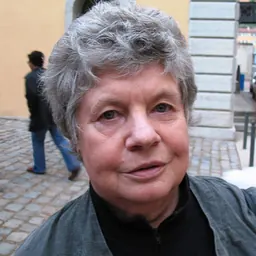
Lived 1920 – 2023 (aged 103). Marga Minco was a Dutch writer and journalist.
Marga Minco (; born Sara Menco; 31 March 192010 July 2023), for some time known as Marga Faes, was a Dutch journalist and writer, and a Holocaust survivor. She married Dutch poet Bert Voeten.
Early life and education Marga Minco was born Sara Menco in Ginneken on 31 March 1920 to an Orthodox Jewish family. Her father was Salomon Minco (1887–1943), and was parnas (warden) in the local Jewish community; he may have worked as a salesman. Her mother was Grietje Minco-van Hoorn (1889–1943). She had a brother, David, and a sister, Bettie. The family moved to Breda, a predominantly Catholic town near her birthplace, when Sara was a young girl, and she went to the local public school.
Career and WWII Minco began work as a trainee journalist at the in 1938, first writing about films, and then eventually becoming a member of the editorial staff.
Later in the war, Minco's parents, her brother, and her sister were all deported, and she was the only who managed to escape by running out of the back door. Having escaped arrest herself she spent the rest of the war in hiding, after bleaching her hair and obtaining a fake ID card. She was the family's only survivor. in 1938 while working at the Bredasche Courant. Voeten was not Jewish and her parents were not pleased with the match while they were alive. in Witsenhuis in Amsterdam.
Bert Voeten died in 1992, and died on 10 July 2023, at the age of 103.
Writing In 1957 Minco published her first book, ("Bitter herbs"), in which a nameless character goes through war experiences reminiscent of the author's. The title of her later book Een leeg huis ("An empty house") refers not only to the demolished house that the protagonist finds after emerging from hiding at the end of the occupation but also to the emptiness that she and her friend Yona experience in the postwar years, to which was added the distance and sometimes even hostility displayed by many people in the Netherlands towards returnees from the concentration camps. This phenomenon was further described by Minco in her collection of short stories, De andere kant ("The other side").
Existentialism imposes a special tightness on her work. The main characters, often survivors of the Holocaust, experience their lives as meaningless. Often, they have survived the war only by a series of coincidences, while their loved ones have been murdered. Frieda Borgstein, for example, in the novella De val ("The Fall"), manages by chance to survive the whole war without falling into the hands of the Nazis who have taken her husband's life. She dies, nevertheless, just before her 85th birthday, by falling accidentally into an unprotected well.
Awards 1957 – Bureau voor Postreclame en Adressen De Mutator N.V., Short story prize for Het adress 1958 – Vijverberg Prize for Het bittere kruid 1999 – Annie Romein Prize, for her entire oeuvre
Don’t just read it —
keep it.
Full-length biographies made to live with: read them, listen on the way to work, watch them tonight.
- E-book
- Audio
- Video
Instant download · yours to keep · every purchase keeps this site free
Important facts
Related people
Same field, nearest in time



Contemporaries
People whose lives overlapped Marga Minco's




Frequently asked questions
Who was Marga Minco?
Dutch journalist and writer (1920–2023)
When was Marga Minco born?
Marga Minco was born on 31 March 1920 in Ginneken.
When did Marga Minco die?
Marga Minco died on 10 July 2023 in Amsterdam.
What was Marga Minco's occupation?
Marga Minco was a writer and journalist.
What nationality was Marga Minco?
Marga Minco was Dutch.
Sources & further reading
Cite this page
APA: Biography.guide. (2026). Marga Minco. https://biography.guide/marga-minco/
MLA: "Marga Minco." Biography.guide, https://biography.guide/marga-minco/.
Chicago: "Marga Minco." Biography.guide. https://biography.guide/marga-minco/.
Data last updated: 2026-09-26 · Spot an error? Report a correction.
Page generated 2026-09-27 05:13 UTC