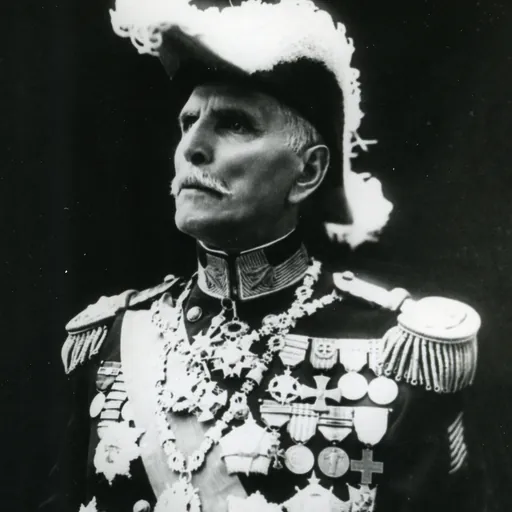
Manuel Gomes da Costa
Portuguese general and politician
About Manuel Gomes da Costa
Lived 1863 – 1929 (aged 66). Manuel Gomes da Costa was a Portuguese politician, military personnel, minister, revolutionary, marshal and military officer.
Manuel de Oliveira Gomes da Costa (14 January 1863 – 17 December 1929) was a Portuguese army officer and politician who served as president of Portugal in 1926. He was the second president of the .
Gomes da Costa had a distinguished military career in the country's colonies, from 1893 to 1915, in India, Mozambique, Angola, and São Tomé, having served under the command of Mouzinho de Albuquerque. After World War I, in which he rose to greater prominence in the command of the 1st Division of the Portuguese Expeditionary Corps, he became actively engaged in politics, in staunch opposition to the dominant Democratic Party.
In 1926, he was involved in the military and political movement that resulted in the 28 May 1926 coup d'état that inaugurated a new conservative, authoritarian regime. Following the military coup, Gomes da Costa deposed moderate José Mendes Cabeçadas, who had received executive and presidential power from the removed Prime Minister António Maria da Silva and President Bernardino Machado, briefly holding the headship of government and of state in the summer of that year, until he was himself removed by another coup, to be replaced by Óscar Carmona.
Early life Gomes da Costa was born to Carlos Dias da Costa and Madalena de Oliveira; he grew up with two younger siblings, Lucrécia and Amália. He began his military career at the Colégio Militar at age 10.
Generals Tamagnini and Gomes da Costa, together with General Haking.
Military career As a soldier, he stood out in colonial campaigns in the African and Indian colonies. After Portugal had entered the First World War (See: Portugal in the Great War) on the Allied side in early 1917, he commanded the Second Division of the Portuguese Expeditionary Corps. During the Battle of the Lys on 9 April 1918, the CEP lost 400 dead and around 6,500 prisoners, a third of its forces in the front line. Gomes da Costa's division was hit particularly hard and was all but wiped out.
For his command in the war, he was made a general and a Grand Officer of the Military Order of Avis. Two years later, on 5 October 1921, he received the Grand Cross of the Military Order of Avis.
Gomes da Costa and his troops march victorious into Lisbon on 6 June 1926.
1926 coup A convinced monarchist, Gomes da Costa had consorted with people of various political convictions. That, and his reputation as a soldier, led to his choice by right-wing revolutionaries to lead the 28 May 1926 coup d'état in Braga that overthrew the Portuguese First Republic, after General Alves Roçadas, their original choice, had fallen fatally ill.
After the success of the revolution, he did not assume power at first, entrusting the posts of President of the Republic and President of the Council of Ministers (Prime Minister) to José Mendes Cabeçadas, the leader of the revolution in Lisbon. Soon, the coup leaders disliked the attitude of Mendes Cabeçadas, a choice of the previous president Bernardino Machado and still sympathetic towards the old republic. He was replaced by Gomes da Costa in both posts in a meeting in Sacavém on 17 June 1926. The new government was the first to include the later prime minister and dictator of Portugal, Antonio de Oliveira Salazar, as finance minister.
Overthrow and exile Gomes da Costa's government lasted about as long as Cabeçadas', because it was overthrown by a new coup on 9 July the same year. This attempt was initiated by João José Sinel de Cordes and Óscar Carmona, after Gomes da Costa attempted to have Carmona removed as minister for foreign affairs. Although more conservative than Cabeçadas, Gomes da Costa had no desire to institute a long-term military regime, which brought him into conflict with Carmona and others in the most conservative and authoritarian faction of the military leadership.
Carmona succeeded Gomes da Costa as President of the Republic and of the Council of Ministers under the pretext that Gomes da Costa was "unfit for office." Gomes da Costa was exiled to the Azores Islands, but also promoted to Marshal of the Portuguese Army.
Don’t just read it —
keep it.
Full-length biographies made to live with: read them, listen on the way to work, watch them tonight.
- E-book
- Audio
- Video
Instant download · yours to keep · every purchase keeps this site free
Important facts
People in Manuel Gomes da Costa's life
Named in this biography and alive at the same time


Related people
Same field, nearest in time




Contemporaries
People whose lives overlapped Manuel Gomes da Costa's



Frequently asked questions
Who was Manuel Gomes da Costa?
Portuguese general and politician (1863–1929)
When was Manuel Gomes da Costa born?
Manuel Gomes da Costa was born on 14 January 1863 in Lisbon.
When did Manuel Gomes da Costa die?
Manuel Gomes da Costa died on 17 December 1929 in Lisbon.
What was Manuel Gomes da Costa's occupation?
Manuel Gomes da Costa was a politician, military personnel, minister, revolutionary, marshal and military officer.
What nationality was Manuel Gomes da Costa?
Manuel Gomes da Costa was Portuguese.
Sources & further reading
· Wikipedia: Manuel Gomes da Costa
· DBpedia: Manuel Gomes da Costa
Cite this page
APA: Biography.guide. (2026). Manuel Gomes da Costa. https://biography.guide/manuel-gomes-da-costa/
MLA: "Manuel Gomes da Costa." Biography.guide, https://biography.guide/manuel-gomes-da-costa/.
Chicago: "Manuel Gomes da Costa." Biography.guide. https://biography.guide/manuel-gomes-da-costa/.
Data last updated: 2026-09-22 · Spot an error? Report a correction.
Portrait: Wikimedia Commons · author & licence
Page generated 2026-09-27 05:01 UTC