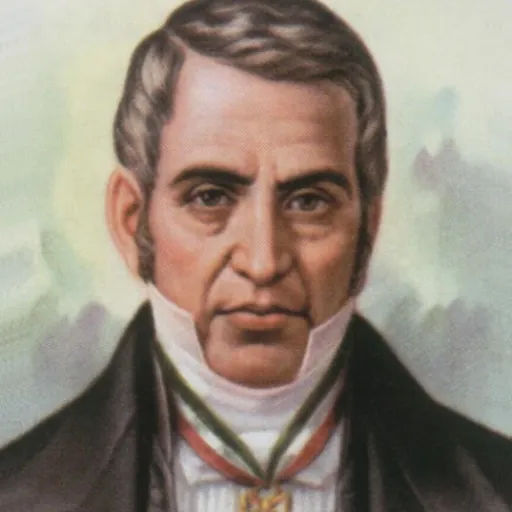
About Manuel de la Peña y Peña
Lived 1789 – 1850 (aged 60). Manuel de la Peña y Peña was a Mexican politician, diplomat, judge and minister.
José Manuel de la Peña y Peña (10 March 1789 – 2 January 1850) was a Mexican lawyer and judge who served two non-consecutive, but closely following, terms as the president of Mexico during the Mexican American War. In contrast to many other nineteenth-century Mexican presidents, he never served in the military, instead coming from a distinguished legal background.
He was foreign minister and a member of the peace party whom under the presidency of José Joaquín de Herrera sought to avoid a war with the United States at a time of rising tensions. After hardliners overthrew Herrera and war broke out with disastrous consequences for Mexico, he was elected president twice to two non-consecutive terms in the final months of the war as peace negotiations were being made. Under his administration the Treaty of Guadalupe Hidalgo was negotiated and ratified.
Early life Peña y Peña was born in the town of Tacuba, in Mexico City, on 10 March 1789 to a poor family. Upon finishing his primary education he entered the Tridentine Seminary and received high marks and various awards from the departments of grammar, rhetoric, philosophy, and civil and canonical jurisprudence, winning a scholarship along with Manuel Posada y Garduño, the future archbishop of Mexico. He was well distinguished in the practice of jurisprudence, and his teacher Jose Gonzales Retana assured him a promising career.
He was admitted to the bar on 16 December 1811 during the Mexican War of Independence, and two years later was named attorney general for the Mexico City Ayuntamiento, a task that he carried out with such notability for the royal government that in 1820 he was awarded with a seat on the Audencia of Quito, but Peña y Peña wished to stay in New Spain and appealed to be granted a seat in one of the Novo-Hispanic Audencias. While this matter was being resolved, Mexico won its independence in September 1821. On May 19, the First Mexican Empire was established with Agustin Iturbide as Emperor.
Judicial career Peña y Peña assumed a seat in the Real Audiencia of Mexico handling both civil and criminal cases, and remained in that post until 21 October 1822 when already being a member of the council of state, was named by Emperor Iturbide minister plenipotentiary to Colombia. He was also awarded the Cross of the Order of Guadalupe. He was never able to occupy that post due to the fall of the Empire in early 1823. The subsequent government, the Supreme Executive Power placed him back on the Audencia until Peña y Peña was elected by a majority of the state legislatures to the Supreme Court and made a member of that body on 25 December 1824. He would remain at that post intermittently until his death.
During the Centralist Republic of Mexico, he was named Minister of the Interior by President Anastasio Bustamante in 1837 and the following year he was named to the Supreme Moderating Power, an executive council that was meant to be above even the president. In this post his sought to counter the tendencies of the federalists who were backed by part of the military and counted upon considerable public support. He gave a detailed report on constitutional reform, and played a role in reforming the law for punishing robbery. Peña y Peña was also professor of public law at the University of Mexico and towards the end of 1841 he was given the task of writing the civil code and civil procedure and named a member of the legislative junta which wrote a new constitution, the Bases Orgánicas. In 1843 he was named to the council of state and also elected to the senate being reelected, in November 1845 in which he once again was named Minister of Foreign Relations, being in agreement with President Herrera's aims in seeking to avoid war with the United States. He was assigned to negotiate an extradition treaty with Spain, and when Herrera was overthrown in December 1846, Peña y Peña returned once again to his post on the Supreme Court.
First Presidency He would be in this post when the Mexican American War broke out in April 1846. A year later, as the Americans approached the capital, President Santa Anna, to provide against the possibility of being killed or captured, issued a decree on 7 September 1847 appointing his substitutes, which he sent to President of the Supreme Court, Peña y Peña. On 16 September, he held a council of war, and resigned the presidency, decreeing that the presidency should now be vested in a triumvirate led by the President of the Supreme Court. Peña y Peña accepted the presidency but rejected the provision of a triumvirate as unconstitutional. He repaired to Toluca and then to Querétaro where he assumed the office of provisional president on September with Luis de la Rosa heading all four portfolios.
He published a manifesto on 13 October 1847, explaining that in spite of his poor health and lack of forces, he was fulfilling a duty prescribed by the constitution, and he assured that he would only be in power shortly, and expounded his principles and sentiments and the conduct he planned to pursue to conclude his presidency with honor and a satisfied conscience. He pleaded with the states to maintain loyalty to the central government and provide arms and funds for the war effort. He promised to protect the public interest, the rights of all classes, and to respect and protect the Catholic religion.
Congress meanwhile joined him at Querétaro. President Peña y Peña was convinced that the war could not be continued due to a lack of funds, and was now intent on pursuing a policy of peace. He released all American prisoners of war, and took measures against corruption and unauthorized guerilla units. On 9 November, congress elected Pedro Maria Anaya as interim president, with the caveat that his term would expire on 8 January 1848, and that if congress was then not in session, the presidency should pass according to the constitutional order of succession. President Peña y Peña stepped down on 12 November 1847, though he remained in the government as Minister of Relations.
Second Presidency Treaty of Guadalupe Hidalgo The Congress at Querétaro now had to negotiate a peace treaty with the invader while also dealing with separatism and anarchy spreading throughout the country. The Caste War was ongoing in Yucatán, and the insurgents had occupied the major cities. Many states considered the federal government to be an enemy and refused to pay taxes. Meanwhile, most notably in the Federal District there was a Mexican element advocating annexation of the entire country to the United States.
The majority of congress supported the government's peace policy viewing in the Treaty of Guadalupe nothing but the unfortunate result of a poorly fought war, and viewed under this perspective as a national necessity. A foreign relations commission returned affirmative answers to two questions that congress had directed it to report upon: May the government with the consent of Congress cede a portion of territory? Is it suitable to make peace upon the terms which have been proposed? The first question was resolved based upon the principle that congress was the deposit of the national sovereignty. The second question was resolved upon the consideration that Mexico had never been in full possession of the territories that were about to be ceded, and that most of that land was either not populated, or populated by hostile indigenous tribes. It was also taken into account that Mexico could not continue the war without facing certain defeat and risking the loss of the entire country. After the commission reported upon its findings, the Treaty of Guadalupe Hidalgo was approved by congress and President Peña y Peña now worked upon decrees to prevent disorder in the capital once the occupiers left, and for the establishment of a national guard. On 26 May 1848 the government received the comiisioners Nathan Clifford and Ambrose Hundley Sevier who were in Mexico to negotiate the treaty after congress had approved it with some slight modifications.
Meanwhile, the President had to deal with guerilla warfare throughout the country afflicting both the American occupiers and Mexican merchants. The aim of the guerillas was to disrupt the American supply chain from Veracruz to the capital. This was also leading to indiscriminate American reprisals. As the peace treaty was concluded and the occupiers were on the point of leaving the country, congress named Jose Joaquin Herrera to the presidency of the republic, and Peña y Peña left his post as president in exchange for the presidency of the Supreme Court on 3 June 1848. The government left Querétaro and returned to the capital.
Death In Mexico City,
Don’t just read it —
keep it.
Full-length biographies made to live with: read them, listen on the way to work, watch them tonight.
- E-book
- Audio
- Video
Instant download · yours to keep · every purchase keeps this site free
Important facts
People in Manuel de la Peña y Peña's life
Named in this biography and alive at the same time




Related people
Same field, nearest in time

Contemporaries
People whose lives overlapped Manuel de la Peña y Peña's



Frequently asked questions
Who was Manuel de la Peña y Peña?
President of Mexico (1789-1850)
When was Manuel de la Peña y Peña born?
Manuel de la Peña y Peña was born on 10 March 1789 in Mexico City.
When did Manuel de la Peña y Peña die?
Manuel de la Peña y Peña died on 2 January 1850 in Mexico City.
What was Manuel de la Peña y Peña's occupation?
Manuel de la Peña y Peña was a politician, diplomat, judge and minister.
What nationality was Manuel de la Peña y Peña?
Manuel de la Peña y Peña was Mexican.
Sources & further reading
· Wikipedia: Manuel de la Peña y Peña
· DBpedia: Manuel de la Peña y Peña
Cite this page
APA: Biography.guide. (2026). Manuel de la Peña y Peña. https://biography.guide/manuel-de-la-pena-y-pena/
MLA: "Manuel de la Peña y Peña." Biography.guide, https://biography.guide/manuel-de-la-pena-y-pena/.
Chicago: "Manuel de la Peña y Peña." Biography.guide. https://biography.guide/manuel-de-la-pena-y-pena/.
Data last updated: 2026-09-21 · Spot an error? Report a correction.
Portrait: Wikimedia Commons · author & licence
Page generated 2026-09-27 04:59 UTC