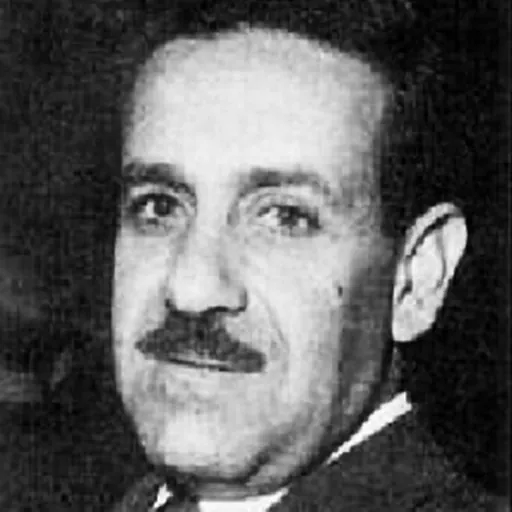
About Mansur al-Atrash
Lived 1925 – 2006 (aged 81). Mansur al-Atrash was a Syrian politician.
Mansur al-Atrash (; 3 February 1925 – 14 November 2006) was a Syrian politician and journalist. Together with fellow university students, Atrash became a founding member of the Ba'ath Party and its Syrian regional branch in 1947. During the presidency of Adib Shishakli (1951–54), he became an anti-government activist and was imprisoned twice, only to be released in an unsuccessful attempt by Shishakli to gain the support of Atrash's father, Sultan. In the year Shishakli was overthrown, Atrash was elected to parliament and turned down an offer to serve in Said al-Ghazzi's government. During the period of the United Arab Republic (1958–61), Atrash became a strong supporter of Egyptian president and pan-Arab leader Gamal Abdel Nasser. He opposed Syria's secession from the UAR and turned down offers to serve in successive separatist governments in protest.
When the Ba'ath Party gained power in the 1963 coup, Atrash became Minister of Social Affairs and in 1965 the head of the Revolutionary Command Council (RCC). A second coup by left-wing Ba'athist officers resulted in a split within the party between the coup officers led by the Military Committee and the founders led by Michel Aflaq, with Atrash being an ardent supporter of the latter. He was subsequently imprisoned, but released in the aftermath of Syria's defeat in the 1967 War with Israel. After two years of self-imposed exile in Lebanon, he returned to Syria where he mostly abandoned political life. He died on 14 November 2006 and was buried near his hometown of al-Qurayya.
Early life
Atrash was born 3 February 1925 in the Druze community of al-Qurayya in Jabal al-Druze (Jabal al-Arab), Prime Minister Khalid al-Azm (term in 1962–63) appointed him minister of social affairs without asking him, but Atrash turned down that job as well.
His seclusion from Syrian politics ended after the Military Committee of the Ba'ath Party took power in a coup d'état on 8 March 1963. The Military Committee's stated goal was to reestablish a pan-Arab state; a goal Atrash shared. He was appointed Minister of Labor and Social Affairs in Salah al-Din al-Bitar's first government, and became a member of the Presidential Council, an organ responsible for running day-to-day state affairs. In February 1964 Atrash was elected to the 12-member Ba'ath Party National Command, which was nominally the highest policy-making body of the party.
Differences between Bitar and the Regional Command had developed in 1964, with the latter viewing Bitar's cabinet as being right-leaning and soft on "reactionary" elements within Syria in the aftermath of Hama uprising in April of that year by the Muslim Brotherhood. President Amin al-Hafiz had been prime minister at the time of the unrest and stepped down in response to countrywide strikes and demonstrations in protest at the severity of the uprising's suppression. Bitar replaced Hafiz to serve a second term as prime minister in May, publicly promising to protect civil liberties. Intra-party tensions culminated with the Regional Command withdrawing its confidence from Bitar's government on 25 September, and Bitar and Atrash (an associate of Bitar) subsequently resigning from the Presidential Council. Their positions were filled by Salah Jadid and Yusuf Zuaiyin, respectively, and effectively brought the Presidential Council under the full control of the Military Committee and the Regional Command. Hafiz also replaced Bitar as premier in October, although Atrash remained in his ministerial post.
On 1 September 1965 Atrash was appointed Chairman of the Revolutionary Command Council (RCC), but acquired little de facto power because of the Military Committee's overarching control, with Atrash later remarking "the officers let us do the talking although, as we later discovered, they had agreed beforehand ... what the decisions would be." The RCC played the role of parliament and Atrash was its speaker. In December tensions between the National Command (loyal to Aflaq and Bitar) and the Regional Command (loyal to Jadid and backed by the military) grew worse as elements of the former attempted to align with Military Committee member Muhammad Umran in an effort to split the military's support (and according to Syria expert Itamar Rabinovich, the Alawite officers' solid backing) of Jadid. However, Atrash, along with Munif al-Razzaz of Jordan and Jubran al-Majdalani and Ali al-Khalil of Lebanon, was a part of the group in the National Command that opposed confrontation with the Regional Command, citing the National Command's lack of military support and political power as well as the fundamental weakness of an alliance with Umran and Amin al-Hafiz. The latter two had been engaged in an antagonistic rivalry over leadership of the Military Committee.
Atrash continued to hold the office of RCC, and was reelected as speaker on 15 February 1966, shortly before the 1966 Syrian coup d'état (21–23 February), which brought the left-wing neo-Ba'athist government of Jadid to power and caused an internal party split. The Jadid government's coming to power resulted in the self-imposed exile of the leading Ba'ath ideologue Michel Aflaq. Atrash, a partisan of Aflaq, was arrested and jailed in the Mezzeh Prison during the coup. The new defense minister and future president Hafez al-Assad later paid him a visit to discuss Syria's political situation and check on his health.
On 9 June 1967, when the Israeli Army occupied the Golan Heights during the Six-Day War, Atrash and other Aflaq loyalists were released from their detention. Atrash later remarked that "It was not agreeable to know that we owed our freedom to defeat." In collaboration with dissenting Ba'athist officer Salim Hatum, Atrash attempted to overthrow Jadid's government in 1967, but failed. Following this unsuccessful coup attempt, he moved into self-imposed exile in Lebanon and lived there until the death of Abd al-Karim al-Jundi, the head of Syria's secret intelligence service. He returned to Syria in 1969 and lived much of the remainder of his life in seclusion.
Later life and death
In 1978 Atrash hosted a dinner aimed at healing the rift between the ruling Ba'ath governments of Syria and neighboring Iraq. The dinner was attended by such notables as Iraqi foreign minister Tariq Aziz and Syrian defense minister Mustafa Tlass. Between 2000 and 2006 Atrash was a member of an organization in support of the Palestinian uprising against Israel. Between 2001 and 2006 he presided over the Syrian Arab Committee, which aimed to end the sanctions against Iraq and later support it after the 2003 invasion. In August 1956 Atrash married teacher Hind al-Shuwayri,
Don’t just read it —
keep it.
Full-length biographies made to live with: read them, listen on the way to work, watch them tonight.
- E-book
- Audio
- Video
Instant download · yours to keep · every purchase keeps this site free
Important facts
People in Mansur al-Atrash's life
Named in this biography and alive at the same time



Related people
Same field, nearest in time




Contemporaries
People whose lives overlapped Mansur al-Atrash's




Frequently asked questions
Who was Mansur al-Atrash?
Syrian politician
When was Mansur al-Atrash born?
Mansur al-Atrash was born on 3 February 1925 in Al-Qurayya.
When did Mansur al-Atrash die?
Mansur al-Atrash died on 14 November 2006 in Syria.
What was Mansur al-Atrash's occupation?
Mansur al-Atrash was a politician.
What nationality was Mansur al-Atrash?
Mansur al-Atrash was Syrian.
Sources & further reading
Cite this page
APA: Biography.guide. (2026). Mansur al-Atrash. https://biography.guide/mansur-al-atrash/
MLA: "Mansur al-Atrash." Biography.guide, https://biography.guide/mansur-al-atrash/.
Chicago: "Mansur al-Atrash." Biography.guide. https://biography.guide/mansur-al-atrash/.
Data last updated: 2026-09-21 · Spot an error? Report a correction.
Portrait: Wikimedia Commons · author & licence
Page generated 2026-09-27 04:58 UTC