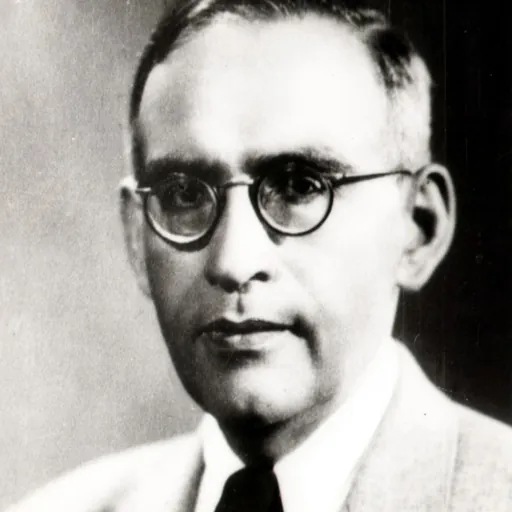
About Mahmoud Hessabi
Lived 1903 – 1992 (aged 89). Mahmoud Hessabi was a nuclear physicist, academic, politician and scientist.
Mahmoud Khan Mirza Hessabi (or Hessaby, ; 23 February 1903 – 3 September 1992) was an Iranian nuclear physicist and senator. He was the minister of education in the cabinet of Prime Minister Mohammad Mosaddegh from 1951 to 1952.
Life Hessabi was born in Tehran to the family of Abbas and Goharshad Hessabi. His family's hometown is Tafresh, Markazi province, Iran. His family moved to Beirut in 1907 when his father was appointed consul at the Iranian embassy. There Hessabi attended primary school. He was still in secondary school when World War I started prompting the closure of his school and so Hessabi continued his education at home and in 1922, he earned a degree in road engineering from the American University of Beirut. After briefly working for the Ministry of Roads, Beirut, Hessabi travelled to Paris for further education, where he was awarded a degree in electrical engineering at the École Superieure d'Electricité and later a doctorate degree in 1927. In Paris, he worked with Aime Cotton.
In Tehran, Hessabi was affiliated with the University of Tehran and organized the science and engineering faculties of the university. He was the teacher of Alenush Terian while she studied at the university. In June 1951, Hessabi was appointed to a three-man provincial board of the Iranian oil company, the designated successor of the Anglo-Iranian Oil Company. Dr. Hessabi led the nationalisation of the company and became its first CEO. In December 1951, he replaced Karim Sanjaby as minister of education. Between 1961 and 1969, Hessabi was Iran's representative on the Scientific and Technical Subcommittee of the United Nations Committee on the Peaceful Uses of Outer Space.
During the congress honoring "60 Years of Physics in Iran," his services were celebrated, and he was dubbed "the father of modern physics in Iran."
Museum In 1992, his house changed to a museum to for recognition of his life. The Mahmoud Hessabi Museum is located Tajrish neighbourhood in Tehran.
The Hessabi family is part of Iran's Muslim elite. One of the capital's avenues is named after them, leading to a square with a statue of Dr. Hessabi. Mahmoud Hessabi had a son and a daughter. His son, an engineering graduate, is head of the Dr. Hessabi Institute (2015). Today, the majority of the family lives outside Iran, particularly following the 1979 Iranian Revolution.
Selected works
Don’t just read it —
keep it.
Full-length biographies made to live with: read them, listen on the way to work, watch them tonight.
- E-book
- Audio
- Video
Instant download · yours to keep · every purchase keeps this site free
Important facts
People in Mahmoud Hessabi's life
Named in this biography and alive at the same time


Related people
Same field, nearest in time





Contemporaries
People whose lives overlapped Mahmoud Hessabi's
Frequently asked questions
Who was Mahmoud Hessabi?
Iranian scientist
When was Mahmoud Hessabi born?
Mahmoud Hessabi was born on 23 February 1903 in Tehran.
When did Mahmoud Hessabi die?
Mahmoud Hessabi died on 3 September 1992 in Geneva.
What was Mahmoud Hessabi's occupation?
Mahmoud Hessabi was a nuclear physicist, academic, politician and scientist.
What nationality was Mahmoud Hessabi?
Mahmoud Hessabi's recorded nationality: Pahlavi Iran, Iranian peoples.
Sources & further reading
Cite this page
APA: Biography.guide. (2026). Mahmoud Hessabi. https://biography.guide/mahmoud-hessabi/
MLA: "Mahmoud Hessabi." Biography.guide, https://biography.guide/mahmoud-hessabi/.
Chicago: "Mahmoud Hessabi." Biography.guide. https://biography.guide/mahmoud-hessabi/.
Data last updated: 2026-09-22 · Spot an error? Report a correction.
Portrait: Wikimedia Commons · author & licence
Page generated 2026-09-27 05:04 UTC