
About Mahinbanu Sultan
Lived 1519 – 1562 (aged 42–43). Mahinbanu Sultan was a politician and courtier.
Mahinbanu Sultan, better known as Princess Sultanum, or Shahzada Sultanum (; 1519–1562) was a Safavid princess of Iran, and the daughter of Shah Ismail I and Tajlu Khanum. She was the youngest sister of Tahmasp I. She had a big influence on the reign of her brother, and acted as his political adviser. She was one of the prominent and highly influential figures of the Safavid era.
Biography Mahinbanu was born in 1519 in Tabriz. She lost her father at the age of five and received higher education at the royal court. She learned Persian and the Qur’an from Tajik teachers, and also studied the art of manuscript copying and painting under the great calligrapher Dust Muhammad Haravi. She was one of the patrons of Persian literature and religious works. She was very interested in politics which her mother, Tajlu Khanum, ensured she had an education in. After her mother's death in 1540, Mahinbanu was chosen as the only advisor to her brother, Shah Tahmasp. During her brother's reign, Mahinbanu was known as the greatest lady of the Safavid Empire. She never married and dedicated her whole life to the governments of her father and brother.
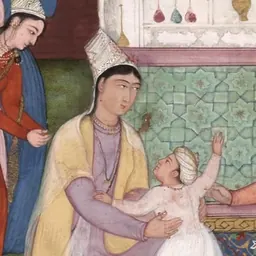
Possible depiction of Bahram Mirza and Princess Sultanum. 1531 painting. After the death of her older brother, Bahram Mirza, she took care of his three children, Sultan Hossein Mirza, Ibrahim Mirza, and Badi-al Zaman Mirza Safavi. Mahinbanu took charge and brought them up, then at her request, the two younger sons of Bahram Mirza married the two eldest daughters of Shah Tahmasp. After that, she was given the title of "Sultana". In 1562, Mahinbanu Sultan died in Qazvin at the age of 43. According to her will, she was buried in her father's tomb in Ardabil.
Policy She had a great interest in politics and her mother, Tajlu Khanum, introduced her to it thoroughly. After her mother’s death in 1540, Mahin Banu was chosen as the sole advisor to her brother, Shah Tahmasp. During her brother’s reign, Mahin Banu became known as the most prominent lady of the Safavid Empire. She never married and devoted her entire life to the service of her father and brother’s governments. It is also said that she established a garden in Qazvin, which was named Mahin Banu Garden after her. This garden was part of the royal residential district founded by Shah Tahmasp.
It is reported that on 8 Muharram 943 AH, Shah Tahmasp was informed that Amir Moʿaz al-Din Mohammad Sadr Esfahani intended to forge a marital alliance with the Alawi Safavid family and sought to marry the princess, Mahin Banu. Upon hearing this, Shah Tahmasp became extremely angry, so much so that he dismissed Amir Moʿaz al-Din from his position and turned his wrath on Mulla Rukn al-Din Hakim Kazerooni, one of the most learned physicians of the time who had delivered the news, ordering that he be executed by burning. She was influential in the political and social affairs of her time. As the Shah’s sister and one of the popular and powerful figures at court, she played a significant role in many political and social matters.
He held her in great affection and valued her guidance. Some kings would write petitions to her, while others sought her intercession. During hunting trips, she would accompany Shah Tahmasp on horseback. During the conflict between Shah Tahmasp and his brother Bahram Mirza, the severity of Bahram Mirza’s punishment was reduced thanks to the mediation of Princess Mahin Banu. Mahin Banu Khanum Dari Vaziri was married to one of the sons of Amir Mohammad Yousuf Sadr-e-Tajik Tahmasp.
Mahinbanu Sultan was in politics for 22 years, from the time of her mother's death until her own death. She corresponded with Hurrem Sultan and, after Hurrem's death, these correspondences continued with Hurrem's daughter Mihrimah Sultan. Mutual gifts were exchanged as part of these correspondences, the most famous of which is the Iranian carpet that was given to Hurrem Sultan. She also corresponded with Hamida Banu Begum, the queen of the Gurkanian court.
Charitable works
Princess Mahin Banu was a wealthy woman. She donated much of her personal wealth to various individuals and charitable institutions.
Mahin Banu Khanum was recognized as an educated and prominent woman. She became well known for her support of shrines and sacred sites, as well as for charitable foundations established from the revenues of her estates in Shirvan, Tabriz, Qazvin, Ray, and Isfahan. She also endowed a waqf to assist women, which facilitated the marriages of young orphaned girls.
International intrigue
She dedicated her jewelry to Imam Zaman and Imam Reza.
Don’t just read it —
keep it.
Full-length biographies made to live with: read them, listen on the way to work, watch them tonight.
- E-book
- Audio
- Video
Instant download · yours to keep · every purchase keeps this site free
Important facts
People in Mahinbanu Sultan's life
Named in this biography and alive at the same time



Related people
Same field, nearest in time




Contemporaries
People whose lives overlapped Mahinbanu Sultan's

Frequently asked questions
Who was Mahinbanu Sultan?
daughter of Ismail I of Persia
When was Mahinbanu Sultan born?
Mahinbanu Sultan was born in 1519 in Tabriz.
When did Mahinbanu Sultan die?
Mahinbanu Sultan died on 20 January 1562 in Qazvin.
What was Mahinbanu Sultan's occupation?
Mahinbanu Sultan was a politician and courtier.
What nationality was Mahinbanu Sultan?
Mahinbanu Sultan's recorded nationality: Safavid Iran.
Sources & further reading
Cite this page
APA: Biography.guide. (2026). Mahinbanu Sultan. https://biography.guide/mahinbanu-sultan/
MLA: "Mahinbanu Sultan." Biography.guide, https://biography.guide/mahinbanu-sultan/.
Chicago: "Mahinbanu Sultan." Biography.guide. https://biography.guide/mahinbanu-sultan/.
Data last updated: 2026-09-20 · Spot an error? Report a correction.
Page generated 2026-09-27 05:27 UTC