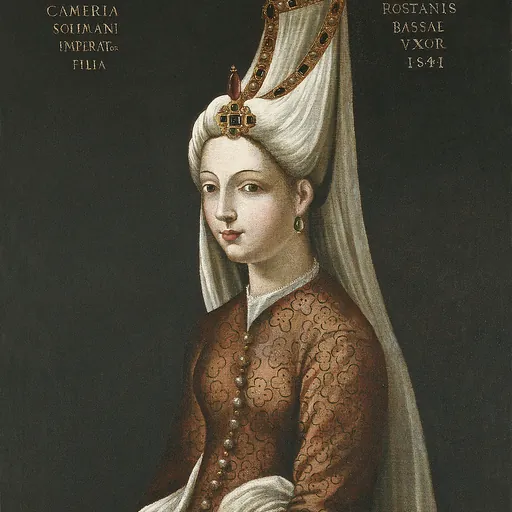
Mihrimah Sultan
Ottoman princess, daughter of Suleiman the Magnificent and Hürrem Sultan
About Mihrimah Sultan
Lived 1522 – 1578 (aged 55–56). Mihrimah Sultan was a Turkish patron of the arts and writer.
Mihrimah Sultan (; ; September 1522 – 25 January 1578) was an Ottoman princess, the daughter of Ottoman Sultan Suleiman the Magnificent and his wife, Hürrem Sultan. According to historian Mustafa Selaniki, she was the most powerful imperial princess in Ottoman history.
Name Mihrimah or Mihrümah means "Sun and Moon", or "Light of the Moon" in Persian. which is a variant of Qamariyyah, an Arabic version of her name meaning "of the moon". Her portrait by Cristofano dell'Altissimo was entitled Cameria Solimani. She was also known as Hanım Sultan, which means "Madam Princess".
Early life Mihrimah was born in Istanbul in September 1522
Marriage In 1539, Suleiman decided that Mihrimah should be married to Rüstem Pasha, probably from Croatia, who had been seized through the devshirme and rose to become governor of Diyarbakır. Rüstem's enemies circulated a rumour that he had leprosy but the doctor dispatched to Diyarbakır to examine him found this to be untrue, although a louse was found in his clothing, despite the fact that he changed his garments daily.
The marriage took place on 26 November 1539 in the Old Palace. Her wedding ceremony and the celebration for her younger brothers Bayezid and Cihangir's circumcision occurred on the same day, with the collective festivities lasting fifteen days. Five years later, in 1544, Süleyman selected her husband to become grand vizier, a post he held until his death in 1561, bar a two-year interval when he was dismissed to assuage popular outrage following the execution of Şehzade Mustafa in 1553.
Shortly after her wedding, she developed a rheumatoid-like disease and spent most of her life dealing with this condition. born in 1541, and at least one son, Sultanzade Osman Bey, who was born in 1546 and who died in 1576.
In 1554, Mihrimah suffered a miscarriage that almost cost her her life. An anonymous author suggested that the couple lived in Pera, although it is more likely that they settled in Mihrimah's palace in Üsküdar. In March 1558, Shaykh Qutb al-Din al-Nahrawali, a religious figure from Mecca, visited Istanbul. In April, he met Mihrimah, and gave her gifts. He met her again in June just before he left Istanbul for Cairo.
After Rüstem's death in 1561, she offered to marry Semiz Ali Pasha, who had succeeded him as grand vizier. When he declined, she chose not to marry again, returning instead to the royal palace.
Political affairs
Although there is no proof of Hürrem or Mihrimah's direct involvement in her half-brother Şehzade Mustafa's downfall, Ottoman and foreign accounts suggest that it was widely believed that Mihrimah worked with Hürrem and Rüstem to eliminate Mustafa to ensure the throne for Hürrem's son and Mihrimah's full brother, Bayezid. The rivalry ended when Mustafa was executed at his own father's command in 1553 during the campaign against Safavid Persia. Although these accounts were not based on first-hand sources, a fear of Mustafa was not unreasonable: had he ascended to the throne, all Mihrimah's full brothers (Selim, Bayezid, and Cihangir) would probably have been executed, according to the fratricidal custom of the Ottoman dynasty, which required the brothers of a new sultan to be executed to avoid feuding. Mihrimah, Rüstem and Hürrem were also blamed for the execution in 1555 of the Grand Vizier Kara Ahmed Pasha, whose elimination cleared the way for Rüstem's return as Grand Vizier.
Hürrem sent letters to Sigismund II, King of Poland and Grand Duke of Lithuania, the contents of which were mirrored in letters written by Mihrimah, and sent by the same courier, who also carried letters from the sultan and her husband Rüstem Pasha the Grand Vizier. After Hürrem's death, Mihrimah also became Süleyman's advisor and confidant, urging him to undertake the conquest of Malta in 1565, and sending him news and forwarding letters for him when he was absent from the capital. She enlisted the help of the Grand Vizier Semiz Ali Pasha, and promised to outfit 400 ships at her own expense. However, Süleyman and his son Selim prevented the campaign from proceeding so that the admiral, Piyale Pasha, could stay in Istanbul with his new wife, Gevherhan Sultan, Selim's daughter. It is also likely that she encouraged Süleyman's decision to launch a campaign against Hungary in 1566, where he met his death at Szigetvár.
Temporary closures of the western and/or eastern grain markets, food shortages and poor harvests led to several crises in the sixteenth century. The citizens of the Dalmatian Republic of Ragusa managed to survive thanks to supplies of Ottoman grain which Mihrimah helped to facilitate. The Ragusans' decision to approach Mihrimah for help may have been the result of tensions between the Republic and the kapudan pasha, Piyale Pasha. During the Great Siege of Malta in 1565, several Ragusan ships sailed in the Christian fleet, as Piyale Pasha reported to the Porte. To Ragusan horror, his ships sailed into their waters and raided the island of Mljet. However, true problems emerged in 1566, leading Ragusan ambassadors to petition Mihrimah to act as their protector.
In later years Mihrimah retired to the Old Palace (Eski Saray). As soon as he came to power, Selim turned to her for help as he needed money, after which she lent him fifty thousand gold coins. She then continued to act as his advisor.
Mosques and charities
Endowment deed of Mihrimah Sultan. This document concerns the endowment of properties in Anatolia and Rumelia, from which revenues were to be used to meet the expenses of the Mihrimah Sultan Mosque complex. April–March 1550. Sadberk Hanım Museum Mihrimah Sultan also commissioned a number of major architectural projects. Her most famous commissions are the two Istanbul mosque complexes that bear her name, both designed by her father's chief architect, Mimar Sinan.
She also funded the repair of the 'Ayn Zubaydah spring in Mecca and established a foundation to supply wrought iron to the navy. having outlived all her siblings. She is Suleiman's only child to have been buried in his tomb in the Süleymaniye Mosque complex. She married three times and had five sons and five daughters. Sultanzade Osman Bey (1546–1576). Buried with his father in his türbe, Şehzade Mosque.
In literature and popular culture Titian's portrait of Mihrimah, entitled Cameria, Daughter of Suleiman the Magnificent as St. Catherine. In the 2003 Turkish TV miniseries, Hürrem Sultan, Mihrimah was played by Turkish actress Özlem Çınar. In the 2011–2014 TV series Muhteşem Yüzyıl (The Magnificent Century) she was portrayed by Pelin Karahan. She appears as a central character in The Architect's Apprentice, a 2014 novel by Elif Shafak. She is one of the central characters in the book Hürrem ve Mihrimah Sultan: Haremin Gülü ve Goncası (Turkish: Hürrem and Mihrimah Sultan: The Rose and the Rosebud of Harem) by Muhterem Yüceyılmaz.
Don’t just read it —
keep it.
Full-length biographies made to live with: read them, listen on the way to work, watch them tonight.
- E-book
- Audio
- Video
Instant download · yours to keep · every purchase keeps this site free
Important facts
Family & relationships
People in Mihrimah Sultan's life
Named in this biography and alive at the same time




Related people
Same field, nearest in time


Contemporaries
People whose lives overlapped Mihrimah Sultan's





Frequently asked questions
Who was Mihrimah Sultan?
Ottoman princess, daughter of Suleiman the Magnificent and Hürrem Sultan
When was Mihrimah Sultan born?
Mihrimah Sultan was born in 1522 in Istanbul.
When did Mihrimah Sultan die?
Mihrimah Sultan died on 25 January 1578 in Old Palace.
What was Mihrimah Sultan's occupation?
Mihrimah Sultan was a patron of the arts and writer.
What nationality was Mihrimah Sultan?
Mihrimah Sultan was Turkish.
Sources & further reading
· DBpedia: Mihrimah Sultan (daughter of Suleiman I)
Cite this page
APA: Biography.guide. (2026). Mihrimah Sultan. https://biography.guide/mihrimah-sultan-patron-of-the-arts/
MLA: "Mihrimah Sultan." Biography.guide, https://biography.guide/mihrimah-sultan-patron-of-the-arts/.
Chicago: "Mihrimah Sultan." Biography.guide. https://biography.guide/mihrimah-sultan-patron-of-the-arts/.
Data last updated: 2026-09-23 · Spot an error? Report a correction.
Portrait: Wikimedia Commons · author & licence
Page generated 2026-09-27 05:08 UTC