
About Madge Morris Wagner
Lived 1862 – 1924 (aged 61–62). Madge Morris Wagner was a writer and journalist.
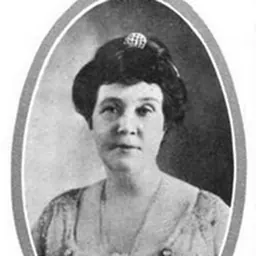
Madge Morris Wagner ( Morris; 1862–1924) was an American poet and journalist associated with The Golden Era. She was a contemporary and friend of Clara Shortridge Foltz and Frona Eunice Wait. Some of Wagner's poems were known around the world.
She was educated in the common schools. There she served as reporter and special writer on J. J. Owen's Daily Mercury, with many of her stanzas appearing there, too. Her notability dates to an order given her, half in jest, by Owen to go to the top of the electric tower at Market and Santa Clara streets, and write a poem on the panorama of Santa Clara Valley to be seen from that dangerous height. Madge took the order seriously. In those days, there was a big bucket run with a windlass which took the electrician up to inspect the lanterns on top. Climbing into this bucket, she was hauled up the tower. Here, unfazed by the dizzy height, she wrote:
Wagner's verse may be divided into two kinds—one is that which contains the pathetic note, the other the suppressed fire. "The Little Brown Bird" is typical of the former, the "Mystery of Carmel" the latter. Many of her poems were well adapted to recitation, such as "My Ships at Sea", "The Liberty Bell", and "Rocking the Baby". While serving as editor of The Golden Era, every edition contained some felicitous quatrain or longer poem, or entertaining story written by her. Her style was characterized by originality and suppressed fire. She wrote prose as well as verse. Her most ambitious work was a patriotic novel, entitled A Titled Plebeian. Her shorter stories were intense and strong in local color, such as "Buzzard's Roost" and a "Memory of Adamsville".
Wagner was the author of Débris, a Book of Poems (San Francisco, 1881); Mystery of Carmel, and other Poems (1885); and a novel, The Titled Plebeian (1890). In the prime of her life, Wagner lived in a cottage in Joaquin Miller Park, later named the Madge Morris Wagner Lodge. In retirement, for many years, she was a resident of San Diego, California.
Her literary work was impeded by poor health, and for long periods she wrote little.
Self-effacing to a marked degree, she was singularly susceptible to surroundings and the moods of her associates. This trait was the source of her shyness and retiring disposition.
Selected works Debris (Sacramento, 1881) (text) Poems (San Francisco, 1885) (text) A Titled Plebeian (San Francisco, 1890) The Lure of the Desert and Other Poems (San Francisco, 1917) (text) Autobiography of a Tame Coyote, illustrations by James A. Holden (San Francisco, 1921) (text) Metric, a novel
Don’t just read it —
keep it.
Full-length biographies made to live with: read them, listen on the way to work, watch them tonight.
- E-book
- Audio
- Video
Instant download · yours to keep · every purchase keeps this site free
Important facts
People in Madge Morris Wagner's life
Named in this biography and alive at the same time



Related people
Same field, nearest in time


Contemporaries
People whose lives overlapped Madge Morris Wagner's



Frequently asked questions
Who was Madge Morris Wagner?
American journalist, poet, writer (1862-1924)
When was Madge Morris Wagner born?
Madge Morris Wagner was born on 25 April 1862.
When did Madge Morris Wagner die?
Madge Morris Wagner died in 1924.
What was Madge Morris Wagner's occupation?
Madge Morris Wagner was a writer and journalist.
Sources & further reading
· Wikipedia: Madge Morris Wagner
· DBpedia: Madge Morris Wagner
Cite this page
APA: Biography.guide. (2026). Madge Morris Wagner. https://biography.guide/madge-morris-wagner/
MLA: "Madge Morris Wagner." Biography.guide, https://biography.guide/madge-morris-wagner/.
Chicago: "Madge Morris Wagner." Biography.guide. https://biography.guide/madge-morris-wagner/.
Data last updated: 2026-09-20 · Spot an error? Report a correction.
Page generated 2026-09-27 05:27 UTC