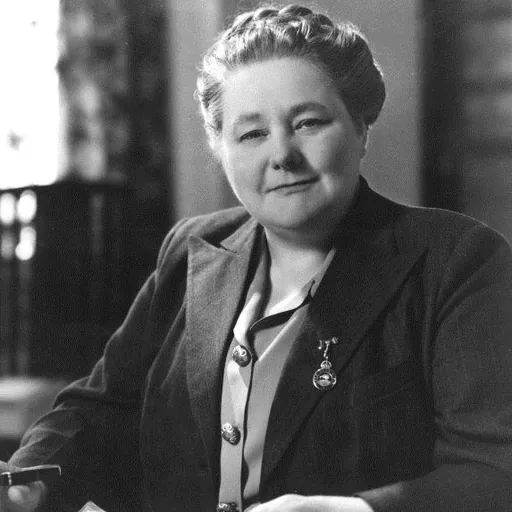
About Mabel Howard
Lived 1894 – 1972 (aged 78). Mabel Howard was an Australian and New Zealand politician and trade unionist.
Mabel Bowden Howard (18 April 1894 – 23 June 1972) was a New Zealand trade unionist and politician. She was the first woman secretary of a predominantly male union (the Canterbury General Labourers' Union).
She was a Member of Parliament for the Labour Party from 1943 until 1969. In 1947 she became New Zealand's first woman cabinet minister when she was made Minister of Health and Minister in charge of Child Welfare. She is remembered for waving two large pairs of bloomers in Parliament in support of her successful campaign to have clothing sizes standardised.
Early life Mabel Howard was born in Bowden, near Adelaide, Australia, on 18 April 1894. She moved to New Zealand with her father (Ted Howard) and sisters after her mother, Harriet Garard Goring, died in 1903. In 1908, after leaving school, she took a commercial course at the Christchurch Technical Institute.
Political career Trade unions Howard joined the Christchurch Socialist Party when still at the Christchurch Technical Institute. She entered the Trades Hall in 1911 as an office assistant for the Canterbury General Labourers' Union. In 1933, at the age of 39, she became the first woman to become secretary of a predominantly male union in New Zealand. Howard also served on the Christchurch Drainage Board and North Canterbury Hospital Board.
Member of Parliament
Her father, Ted Howard, was Member of Parliament for from 1919 until his death in 1939. Mabel Howard hoped to be chosen to stand for the after her father's death, and although she had local support, the Labour Party chose Christchurch mayor Robert Macfarlane.
In 1943, Mabel Howard was elected Member of Parliament for Christchurch East at a by-election, becoming New Zealand's fifth female MP. She retained the seat at the 1943 general election, becoming the first woman MP to be re-elected.
In 1946, Mabel Howard became the Member of Parliament for the new electorate, winning 75.2 percent of the vote. This was an outstanding result and a reflection of the high regard in which she was held. Howard's concern was for "women, the aged, the sick and the unfortunate" (5 September 1944). In Parliament, she was a "forthright" representative for her people, stating "I stand here and say what I honestly believe" (September 1961).
In 1953, Howard was awarded the Queen Elizabeth II Coronation Medal.
In Parliament in 1954, she waved two pairs of bloomers that were both labelled OS in front of an astonished House. She demonstrated that, although clothing was supposed to be in standard sizes and correctly labelled, much variation existed. The two pieces were quite clearly of differing sizes. Although opposed by clothing manufacturers, she received much support from the House, including from National Party members and standardisation was legislated. On another occasion, she threw a stone onto the floor of Parliament to illustrate what buyers of bagged coal may find. In relation to this work she said, "I am a pacifist at heart, at a time like this one cannot be a pacifist and retain one's honour. Women can best serve their country by being prepared for any emergency."
She worked as a volunteer for many organisations, among them St John's Ambulance and the Royal New Zealand Society for the Prevention of Cruelty to Animals (RNZSPCA). She successfully fought to enact the first Prevention of Cruelty to Animals Bill in 1960 and was president of the Canterbury branch of the RNZSPCA for nearly twenty years.
Later life
By the time the 1966 election campaign began, Mabel Howard was clearly ill. Mel Courtney, a member of her campaign committee and later MP for Nelson (1976–81), ensured she was assisted at public appearances. Howard had helped his family in their hour of need and now he was helping her. Howard retired from politics at the 1969 election, after a lifetime of service to her community. The Labour Party had introduced a compulsory retirement age for MPs, which applied to Howard, who had already been showing signs of ageing. Once retired, she became increasingly isolated and paranoid, on top of the onset of dementia and pneumonia that she had already suffered while still in Parliament. On a court order, she was eventually committed to Sunnyside Hospital, a mental asylum. She died there on 23 June 1972. She is buried with her father, Ted Howard, at Bromley Cemetery in Christchurch.
Don’t just read it —
keep it.
Full-length biographies made to live with: read them, listen on the way to work, watch them tonight.
- E-book
- Audio
- Video
Instant download · yours to keep · every purchase keeps this site free
Important facts
People in Mabel Howard's life
Named in this biography and alive at the same time



Related people
Same field, nearest in time





Contemporaries
People whose lives overlapped Mabel Howard's


Frequently asked questions
Who was Mabel Howard?
New Zealand trade unionist and politician (1894-1972)
When was Mabel Howard born?
Mabel Howard was born on 18 April 1894 in Adelaide, Bowden.
When did Mabel Howard die?
Mabel Howard died on 23 June 1972 in Sunnyside Hospital.
What was Mabel Howard's occupation?
Mabel Howard was a politician and trade unionist.
What nationality was Mabel Howard?
Mabel Howard was Australian and New Zealand.
Sources & further reading
Cite this page
APA: Biography.guide. (2026). Mabel Howard. https://biography.guide/mabel-howard/
MLA: "Mabel Howard." Biography.guide, https://biography.guide/mabel-howard/.
Chicago: "Mabel Howard." Biography.guide. https://biography.guide/mabel-howard/.
Data last updated: 2026-09-21 · Spot an error? Report a correction.
Portrait: Wikimedia Commons · author & licence
Page generated 2026-09-27 04:58 UTC