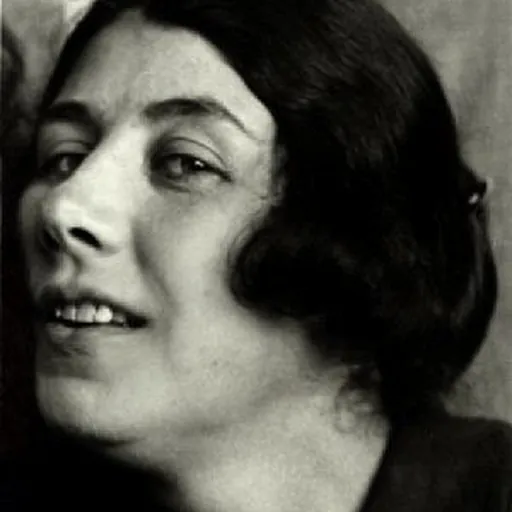
About Lyubov Popova
Lived 1889 – 1924 (aged 35). Lyubov Popova was a Russian painter, university teacher, graphic artist, illustrator, draftsperson and scenographer.
Lyubov Sergeyevna Popova (; 24 April 1889 – 25 May 1924) was a Russian-Soviet avant-garde artist, painter and designer.
Early life Popova was born in Ivanovskoe, near Moscow, to the wealthy family of Sergei Maximovich Popov, a very successful textile merchant and vigorous patron of the arts, and Lyubov Vasilievna Zubova, who came from a highly cultured family. Lyubov Sergeyevna had two brothers and a sister: Sergei was the eldest, then Lyubov, Pavel and Olga. Pavel became a philosopher and the guardian of his sister's artistic legacy.
Popova grew up with a strong interest in art, especially Italian Renaissance painting. At eleven years old she began formal art lessons at home. She was first enrolled in Yaltinskaia's Women's Gymnasium, then in Arseneva's Gymnasium in Moscow. By the age of 18 she was studying with Stanislav Zhukovsky, and in 1908 entered the private studios of Konstantin Yuon and Ivan Dudin. Between 1912 and 1913, she began attending the studios of the Cubist painters Henri Le Fauconnier and Jean Metzinger at Académie de La Palette in Paris.
Style
Cubo-Futurism
Popova was one of the first female pioneers in Cubo-Futurism. Through a synthesis of styles she worked towards what she termed painterly architectonics. After first exploring Impressionism, by 1913, in Composition with Figures, she was experimenting with the particularly Russian development of Cubo-Futurism: a fusion of two equal influences from France and Italy.
From 1914 to 1915 her Moscow home became the meeting-place for artists and writers. In 1914–1916 Popova together with other avant-garde artists (Aleksandra Ekster, Nadezhda Udaltsova, Olga Rozanova) contributed to the two Knave of Diamonds exhibitions, in Petrograd Tramway V and the 0.10, The Store in Moscow. An analysis of Popova's cubo-futurist work also suggests an affinity with the work of Fernand Leger, whose geometry of tubular and conical forms in his series of paintings from 1913 to 1914 is similar to that in Popova's paintings. Popova embraced both of these ideals but eventually identified herself entirely with the aims of the Revolution working in poster, book design, fabric and theatre design, as well as teaching. At 0.10 she had exhibited a number of figurative painted cardboard reliefs in a cubist derived style. In 1916 she began to paint completely abstract Suprematist compositions, but the title "Painterly Architectonics" (which she gave to many of her paintings) suggests that, even as a Suprematist, Popova was more interested in painting as a projection of material reality than as the personal expression of a metaphysical reality. Popova's superimposed planes and strong color have the objective presence of actual space and materials.
In 1918 Popova married the art historian Boris von Eding, and gave birth to a son. Von Eding died the following year of typhoid fever. Popova was also seriously ill but recovered.
Constructivism As early as 1917, in parallel with her Suprematist work, the artist had made fabric designs and worked on Agitprop books and posters, In the Tenth State Exhibition: Non Objective Creativity and Suprematism, 1918, she contributed the architectonic series of paintings. She continued painting advanced abstract works until 1921. In the 5x5=25 Exhibition of 1921, Popova and her four fellow Constructivists declared that easel painting was to be abandoned and all creative work was to be for the people and the making of the new society. Popova worked in a broad range of mediums and disciplines, including painting, relief, works on paper, and designs for the theater, textiles, and typography. Popova did not join the Working Group of Constructivists when it was set up in Moscow in March 1921, but joined by the end of 1921. In 1923 she began creating designs for fabric to be manufactured by the First State Textile Printing Works in Moscow.
From 1921 to 1924 Popova became entirely involved in Constructivist projects, sometimes in collaboration with Varvara Stepanova, the architect Alexander Vesnin and Alexander Rodchenko. She produced stage designs: Vsevolod Meyerhold's production of Fernand Crommelynck's The Magnanimous Cuckold, 1922; her Spatial Force Constructions were used as the basis of her art teaching theory at Vkhutemas. She designed typography of books, production art and textiles, and contributed designs for dresses to LEF.
She worked briefly in the Cotton Printing Factory in Moscow with Varvara Stepanova.
Death and legacy Popova died at the peak of her artistic powers two days after the death of her son, from whom she had contracted scarlet fever in 1924 in Moscow. A large exhibition of her work opened in Moscow from 21 December 1924 to January 1925, at Stroganov Institute, Moscow. The exhibition included Popova's works such as seventy-seven paintings, as well as books, posters, textile designs, and line engravings. "Artist-Constructor" was the term applied to Popova by her contemporaries in the catalogue of the artist's posthumous exhibition.
Popova was the subject of an exhibition at the Museo de Arte Abstracto Español, Cuenca (18 February - 23 May 2004) and Museu Fundación Juan March, Palma (4 June - 4 September 2004) of works created from 1910 to 1922 and loaned from the State Tretyakov Gallery in Moscow.
Rodchenko/Popova: Defining Constructivism, an exhibition of the work of Popova, Rodchenko, and other Constructivists was shown at Tate Modern, London, in 2009, and subsequently at Museo Reina Sofia, Madrid.
Popova's work was included in the 2021 exhibition Women in Abstraction at the Centre Pompidou.
Gallery
Don’t just read it —
keep it.
Full-length biographies made to live with: read them, listen on the way to work, watch them tonight.
- E-book
- Audio
- Video
Instant download · yours to keep · every purchase keeps this site free
Important facts
more
Ljubov Sergeevna Popova, Lyubov' Sergeevna Popova, Lioubov Popova, Ljoubov Sergueevna Popova, Ljubov' Sergeyevna Popova, Ljubow Popova, Liubov Sergeevna Popova, Ljubowj Ssergejewna Popowa, Lyubov Sergeyevna Popova, Lyubov' PopovaPeople in Lyubov Popova's life
Named in this biography and alive at the same time



Related people
Same field, nearest in time


Contemporaries
People whose lives overlapped Lyubov Popova's




Frequently asked questions
Who was Lyubov Popova?
Russian artist (1889-1924)
When was Lyubov Popova born?
Lyubov Popova was born on 24 April 1889 in Krasnovidovo.
When did Lyubov Popova die?
Lyubov Popova died on 25 May 1924 in Moscow.
What was Lyubov Popova's occupation?
Lyubov Popova was a painter, university teacher, graphic artist, illustrator, draftsperson and scenographer.
What nationality was Lyubov Popova?
Lyubov Popova was Russian.
Sources & further reading
Cite this page
APA: Biography.guide. (2026). Lyubov Popova. https://biography.guide/lyubov-popova/
MLA: "Lyubov Popova." Biography.guide, https://biography.guide/lyubov-popova/.
Chicago: "Lyubov Popova." Biography.guide. https://biography.guide/lyubov-popova/.
Data last updated: 2026-09-21 · Spot an error? Report a correction.
Portrait: Wikimedia Commons · author & licence
Page generated 2026-09-27 05:00 UTC