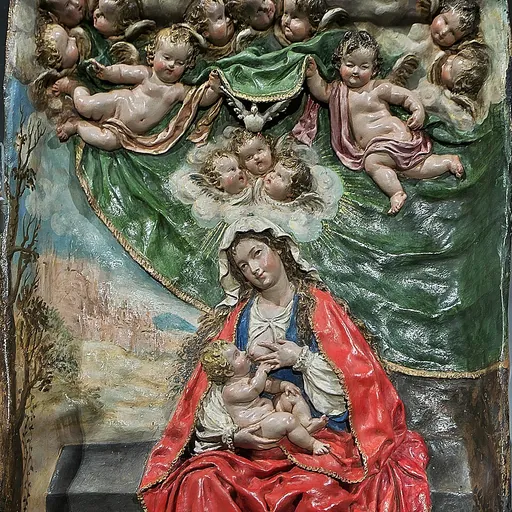
About Luisa Roldán
Lived 1652 – 1706 (aged 53). Luisa Roldán was a Spanish sculptor and artist.
Saint Ginés de la Jara, 1692, J. Paul Getty Museum, Los Angeles
Luisa Ignacia Roldán (8 September 1652 – 10 January 1706), known also as La Roldana, was a Spanish sculptor of the Baroque Era. She is the earliest woman sculptor documented in Spain. Roldán is recognized by the Hispanic Society of America for being "one of the few women artists to have maintained a studio outside the convents in Golden Age Spain".
Because of the quality of her work, Antonio Palomino considered her as important a sculptor as her father, Pedro Roldán.
Although Roldán became the Escultor de Cámara, or Court Sculptor, to the Habsburg King Charles II, she struggled financially. Like many artists of her time she died poor, signing a declaration of poverty shortly before her death. On the day of her death, Roldan was given the title of "Academician of Merit" from the Accademia di San Luca in Rome. She was taught by her father, alongside her siblings, how to draw, utilize clay to shape figures and finally sculpt or carve in wood. She became an apprentice in her father's workshop.
Also working within the workshop was Luis Antonio de los Arcos, who Roldán married when she was 19. The marriage was against her father's wishes. Santiago Montoto, writing in 1920, went so far as to characterize it as an "abduction" ("rapto"), perhaps reflecting his lack of understanding of marriage customs of the period. The chosen partnerships of two of her sisters and one brother also met with parental disapproval.
Afterwards, Roldán worked in Cádiz from 1686 to 1688. She established her own workshop, together with her husband and her brother-in-law, Tomás de los Arcos, to create religious polychromed wooden sculptures. Roldán was the principal sculptor, He was a specialist in painting flesh tones. and in 1692 was later awarded the position of "escultora de camara" or "Sculptor to the Chamber", serving Charles II and later Philip V as "Sculptor to the King". Roldán created a terracotta piece called the Virgen con el Nino, and donated it to the Accademia di San Luca, to which she was admitted at the end of her life.
Roldán had seven children, two of whom survived to adulthood. During her time working for Charles II, Roldán, her husband, and their children all suffered during the country's economic crisis.
She tried to improve her financial situation by appealing to Charles II's second wife, Queen Maria Anna for help. The queen responded by granting money, but it proved insufficient. Luisa's husband, Luis Antonio de los Arcos hoped to improve matters by applying for a position at court, but was unsuccessful. Her sculpture of the Virgen de la Soledad appeared in several Catholic Churches and appealed to many people from different social classes. In Cádiz, works by her include statues of Anthony of Padua, Ecce Homo, and Saints Servandus and Cermanus. While living in Madrid she also made small terracotta works popular with the petty bourgeoisie. The smaller works could be used for personal devotion and took the forms of religious scenes, human forms and animals. Ecce Homo, Córdoba Christ of the Pardon, (Cristo del Perdón), Fregenal de la Sierra Saint Ferdinand, Las Palmas Cathedral, Gran Canaria Penitent (Nazareno), Iglesia de las Hermanas Nazarenas, Sisante
A figure of Mary Magdalene in Cádiz was destroyed by fire at the outbreak of the Spanish Civil War in 1936.
Other notable works are in collections and museums: St. Michael Overwhelming the Demon, Royal Collections Gallery, Madrid Virgo lactans, Museum of Fine Arts of Seville Death or Ecstasy of Mary Magdalene, Marriage of Saint Catherine, Hispanic Society of America, New York City Saint Joachim, Saint Ann and the Virgin as a Child (La Virgen niña con San Joaquín y Santa Ana) and Jesus' First Steps (Los primeros pasos de Jesús), Museum of Fine Arts, Guadalajara, Spain Saint Michael, Royal Ontario Museum, Toronto, Canada. The Virgin Appears to Saint James Victoria and Albert Museum, London, England. The Entombment of Christ, Metropolitan Museum of Art, New York. The Education of the Virgin, LACMA, Los Angeles. Education of the Virgin, Blanton Museum of Art, Austin.
Style and method Roldán's style of art was created through her point of view of the world, her access to resources and the materials she used to cultivate her detailed sculptures. She used three different types of wood to create certain sculptures, like the St. Ginés de la Jara. There were two types she preferred that were soft and fine grained. Women artists were seen as belonging to a "private" sphere and men to a "public" sphere. When Roldan created her sculptures she made her work public and changed the way art was perceived in the 1600s. She is a female artist that is known as the Spanish sculptor that created her own name. Through her artwork, she was able to earn a royal title as "escultora de camara". Roldán was able to illustrate her own entray called Lives of the Eminent Spanish Painters and Sculptors. However, in the eighteenth century it was discovered that more than ninety women were active artists in Spain and Portugal. Many other women artists were being discovered at the time Roldán published her artwork. She paved the way for innovational art that focused on terracotta imagery and sculptures.
Don’t just read it —
keep it.
Full-length biographies made to live with: read them, listen on the way to work, watch them tonight.
- E-book
- Audio
- Video
Instant download · yours to keep · every purchase keeps this site free
Important facts
People in Luisa Roldán's life
Named in this biography and alive at the same time


Related people
Same field, nearest in time


Contemporaries
People whose lives overlapped Luisa Roldán's



Frequently asked questions
Who was Luisa Roldán?
Spanish sculptor of the Baroque Era (1652–1706)
When was Luisa Roldán born?
Luisa Roldán was born on 8 September 1652 in Seville.
When did Luisa Roldán die?
Luisa Roldán died on 10 January 1706 in Madrid.
What was Luisa Roldán's occupation?
Luisa Roldán was a sculptor and artist.
What nationality was Luisa Roldán?
Luisa Roldán was Spanish.
Sources & further reading
Cite this page
APA: Biography.guide. (2026). Luisa Roldán. https://biography.guide/luisa-roldan/
MLA: "Luisa Roldán." Biography.guide, https://biography.guide/luisa-roldan/.
Chicago: "Luisa Roldán." Biography.guide. https://biography.guide/luisa-roldan/.
Data last updated: 2026-09-24 · Spot an error? Report a correction.
Portrait: Wikimedia Commons · author & licence
Page generated 2026-09-27 05:08 UTC