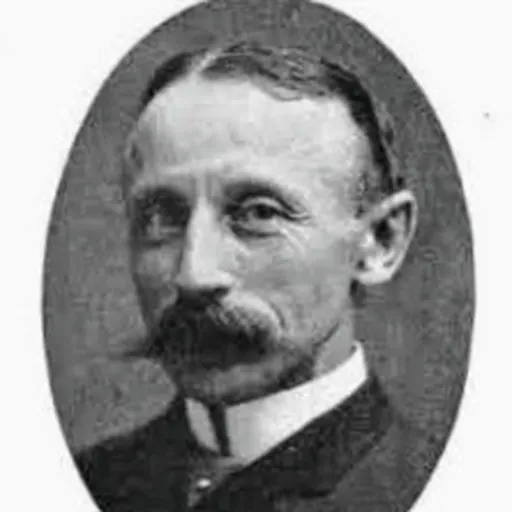
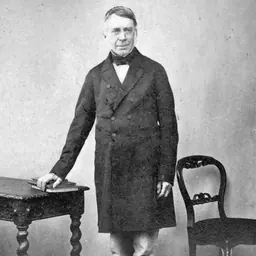
Ludvig Sandöe Ipsen
Danish-American architect, illustrator and designer
About Ludvig Sandöe Ipsen
Lived 1840 – 1920 (aged 79–80). Ludvig Sandöe Ipsen was an illustrator, designer and architect.
Ludvig Sandöe Ipsen (April 20, 1840 – 1920) was a Danish-American artist and designer. Trained as an architect, he is known for his designs in a wide variety of disciplines.
Early life and education Ludvig Sandöe Ipsen was born on April 20, 1840, to Ludvig Ipsen and Mette Margrethe Ipsen in Copenhagen, Denmark.
He trained as an architect at the Royal Danish Academy of Fine Arts, School of Architecture in Copenhagen. In 1860, shortly after graduation, he entered the military, serving in the engineering corps and participating in the Second Schleswig War in 1864.
Career After military service, Ipsen worked for a few years in the office of a Copenhagen architect before emigrating to the United States. He found work with the Boston architect Henry W. Hartwell, and was later a member of the firm Hartwell & Swasey. By 1875, he had abandoned the practice of architecture in favor of the decorative arts and illustration. He did, however, return to architecture at least once, for the design of a crematorium chapel.
Book illustration Ipsen was employed as a staff illustrator by the James R. Osgood publishing firm in Boston and also worked for several other local publishers. Chapter heading for The Prince and The Pauper by L. S. Ipsen The Skeleton in Armor by Henry Wadsworth Longfellow (1877) The Scarlet Letter by Nathaniel Hawthorne (1878) The Confessions of a Frivolous Girl by Robert Grant (1880) The Prince and the Pauper by Mark Twain, sharing illustration credit with Frank T. Merrill and John J. Harley. (1881) The Lady of the Lake by Sir Walter Scott (1883) Marmion by Sir Walter Scott (1885) Eudora by M. B. M. Toland (1888)
The book that brought Ipsen the most acclaim was Sonnets from the Portuguese by Elizabeth Barrett Browning, issued in 1886 by Ticknor and Company of Boston.
Other works on paper Shortly after the Boston-based men's choral society, the Apollo Club, was incorporated, Ipsen was commissioned by Arthur Reed, the club secretary, to illustrate the club's publications, and he designed 130 program covers over the course of 23 years, as well as designing the club's seal in 1876. The club's records, now held by the Massachusetts Historical Society, include fifty-one original illustrations created for Apollo Club concert programs.
Typography
In 1903, Ipsen was granted two patents for typefaces created for the American Type Founders Company (ATF): Florentine Bold Condensed (pat. no. 36,366) and Florentine Bold Extra Condensed (pat. no. 36,367). The fonts were variants of the Florentine typeface which first appeared in the ATF 1896 catalog. That catalog did not acknowledge a designer but the typographical historian Max McGrew credited Ipsen and the National Museum of American History holds original drawings for the related font Florentine Heavy dated 1896 and ascribed to Ipsen. He also designed decorative borders and initials for ATF.
Architecture and architectural elements In 1893, the Massachusetts Cremation Society opened a crematorium designed by Ipsen and built of Roxbury felsite in the neoclassical style. Now owned by Forest Hills Cemetery, it includes the Lucy Stone Chapel, named after the Boston abolitionist and suffragist who was the first person cremated there.
Ipsen received a commission in 1910 to design a pair of iron gates for the Converse Memorial Library, which was designed by H. H. Richardson, in Malden. The gates enclose a garden designed by Frederick Law Olmsted.
Personal life Ipsen emigrated to the United States in 1867, arriving first in New York, where he married Emma Petrea Petersen (18461914) in Manhattan on August 10, 1868. Emma, also born in Copenhagen, was a well-known mezzo-soprano who performed in recital halls and churches. She was the sister of John Petersen (18391874), a marine painter also known as Johan Erik Christian Petersen.
The couple had moved to Malden, Massachusetts by the following year when their son, Ernest, was born. Ernest Ludvig Ipsen (18691951) became an internationally renowned portrait painter.
Gallery
Don’t just read it —
keep it.
Full-length biographies made to live with: read them, listen on the way to work, watch them tonight.
- E-book
- Audio
- Video
Instant download · yours to keep · every purchase keeps this site free
Important facts
Family & relationships
People in Ludvig Sandöe Ipsen's life
Named in this biography and alive at the same time





Related people
Same field, nearest in time

Contemporaries
People whose lives overlapped Ludvig Sandöe Ipsen's

Frequently asked questions
Who was Ludvig Sandöe Ipsen?
Danish-American architect, illustrator and designer
When was Ludvig Sandöe Ipsen born?
Ludvig Sandöe Ipsen was born on 20 April 1840 in Copenhagen.
When did Ludvig Sandöe Ipsen die?
Ludvig Sandöe Ipsen died in 1920 in Malden.
What was Ludvig Sandöe Ipsen's occupation?
Ludvig Sandöe Ipsen was an illustrator, designer and architect.
Sources & further reading
· Wikipedia: Ludvig Sandöe Ipsen
· DBpedia: Ludvig Sandöe Ipsen
Cite this page
APA: Biography.guide. (2026). Ludvig Sandöe Ipsen. https://biography.guide/ludvig-sandoe-ipsen/
MLA: "Ludvig Sandöe Ipsen." Biography.guide, https://biography.guide/ludvig-sandoe-ipsen/.
Chicago: "Ludvig Sandöe Ipsen." Biography.guide. https://biography.guide/ludvig-sandoe-ipsen/.
Data last updated: 2026-09-20 · Spot an error? Report a correction.
Portrait: Wikimedia Commons · author & licence
Page generated 2026-09-27 04:57 UTC