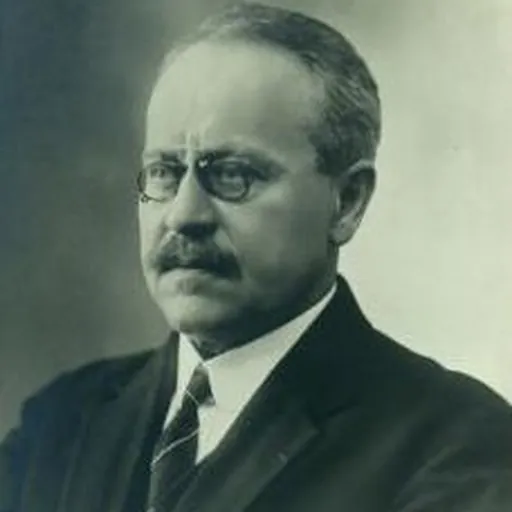
Ludvig Puusepp
Estonian medical researcher and physician
About Ludvig Puusepp
Lived 1875 – 1942 (aged 66). Ludvig Puusepp was a Russian and Estonian surgeon, university teacher, physician, medical researcher and neurosurgeon.
Ludvig Puusepp (also Ludwig Martynowicz Pussep or Pousep, Rus. Людвиг Мартынович Пуссеп; in Kyiv – 19 October 1942 in Tartu) was an Estonian surgeon and researcher and the world's first professor of neurosurgery.
Early life Ludvig Puusepp was born on 3 December 1875 His father Martin Puusepp was a shoemaker who had migrated from Rakvere, Estonia to St. Petersburg where he met and married Victoria-Stephania Goebel.
Puusepp learned German at home and Russian in school; it was not until 1920 at age 44 that he learned Estonian. He continued to study languages including French, English, and Italian.
Career Puusepp undertook medical studies at the St. Petersburg Medical Military Academy from 1894 to 1899. Puusepp began training in neurology under Vladimir Bekhterev, and performed his first neurosurgical operation in 1899. Dissatisfied with the results, they ceased further attempts at psychosurgery.
Bekhterev had become dissatisfied with the attempts of general surgeons to operate upon the nervous system and felt that neurology should become a surgical specialty like gynecology or ophthalmology: "neurologists will take a knife in their hands and do what they should do". He established an operating room in the Department of Nervous and Mental Diseases and a curriculum which emphasized neurological diagnosis. When the St. Petersburg Psycho-Neurological Institute later that year established a Chair of Surgical Neurology, Bekhterev's protégé Puusepp was named to head the new division. This independent department for neurological surgery was the first in the world, and when Puusepp was named full professor in 1910, he was the world's first professor of neurological surgery. During his tenure in St. Petersburg he published over 100 research papers. Puusepp served in the Russian Army Medical Service at the start of World War I, but was discharged and returned to teaching and academic leadership in St. Petersburg after being wounded. In 1917 he published a Russian-language neurology text, Principles of Surgical Neurology.
Later career in Estonia In 1920, Puusepp relocated from St. Petersburg to Tartu, in the newly independent Estonia, to begin the most productive chapter of his career. He was granted Estonian citizenship on August 6, 1920. He was appointed Professor of Neurology at the University of Tartu and Director of the Hospital of Nervous Diseases (established 1921). Puusepp performed the first brain tumor operation in Estonia on April 30, 1921, for a right-sided cerebellopontine angle mass. Over the next twenty years he developed a strong neurological and neurosurgical teaching and clinical service with its own operating rooms and neuroradiology support. His forward-thinking approach to organizing the treatment, research, and educational missions of the institute was articulated in a plan drawn up in the 1920s. Until 1940 the Tartu clinic remained the only specialty neurological center in the Baltics, attracting patients from Finland, Latvia and Lithuania. Physicians from across Europe, including from Spain and Yugoslavia, traveled to Tartu to train with Puusepp.thumb
In Tartu, Puusepp continued to research, innovate and publish. He was a founding editor of Eesti Arst (Estonian Physician). A 726-page work, Die Tumoren des Gehirns, was published in 1929, and then translated for a Spanish edition in 1931. Puusepp founded the medical journal Folia Neuropathologica Estoniana. Published from 1923 to 1939, it incorporated work not only from other Tartu researchers but also from international authors including Marburg, Freeman, his mentor Bekhterev, Walter Dandy, Walker, Guillain, and Alajouaine. The first volume of Die Neuropathologie chirurgische, a monumental 1400-page work, was released in 1931. The work remained unfinished due to the advent of World War II and Puusepp's failing health. His final work, Peaaju, tema töö ja tervishoid was published in Tartu in 1941.
Puusepp's contributions included published books on the surgery of brain tumors and the nervous system and papers on a diverse number of topics within neurosurgery including the description of Puusepp's sign—demonstrating abnormal reflex at the 5th toe —and Puusepp's operation for syringomyelia. He also refined the techniques of ventriculography, reviewed the surgical treatment of cerebral aneurysms, experimented with measuring intracranial pressure using a manometer, and investigated nerve compression due to herniated spinal disks. He was one of the founding members of the Estonian Neurological Society (Eesti Neuroloogide Selts) in 1922, and he later served as the association's president. Some authors have suggested that Puusepp, through the role he played in the advancement of the neurosurgical profession, was Harvey Cushing's counterpart in the Eastern hemisphere.
Honors Puusepp traveled widely as an invited lecturer and visiting professor. He was awarded honorary doctorates at the University of Padua (1922) and University of Vilnius (1929). In 1938 he was one of the first twelve Estonians granted membership in the Estonian Academy of Sciences. He was also a corresponding member of the Portuguese Academy of Sciences and of the French Academy of Surgery. After Estonia was occupied by the USSR in 1940, Puusepp was awarded the title of Merited Scientist. A granite and bronze monument designed by Endel Eduard Taniloo was erected in 1982 in west Tartu at Maarjamõisa. The current TÜ Kliinikum Närvikliinik is on Ludvig Puusepa street in Tartu.
Family
Puusepp married Maria Kotšubei in 1906. After her death in 1929, he married Maria Küppar, and in 1932 their only daughter Liivia (who became a neurosurgeon herself) was born.
Puusepp's health began to decline in the second half of 1940, and he died of carcinoma of the stomach on 19 October 1942, in Tartu. He is buried in Tartu at Raadi cemetery.
Works О влиянии рентгеновских лучей на возбудимость мозговой коры. Отчеты научных собраний врачей С.-Петербургской клиники душевных и нервных болезней за 1897–1898 гг. С.-Петербург: 1899. О мозговых центрах, управляющих эрекцией полового члена и семяотделением. С.-Петербург: 1902.; 180 pp., 3 plates Экспериментальное психологическое исследование умственной работы школьников-онанистов по сравнению с нормальными. Юбилейный сборник Трудов по психиатрии и невропатологии, посвящённый В.М. Бехтереву. Том второй. С.-Петербург: 1903. Нервно-сосудистый отек кожи. С.-Петербург: V. S. Ettinger, 1907.; 23 pp. Травматический невроз военного времени: клинический очерк на основании собственных наблюдений. Петроград: Практическая медицина, 1916. Основы хирургической невропатологии в 4-х частях. Т. 1: Периферическая нервная система. Петроград: 1917.; 38 pp. Der Blutkreislauf im Gehirn beim Koitus. Dorpat: 1922?. Noorus ja eluväärtus: (noorsoo enesetapmiste andmetel). s.n.: 1926. Symptomatologie et traitement chirurgical des lésions de la moelle épinière. J. G. Krüger, 1926; 39 pp. (With Endel Kirsimägi): Hüpnoos ja suggestioon arstiteaduses ja seltskondlikus elus. s.n.: 1927. К вопросу об оперативном удалении опухолей спинного мозга. Ленинград : Государственное издательство, 1928 Die Tumoren des Gehirns; ihre Symptomatologie, Diagnostik und operative Behandlung auf Grund eigener Beobachtungen. Tartu: 1929. К вопросу о доброкачественных кистовидных опухолях париетальной доли. Эстония, 193? Los tumores del cerebro: Su sintomatologia, diagnóstico y tratamiento operatorio. Barcelona: Salvat Editores, 1931; 661 pp. Über die Entwicklung der chirurgischen Neuropathologie während der letzten 10 Jahre, nach den Daten der Nervenklinik der Universität Tartu-Dorpat. [Tartu], Chirurgische Neuropathologie. Bd. 1, Die peripherischen Nerven. Tartu (Dorpt): Krüger, 1932. Chirurgische Neuropathologie. Bd. 2, Das Rückenmark. Tartu (Dorpat): Krüger, 1933. Über Hirnmeningiome in Einzeldarstellungen : (Symptomatologie, Diagnostik und operative Behandlung auf Grund eigener Beobachtungen). Tartu: J. Mällo, 1935. Chirurgische Neuropathologie. Bd. 3. T. 1, Das Gehirn. Tartu: Krüger, 1939. Peaaju, tema töö ja tervishoid. Teaduslik Kirjandus, 1941.; 70 pp.
Don’t just read it —
keep it.
Full-length biographies made to live with: read them, listen on the way to work, watch them tonight.
- E-book
- Audio
- Video
Instant download · yours to keep · every purchase keeps this site free
Important facts
People in Ludvig Puusepp's life
Named in this biography and alive at the same time
Related people
Same field, nearest in time

Contemporaries
People whose lives overlapped Ludvig Puusepp's



Frequently asked questions
Who was Ludvig Puusepp?
Estonian medical researcher and physician (1875-1942)
When was Ludvig Puusepp born?
Ludvig Puusepp was born on 3 December 1875 in Kyiv.
When did Ludvig Puusepp die?
Ludvig Puusepp died on 19 October 1942 in Tartu.
What was Ludvig Puusepp's occupation?
Ludvig Puusepp was a surgeon, university teacher, physician, medical researcher and neurosurgeon.
What nationality was Ludvig Puusepp?
Ludvig Puusepp was Russian and Estonian.
Sources & further reading
Cite this page
APA: Biography.guide. (2026). Ludvig Puusepp. https://biography.guide/ludvig-puusepp/
MLA: "Ludvig Puusepp." Biography.guide, https://biography.guide/ludvig-puusepp/.
Chicago: "Ludvig Puusepp." Biography.guide. https://biography.guide/ludvig-puusepp/.
Data last updated: 2026-09-22 · Spot an error? Report a correction.
Portrait: Wikimedia Commons · author & licence
Page generated 2026-09-27 05:04 UTC