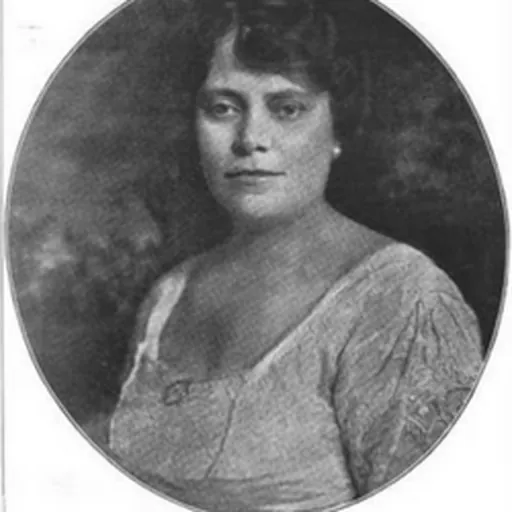
Lucy Isabelle Marsh
American lyric soprano, church soloist and concert performer
About Lucy Isabelle Marsh
Lived 1878 – 1956 (aged 77). Lucy Isabelle Marsh was an American opera singer and soprano.
Lucy Isabelle Marsh (April 10, 1878 – January 20, 1956) was an American lyric soprano who made her career as a professional recording artist for the Victor Talking Machine Company. She was an anonymous mainstay of the company, recording prodigiously from 1909 into the late 1920s. At the same time, she quickly won popular and critical recognition under her own name as a major artist on recordings for Victor.
Biography Training Marsh obtained training in Paris under Baldelli, and under Trabadelo, who also taught Mary Garden. She studied under John Walter Hall in New York.
Career Marsh sang in church choirs, and became lead soprano in important churches in New York City. As a Flower Maiden in the opera "Parsifal" she is known to have given nine performances at the Metropolitan Opera between November 1904 and March 1905. In 1908, she recorded three sides for Columbia Records.
In 1909, Marsh was engaged by The Victor Talking Machine Company in Camden, New Jersey, beginning her dual career as a recording artist and as a technically and artistically accomplished singer. Although she occasionally appeared on stage, she was best-known primarily through her many records for Victor.
The "recording artist" was essential to the commercial success of recording companies such as Victor in the early days of acoustic recording technology, from around 1902 through 1924. Female singers, particularly sopranos, were especially difficult to record well and singers were required whose sound quality registered well through the mechanical diaphragm. Marsh possessed such a "phonogenic" voice. Singers also needed to be quick studies at learning the latest song or an arrangement prepared for a recording. Such singers had to master the techniques of singing into a horn, which included knowing the best distance from the horn to stand for their voice, how and when to back away to avoid blasting or move forward for softer passages, how to adopt a position to blend with a partner or change positions to maintain the best balance when alternating lead passages with a partner, ensemble or accompanist. Marsh herself provided a description of the situation.
The Victor Talking Machine Company employed several fine singers as recording artists beginning with the company's founding in 1901, through the introduction of electrical recording in 1925. The Encyclopedic Discography of Victor Records, a project of researchers based at the University of California, Santa Barbara, has published the information contained in the session ledgers of Victor, supplemented with other sources. Examination of the database, made available on line, shows that Victor used many of these singers as anonymous members of several ensembles such as the Trinity Choir, the Lyric Quartet and the Victor Opera Quartet to produce recordings of "standards" and selections from shows, operas and operettas. Victor also afforded some of these artists occasional solo and ensemble recordings under their own names, some more and some less.
A popular specialty of the Victor company was a series of records known as "Gems from" operas, operettas and musical shows. These were attributed not to individual singers but to the Victor Opera Company, or Victor Light Opera Company. "Gems" were arrangements of fragments or medleys of selected numbers. A purchaser could expect to hear snatches of the most popular tunes and choruses, usually ending with an up-tempo number. Production of these records required several singers to collaborate by stepping forward at the proper time to sing solos into the horn and back for choral numbers. A typical "Gems" recording played for around four and a half minutes on one side of a 12-inch, 78 rpm record; occasionally, shows or operas contained enough material to merit two sides of a record. Many of these "Gems" records were re-recorded more than once but issued under the same catalog numbers. Over 25% of the Marsh matrices made between 1909 and 1922 were "Gems" records; another 38% were as a member of the Trinity Choir or Lyric Quartet, performing religious numbers or standards, and were also unattributed.
Marsh did stand out, however, in the number and quality of her solo recordings. About a quarter of the matrices, in the production of which Marsh participated, were solo recordings attributed to her on the label. At her first session for Victor, Marsh recorded "Angels ever bright and fair" from Handel's Theodora, an aria which is a test for the most accomplished soprano. Soon thereafter, Marsh solo recordings were moved from Victor's standard black label series, to the mid-priced purple label series, an exclusive position midway between the lower-priced black labels and the highly promoted and expensive Red Seal records. Marsh also recorded a few titles for Victor under the pseudonym of Anna Howard.
After a few turns of a Marsh disc, it becomes apparent that ... she could have had a brilliant operatic career. As far as voice goes, hers had all the requisites; and as for its production – a little more work in the chest register would have brought it up to par. Otherwise, she was musical, intelligent, resourceful, and obviously had a sound knowledge of the vocal technicalities. A pity that while her French was passable, her Italian left much to be desired.
Favia-Artsay's evaluation of several of her acoustic records provides detail for this assessment. A few selected quotations follow: The Nightingale (Alyabyev): "Exquisite timbre, individual voice – of virginal purity, round and equal. Precise chromatic scale, also the trill. Judicious phrasing and breath distribution." Spring's Awakening (Sanderson) "... Flowing, smooth coloratura. Phrasing fine:" O for the Wings of a Dove (Mendelssohn) "sings with subtle feeling. Not showy, but very artistic. Really an amazingly polished singer. Can hold her own with some of our best recording artists; and even top a few in some cases." Italian street song (Herbert) "Indeed, a brilliant piece of vocalization." Some of her later records made with a microphone were also held in high regard. Kutsch and Riemens speaks of "...masterly conceived recordings of arias from the Messiah and the oratorios of Mendelssohn and Rossini.".
Personal life Marsh married Walter Colwell Gordon, a medical doctor, in 1910, and moved to Providence, Rhode Island. She had two sons, Calvin and Walter; Calvin also became a doctor, and Walter was a sales manager for several national companies. Marsh had four grandchildren. She died in 1956 at age seventy-seven. 1908 "The Glow-Worm" (from the Broadway musical The Girl Behind the Counter)
"My Hero" (from the Broadway musical The Chocolate Soldier)
"Ring O' Roses" (with Harry Macdonough; from the Broadway musical The Dollar Princess)
"Every Little Movement" (with Harry Macdonough; from the Broadway musical Madame Sherry)
"Italian Street Song" (with the Victor Light Opera Co.; from the Broadway musical Naughty Marietta)
"My Beautiful Lady" (from the Broadway musical The Pink Lady)
"Melody of Love" (from the Broadway musical Gypsy Love)
"The Maids of Cadiz (Les Filles de Cadiz)" (non-Broadway musical release)
"To the Land of My Own Romance (I Have a Dream, By Night, By Day)" (from the Broadway musical The Enchantress)
1913 "Homeland" (from the Broadway musical The Merry Countess)
1915 Aida – O Terra Addio ("Farewell, Oh Earth") (with John McCormack; non-Broadway musical release)
1916 "Just a-Wearyin' for You" (non-Broadway musical release)
1917 "Babes in the Wood" (with Harry Macdonough; from the Broadway musical Very Good Eddie)
1921 "Deep in Your Eyes" (from the Broadway musical The Half Moon)
1922 "The Song of Love" (with Royal Dadmun; from the Broadway musical Blossom Time)
All the above were released by Victor, except for "The Glow-Worm", which was released by Columbia.
Don’t just read it —
keep it.
Full-length biographies made to live with: read them, listen on the way to work, watch them tonight.
- E-book
- Audio
- Video
Instant download · yours to keep · every purchase keeps this site free
Important facts
People in Lucy Isabelle Marsh's life
Named in this biography and alive at the same time





Related people
Same field, nearest in time


Contemporaries
People whose lives overlapped Lucy Isabelle Marsh's




Frequently asked questions
Who was Lucy Isabelle Marsh?
American lyric soprano, church soloist and concert performer (1878-1956)
When was Lucy Isabelle Marsh born?
Lucy Isabelle Marsh was born on 10 April 1878.
When did Lucy Isabelle Marsh die?
Lucy Isabelle Marsh died on 20 January 1956.
What was Lucy Isabelle Marsh's occupation?
Lucy Isabelle Marsh was an opera singer and soprano.
What nationality was Lucy Isabelle Marsh?
Lucy Isabelle Marsh was American.
Sources & further reading
· Wikipedia: Lucy Isabelle Marsh
· DBpedia: Lucy Isabelle Marsh
Cite this page
APA: Biography.guide. (2026). Lucy Isabelle Marsh. https://biography.guide/lucy-isabelle-marsh/
MLA: "Lucy Isabelle Marsh." Biography.guide, https://biography.guide/lucy-isabelle-marsh/.
Chicago: "Lucy Isabelle Marsh." Biography.guide. https://biography.guide/lucy-isabelle-marsh/.
Data last updated: 2026-09-20 · Spot an error? Report a correction.
Portrait: Wikimedia Commons · author & licence
Page generated 2026-09-27 04:58 UTC