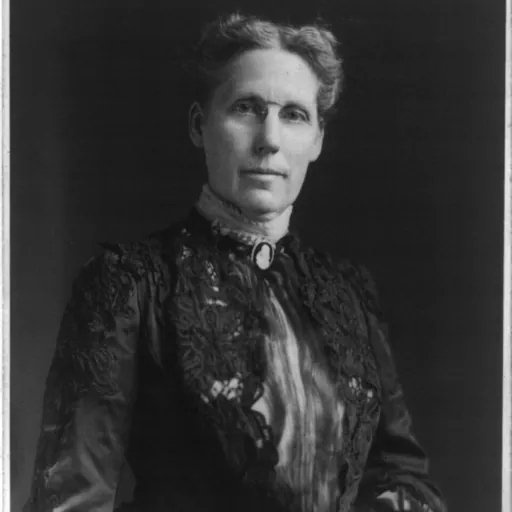
Lucretia Longshore Blankenburg
American suffragist, reformer
About Lucretia Longshore Blankenburg
Lived 1845 – 1937 (aged 91). Lucretia Longshore Blankenburg was an American biographer, autobiographer, writer and suffragist.
Lucretia Blankenburg ( Longshore; May 8, 1845 – March 28, 1937) was an American second-generation suffragist, social activist, civic reformer, and writer. During the period of 1892 until 1908, she served as president of the Pennsylvania Woman Suffrage Association.
Her husband, Rudolph Blankenburg, served as mayor of Philadelphia. Together, the Blankenburgs worked for the things that uplifted humanity, that made for cleaner politics, and for better citizenship. During his term, she aided the city in scores of ways, doing some of the routine speech-making for him. She took almost full charge handling his correspondence.
Blankenburg was one of the leading club women of the city. She served as vice-president of the National Education Association; president of the Pennsylvania State Suffrage Association, 1892; and first vice-president of the General Federation of Women's Clubs, 1912–1914. She was a member of the New Century Club, the Working Women's Guild, and the Civic Club. Blankenburg addressed the Pennsylvania General Assembly numerous times. She held four different meetings in the hall of the House of Representatives in behalf of laws for women, and spoke often in both House and Senate. She also spoke at Congress when her organizations had hearings on bills.
Early years and education Lucretia Longshore was born May 8, 1845, on a farm near New Lisbon, Ohio (now Lisbon, Ohio), her maternal grandfather, Samuel Myers, having settled there in 1833. Mark Hanna was born on the adjacent farm. Dr. Longshore was one of the women pioneers in the medical profession. Blankenburg was named for Lucretia Mott, a pioneer woman suffragist and a Friend; Lucretia Mott was Hannah Longshore's intimate friend.
In 1845, Blankenburg, age six-months-old, her parents, and her brother, Channing (born 1842; became a physician), removed to Attleboro, Pennsylvania (now Langhorne, Pennsylvania). Five years later, the family moved to Philadelphia so that Hannah could attend medical school. She was graduated in the first class of the Woman's Medical College of Pennsylvania. Hannah's sister, Dr. Anna M. Longshore-Potts, graduated in the same class.
Blankenburg attended the Friend's Central School in Philadelphia. She was shunned by her playmates, who pelted her with stones and sticks, refusing to admit her to any of their childish sports. They called her "The woman doctor's child", a term intended to convey as much reproach as that of "witch's daughter" in New England colonial days. After graduating from this school and the Bryant and Stratton Commercial College, she enrolled in the Woman's Medical College, but later withdrew after deciding that she did not want to pursue the study of medicine.
Career Before their wedding, 1867. Mrs. Julia A. Myers, Lucretia's aunt, is on the right. When she was a young girl, a German youth, age 22, Rudolph Blankenburg, came to Philadelphia with letters of introduction to her family. At once, he became a welcome visitor. When he had made a start in the new country, on April 18, 1867, Rudolph and Lucretia were married. Three daughters were born to the young couple; but none lived past childhood. After the grief following their death had softened, the Blankenburgs endeavored to fill the vacant place. They adopted a daughter.
Social activist and civic reformer After the Centennial Exposition in Philadelphia, 1876, the Blankenburgs began their public work. The exposition had called for assistance from all public-spirited citizens and there seemed much to be done when it ended. The Blankenburg business of manufacturing bedquilts, spreads and yarn was doing well, and its head, unlike the average money-maker, thought he could discern equally important duties elsewhere. Blankenburg began by joining a woman's club.
Women's clubs were few and the majority of those in existence were given over to literary and musical events and to the study of Shakespeare and Browning. A committee of the New Century Club, of which Blankenburg was a member and co-founder, interested themselves in starting night classes in instruction for working women, did not think of regarding their work as a civic movement. Blankenburg chaired the Committee on Education of the New Century Club. The beginning consisted of three or four classes held in the building of the New Century Club. Blankenburg had studied bookkeeping and she became the teacher in that department. She assisted in planning the cooking class, and for coordinating the financing for the adjunct organization, the New Century Guild, an organization composed of working women, to be fostered and helped by the parent association until it could stand alone.
In 1892, she was elected President of the Pennsylvania Woman Suffrage Association, which office she held until 1908.
Personal life
Despite the years given to public service, the Blankenburg business and the Blankenburg fortune increased. But there was little change in the home. The Quaker touch was plainly seen in its comfortable, unostentatious furnishings. Blankenburg managed her own household affairs, planned her dinners, cooked them herself, and made her own dresses. The household was not troubled by social ambitions.
Lucretia and Rudolph married on April 18, 1867, in a Quaker ceremony before then-mayor Morton McMichael. They moved to the home of Lucretia's parents, Mr. and Dr. Longshore, at 1326 Arch Street. On April 12, 1918, Rudolph died at the couple's home at 138 West Walnut Lane in the city's Germantown neighborhood.
In their time in the Longshore home on Arch Street, Lucretia and Rudolph had three children, all daughters, but none survived to adulthood. The first, Emma, died in infancy. The second, Marian, lived longer, and the third, Julia, died in her thirteenth year.
Blankenburg had been ill with pneumonia for three days before she died, March 28, 1937, in her apartment in the Bellevue-Stratford in Philadelphia. She was buried in the city's Fair Hill Burial Ground.
Selected works Pennsylvania law concerning women, 189? The Blankenburgs of Philadelphia, 1928 (biography of her husband; autobiography)
Don’t just read it —
keep it.
Full-length biographies made to live with: read them, listen on the way to work, watch them tonight.
- E-book
- Audio
- Video
Instant download · yours to keep · every purchase keeps this site free
Important facts
People in Lucretia Longshore Blankenburg's life
Named in this biography and alive at the same time

Related people
Same field, nearest in time


Contemporaries
People whose lives overlapped Lucretia Longshore Blankenburg's

Frequently asked questions
Who was Lucretia Longshore Blankenburg?
American suffragist, reformer (1845-1937)
When was Lucretia Longshore Blankenburg born?
Lucretia Longshore Blankenburg was born on 8 May 1845 in Lisbon.
When did Lucretia Longshore Blankenburg die?
Lucretia Longshore Blankenburg died on 29 March 1937 in Philadelphia.
What was Lucretia Longshore Blankenburg's occupation?
Lucretia Longshore Blankenburg was a biographer, autobiographer, writer and suffragist.
What nationality was Lucretia Longshore Blankenburg?
Lucretia Longshore Blankenburg was American.
Sources & further reading
· Wikipedia: Lucretia Longshore Blankenburg
· DBpedia: Lucretia Blankenburg
Cite this page
APA: Biography.guide. (2026). Lucretia Longshore Blankenburg. https://biography.guide/lucretia-longshore-blankenburg/
MLA: "Lucretia Longshore Blankenburg." Biography.guide, https://biography.guide/lucretia-longshore-blankenburg/.
Chicago: "Lucretia Longshore Blankenburg." Biography.guide. https://biography.guide/lucretia-longshore-blankenburg/.
Data last updated: 2026-09-21 · Spot an error? Report a correction.
Portrait: Wikimedia Commons · author & licence
Page generated 2026-09-27 05:00 UTC