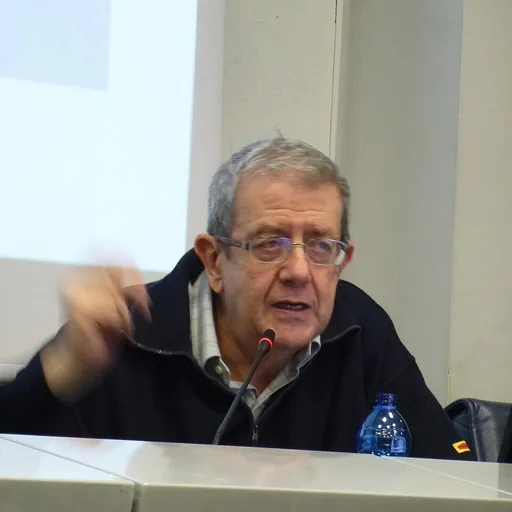
About Lucio Russo
Lived 1944 – 2025 (aged 80). Lucio Russo was an Italian physicist, mathematician, historian, university teacher and philologist.
Lucio Russo (22 November 1944 – 12 July 2025) was an Italian physicist, mathematician and historian of science. Born in Venice, he taught at the Mathematics Department of the University of Rome Tor Vergata. He died in Bologna on 12 July 2025, at the age of 80.
Among his main areas of interest were Gibbs measure of the Ising model, percolation theory, and finite Bernoulli schemes, within which he proved an approximate version of the classical Kolmogorov's zero–one law.
In the history of science, he reconstructed some contributions of the Hellenistic astronomer Hipparchus, through the analysis of his surviving works, and the proof of heliocentrism attributed by Plutarch to Seleucus of Seleucia and studied the history of theories of tides, from the Hellenistic to modern age.
Books
The Forgotten Revolution In The Forgotten Revolution: How Science Was Born in 300 BC and Why It Had to Be Reborn (Italian: La rivoluzione dimenticata), Russo promotes the belief that Hellenistic science in the period 320–144 BC reached heights not achieved by Classical age science, and proposes that it went further than ordinarily thought, in multiple fields not normally associated with ancient science.
According to Russo, Hellenistic scientists were not simply forerunners, but actually achieved scientific results of high importance, in the fields of "mathematics, solid and fluid mechanics, optics, astronomy, anatomy, physiology, scientific medicine", even psychoanalysis. They may have even discovered the inverse square law of gravitation (Russo's argument on this point hinges on well established, but seldom discussed, evidence). Hellenistic scientists, among them Euclid, Archimedes and Eratosthenes, developed an axiomatic and deductive way of argumentation. When this way of argumentation was dropped, the ability to understand the results were lost as well. Thus, Russo conjectures that the definitions of elementary geometric objects were introduced in Euclid's Elements by Heron of Alexandria, 400 years after the work was completed. The Forgotten Revolution has received mixed reviews, praising Russo's enthusiasm but noting that his conclusions outreach his sources.
L'America dimenticata In L'America dimenticata, Russo suggests that the Americas were known to some European civilizations in ancient times, probably discovered by the Phoenicians or the Carthaginians, but that the knowledge was lost under Roman expansion in the second century BC.
Russo notes paintings dating to the Roman period that, he claims, represent American fruits (Ananas), and small Mesoamerican toys representing wheeled trucks, when the wheel had not been invented nor used in pre-Columbian times.
With the collapse of the Hellenistic world under the attacks of the Romans around the middle of the 2nd century BC (specifically, the destruction of Corinth and Carthage in 146 BC and the expulsion of the scientific elite from Alexandria in 145 BC), he claims, these geographic notions were lost. According to his theories, Ptolemy's later identification of the Blessed Islands with the Canaries was incorrect. Instead, he claims that the Blessed Islands were known to be antipodal to the eastern part of China, and that Ptolemy made ends meet by erroneously enlarging the longitude of all known places, and shrinking the width of a degree of longitude (500 instead of 700 stadia).
Based on this correction, Lucio Russo claims to pinpoint the position of the mythical Thule, reached in the 4th century BC by explorer Pytheas, on the coast of Greenland. He interprets in light of this claim an obscure sentence of Pliny according to which Hipparchus would have enlarged the ecumene (the known world) by 26,000 stadia.
Don’t just read it —
keep it.
Full-length biographies made to live with: read them, listen on the way to work, watch them tonight.
- E-book
- Audio
- Video
Instant download · yours to keep · every purchase keeps this site free
Important facts
Related people
Same field, nearest in time


Contemporaries
People whose lives overlapped Lucio Russo's



Frequently asked questions
Who was Lucio Russo?
Italian historian and scientist
When was Lucio Russo born?
Lucio Russo was born on 22 November 1944 in Venice.
When did Lucio Russo die?
Lucio Russo died on 12 July 2025 in Bologna.
What was Lucio Russo's occupation?
Lucio Russo was a physicist, mathematician, historian, university teacher and philologist.
What nationality was Lucio Russo?
Lucio Russo was Italian.
Sources & further reading
Cite this page
APA: Biography.guide. (2026). Lucio Russo. https://biography.guide/lucio-russo/
MLA: "Lucio Russo." Biography.guide, https://biography.guide/lucio-russo/.
Chicago: "Lucio Russo." Biography.guide. https://biography.guide/lucio-russo/.
Data last updated: 2026-09-20 · Spot an error? Report a correction.
Portrait: Wikimedia Commons · author & licence
Page generated 2026-09-27 04:58 UTC