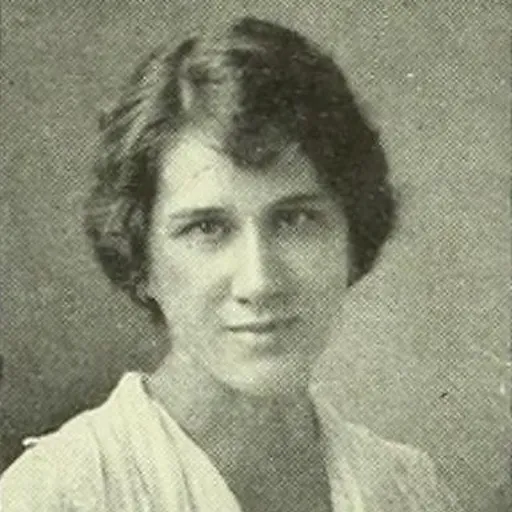
Lucile Marsh
American dance critic
About Lucile Marsh
Lived 1899 – 1982 (aged 82). Lucile Marsh was an American dance critic.
Lucile Marsh Murray (; November 13, 1899 – June 15, 1982) was an American dancer, writer, and businesswoman. Marsh trained as a dancer during the early days of the modern dance movement, and was active in the fields of dance criticism, dance education, and physical education. Marsh was one of the first full-time newspaper dance critics in the United States, writing for the New York World in the late 1920s. In her later life, Marsh was the editor of multiple dance publications and operated a custom shoe manufacturing company.
Early life and education Lucile Marsh was born on November 13, 1899, and grew up in Bridgeport, Connecticut. She attended high school in Bridgeport, graduating in 1916. Marsh studied dance at Barnard College in New York City, graduating in 1920. Following her graduation from Barnard, Marsh studied Dalcroze eurhythmics for a summer.
Dance writing and teaching Marsh regularly taught at the University of Georgia during summers in the 1920s, where her associates included future Atlanta Ballet founder Dorothy Alexander. Marsh's choreography at the University of Georgia was often presented outdoors, and was aesthetically inspired by both the classical architecture of the campus and the natural environment it existed within.
Throughout the mid-1920s, Marsh regularly advocated for New York newspapers to expand their coverage of dance. Marsh wrote regular letters to the editor to the city's newspapers, criticizing what she perceived as biases in newspaper music and dance criticism. Marsh's writing had little effect on the state of newspaper dance coverage until the fall of 1927, when three major New York newspapers appointed dance critics, potentially in response to a successful series of performances by the Denishawn company at Carnegie Hall. Marsh was hired by the New York World, and was a contemporary of John Martin at The New York Times and Mary Fitch Watkins at the New York Herald Tribune.
Marsh began writing a Sunday column on dance for the World in September 1927, which developed into a beat on the city's dance performances. Marsh's writing served as a resource for both the general public and the modern dance community, reflecting her status as both a dancer and a reporter. For the general public, Marsh's reviews offered analysis of the aesthetics and development of the rapidly changing dance landscape in New York. For the dance community, Marsh advocated for better coordination between dance companies, arguing that the then-small number of artists could better coordinate their performance schedules to avoid presenting competing performances on the same dates.
In 1936, Marsh and the National Dance League came into conflict with the Federal Dance Project, a division of the Works Progress Administration's Federal Theatre Project led by modern dancer Helen Tamiris. The National Dance League contended that the FDP employed amateurs in its productions, disadvantaging out-of-work professional dancers such as ballet dancers, ballroom dancers, and chorus girls.
Marsh was the editor of Dance Magazine in the 1940s, and continued writing about dance education, pedagogy, and hygiene.
Murray Space Shoe and later life
Marsh married Alan E. Murray, the inventor of the Murray Space Shoe, in 1943. Murray, a former professional ice skater, developed a concept for an ice skate molded for the wearer's feet in the 1930s. He refined the concept into a brand of custom-molded, side-laced neoprene shoes in a variety of styles, and began selling them commercially in Wilmington, Delaware in 1937. Their business expanded steadily, with a national network of dealers who took molds of customers' feet for manufacturing at a central factory. Marsh wrote the company's advertising copy, promoting the shoes as the cure to numerous ailments.
Marsh and Murray separated in 1965, following extended divorce proceedings that also included a dispute over control of the company. Both parties continued manufacturing the Space Shoe, Marsh at the Connecticut factory and Murray at a workshop in Long Island City. By 1968, Marsh's version of the Space Shoe was sold by 50 dealers across the country at $75 per pair. Murray's workshop also continued in operation, and was taken over by his longtime business associate and second wife Anna Veronika Murray after his death in 1978.
Marsh sold her Space Shoe business in 1979 to one of her company's dealers in California. The mother-and-son partnership moved the manufacturing to Mountain View and later to Guinda, California, and was still in business on a limited scale in 2016. Historian Mark Franko argues that this criticism was a clear political statement, writing in 2002 that "the charge of unprofessionalism thinly veiled the graver charge of political radicalism."
Selected works
Don’t just read it —
keep it.
Full-length biographies made to live with: read them, listen on the way to work, watch them tonight.
- E-book
- Audio
- Video
Instant download · yours to keep · every purchase keeps this site free
Important facts
People in Lucile Marsh's life
Named in this biography and alive at the same time





Related people
Same field, nearest in time




Contemporaries
People whose lives overlapped Lucile Marsh's

Frequently asked questions
Who was Lucile Marsh?
American dance critic (1899–1982)
When was Lucile Marsh born?
Lucile Marsh was born on 13 November 1899 in Connecticut.
When did Lucile Marsh die?
Lucile Marsh died on 15 June 1982 in Illinois.
What was Lucile Marsh's occupation?
Lucile Marsh was a dance critic.
What nationality was Lucile Marsh?
Lucile Marsh was American.
Sources & further reading
· DBpedia: Lucile Marsh Murray
Cite this page
APA: Biography.guide. (2026). Lucile Marsh. https://biography.guide/lucile-marsh/
MLA: "Lucile Marsh." Biography.guide, https://biography.guide/lucile-marsh/.
Chicago: "Lucile Marsh." Biography.guide. https://biography.guide/lucile-marsh/.
Data last updated: 2026-09-21 · Spot an error? Report a correction.
Portrait: Wikimedia Commons · author & licence
Page generated 2026-09-27 04:58 UTC