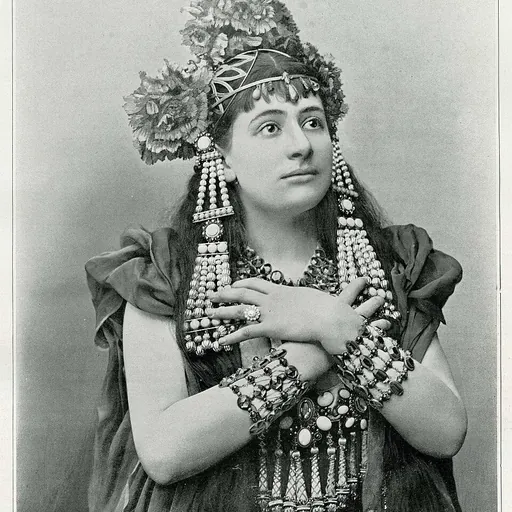
About Lucienne Bréval
Lived 1869 – 1935 (aged 65). Lucienne Bréval was a French and Swiss opera singer.
Lucienne Bréval (4 November 1869 – 15 August 1935) was a Swiss dramatic soprano who had a major international opera career from 1892 to 1918. Although she appeared throughout Europe and in the United States, Bréval spent most of her career performing with the Paris Opera where she became a greatly admired interpreter of French grand opera roles and Wagner heroines. She also specialized in the works of Gluck and Rameau, becoming particularly associated with the title roles in Gluck’s Armide and Rameau's Hippolyte et Aricie. A favorite of the composers of her day, such as Massenet and Dukas, Bréval sang in numerous world premières during her career.
Biography Born with the name Bertha Agnès Lisette Schilling, Bréval initially studied to be a pianist at Lausanne and briefly in Geneva before deciding to pursue an opera career. She studied voice with Victor Warot at the Paris Conservatoire before making her debut at the Paris Opera in 1892 as Selika in l'Africaine by Giacomo Meyerbeer.
At the Paris Opéra Bréval became a principal soprano at the Paris Opéra and remained there until 1919. Her roles with the company included several world premières including Augusta Holmès's La Montagne Noire (1895), Camille Erlanger's Le fils de l' étoile (1904), Dukas’ Ariane et Barbe-bleue (1907), Massenet's Bacchus (1909), and the title roles in Massenet's Ariane (1906) and Henry Février’s Monna Vanna (1909). She also was Kundry in France's first performance of Wagner's Parsifal (1914). Her other notable roles at the Paris Opera included Brünnhilde in Richard Wagner's Die Walküre (1893), Venus in Wagner's Tannhäuser (1895), Marguerite in Hector Berlioz's La damnation de Faust (1897), and the title role in Rameau's Hippolyte et Aricie (1908). Two years later she made her American début at the Metropolitan Opera as Chimène in Le Cid, singing also in Die Walküre and the American première of Ernest Reyer’s Salammbô. Five years later she returned to Covent Garden for the second and last time in the title role of Gluck’s Armide. In 1913 she created the title role in Fauré’s Pénélope at the Opéra de Monte-Carlo; her other title roles there had been in Isidore De Lara's Amy Robsart and in Bizet's Carmen.
Throughout her career Bréval appeared in recitals and concerts throughout Europe, including performances in Italy, England, Germany, Holland, Belgium, Switzerland and throughout France. In spite of her great reputation in Europe she was not as well received in America as critics believed her singing lacked polish and described her acting as "semaphoric". After her retirement from the stage in 1919, Bréval taught singing in Paris.
Recordings The only sound recording of Bréval singing was made on a Mapleson cylinder during a performance of L’Africaine at the Metropolitan Opera.
Don’t just read it —
keep it.
Full-length biographies made to live with: read them, listen on the way to work, watch them tonight.
- E-book
- Audio
- Video
Instant download · yours to keep · every purchase keeps this site free
Important facts
People in Lucienne Bréval's life
Named in this biography and alive at the same time

Related people
Same field, nearest in time


Contemporaries
People whose lives overlapped Lucienne Bréval's




Frequently asked questions
Who was Lucienne Bréval?
Swiss dramatic soprano, later French naturalized (1869–1935)
When was Lucienne Bréval born?
Lucienne Bréval was born on 4 November 1869 in Berlin.
When did Lucienne Bréval die?
Lucienne Bréval died on 15 August 1935 in Neuilly-sur-Seine.
What was Lucienne Bréval's occupation?
Lucienne Bréval was an opera singer.
What nationality was Lucienne Bréval?
Lucienne Bréval was French and Swiss.
Sources & further reading
Cite this page
APA: Biography.guide. (2026). Lucienne Bréval. https://biography.guide/lucienne-breval/
MLA: "Lucienne Bréval." Biography.guide, https://biography.guide/lucienne-breval/.
Chicago: "Lucienne Bréval." Biography.guide. https://biography.guide/lucienne-breval/.
Data last updated: 2026-09-22 · Spot an error? Report a correction.
Portrait: Wikimedia Commons · author & licence
Page generated 2026-09-27 05:03 UTC