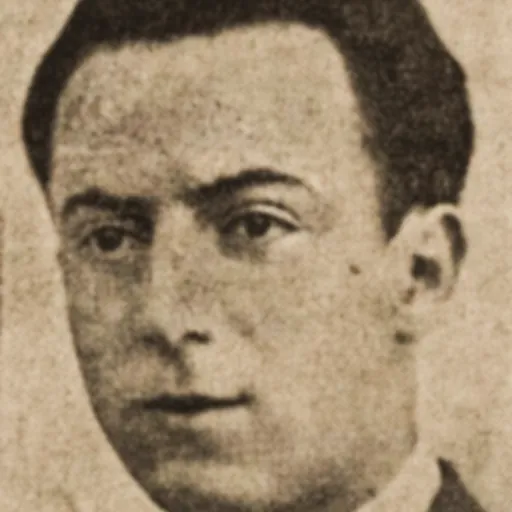
About Lucian Boz
Lived 1908 – 2003 (aged 94). Lucian Boz was a Romanian and Australian journalist, literary critic, biographer, translator, resistance fighter and writer.
Lucian Boz (; also rendered as Lucien Boz; November 9, 1908 – March 14, 2003) was a Romanian literary critic, essayist, novelist, poet and translator. Raised in Bucharest, he had a lawyer's training but never practiced, instead opting for a career in journalism and literary criticism. An active participant in the 1930s cultural scene, he theorized an empathetic and "enthusiastic" approach to literature, which was in tune with the avant-garde tendencies of his lifetime. After a stint editing the review Ulise in 1932–1933, he became a contributor to more major newspapers, including Adevărul, Cuvântul Liber, and Vremea; he was also for a while an editorial secretary at Ion Vinea's Contimporanul.
Earning attention for his critical treatment of authors from Mihai Eminescu to Urmuz, Boz was singled out on the literary scene for his Jewish origins. His Romanian career was cut short with the advent of a censorious authoritarian and antisemitic government in 1937. Moving to Paris, he graduated from the École pratique des hautes études and settled into journalistic work, but was displaced by the German occupation. Upon this, Boz joined the French Resistance and was then interned at Drancy. His plight drew the attention of a fellow Romanian exile, Emil Cioran, who networked on his behalf; Boz was subsequently freed, becoming one of very few Jews to escape alive.
Resuming his reporter's activity, and contributing to Le Monde, Boz divided his time between France and Romania from 1944 to 1947, debuting as an autofictional novelist and translating from Jean Bruller. Though initially tolerated by the Romanian Communist Party, he never returned to his native country after a Communist regime was fully established. After a few more years in France, he left for Australia in 1951, and worked for a while as a welder. He was eventually hired by Air France to head its local office, and Boz's literary activity abated until his retirement in 1974. Afterwards, he republished some of his old work in photocopy and contributed to Romanian cultural activities in his adopted country. Never a declared opponent of the regime, his work was nonetheless unwelcome in Communist Romania, and had to wait until after the 1989 Revolution to regain critical favor. During the 1990s and until soon before his death, Boz contributed material to a Romanian magazine. In 2000, his short roman à clef, dealing with the war years, was printed as his last major contribution.
Early life and career Originally from Hârlău, Iași County, Boz was born to Jewish parents Mendel, later wounded and decorated in World War I, and Clara (née Sapina). Clara also gave birth to Lucian's elder brother, Marcel, who worked as a physician in France; close relatives included Marcela, wife of novelist Ury Benador. The Bozes moved to the national capital Bucharest in 1909, where Lucian attended Gheorghe Lazăr High School. He then enrolled in the Law faculty of the University of Bucharest, where his professors included Istrate Micescu, Constantin C. Stoicescu, and Vintilă Dongoroz. He graduated in 1934 but never practiced, instead entering a career in the press and in literary criticism. As he himself noted, he then used this text as a reference to be hired by Ion Vinea at Facla. Vinea preferred to have him work for the literary magazine, Contimporanul, though Facla also carried Boz's literary chronicles. With Ludo and Benador, he also attended a Jewish literary salon at Slova printing house, where he recalled running into Barbu Lăzăreanu, Theodor Loewenstein-Lavi, and Henric Streitman.
Boz was a noted promoter of literary modernism, and, according to scholar Paul Cernat, "the only enthusiastic supporter of the homegrown avant-garde". In Contimporanul, he introduced Romanians to the work of James Joyce. It is seen by Cernat as his "most important" piece of commentary, even though (as noted by Arleen Ionescu) his reading of Ulysses contains "errors of interpretation" which "today [...] appear hilarious." In March 1930, in Facla, he published the only interview ever granted by Constantin Brâncuși, then on a visit to Bucharest. At Zodiac, a literary sheet put out by I. Peltz, Boz wrote similar reviews of literary works by Vinea and Hortensia Papadat-Bengescu. In 1931, Adevărul daily hosted his homage to Tristan Tzara.
Alongside Em. Ungher, Boz edited his own publication, the avant-garde magazine Ulise, which appeared in four numbers in 1932–1933. Largely a continuation of Contimporanul, it grouped around it an eclectic circle, comprising Ionesco, Uranus, alongside Arșavir Acterian, Dan Botta, Emil Botta, Marcel Bresliska, Barbu Brezianu, Petru Comarnescu, Virgil Gheorghiu, Anton Holban, Eugen Jebeleanu, Alexandru Robot, Horia Stamatu, Simion Stolnicu, Octav Șuluțiu, and writer-cartoonist Neagu Rădulescu. In 1933, Boz became editor at Adevărul and Dimineața, as well as at the weekly Cuvântul Liber.
Boz's 1932 essay on Mihai Eminescu (Eminescu. Încercare critică), originally printed in Capricorn, drew lavish praise from George Călinescu. Other contemporary critics who appreciated his work included Lovinescu, Ionesco, Perpessicius, Pompiliu Constantinescu, Among later reviewers, Sergiu Ailenei notes that Boz's attempt to describe Eminescu by means of national psychology was "far-fetched". In nationalist and traditionalist circles, the work was panned as offensive and anomalous. C. Vrăbete of Neamul Românesc saw it comprising "the most fantastic aberrations" and "monstrosities", for being "fed on German theories", and for suggesting that the Romanians were contemplative and had "Slavic blood". Boz, he noted, "seems not to be a Romanian, and not to have any links with the aspirations of our people".
Before 1935, Boz was a columnist at Vremea, where he covered the modern literature of France. He followed up on his writing with Cartea cu poeți ("The Book of Poets"), published in 1935. Displaying "extreme eclecticism", it included essays about 31 contemporary Romanian poets, nearly all of whom entered the literary canon. His essays often focused on finding international connections for Romanian particulars, for instance tracing links between Vinea and Frank Wedekind; Tudor Arghezi, Urmuz, and Ramón Gómez de la Serna or François Villon; Geo Bogza and the Marquis de Sade. In later decades, Boz was reviewed with reserve. In 1941, revising his early stance, Călinescu suggested that Boz's "visionary enthusiasm" was "an aberration", since it impaired the selection of values. He found Boz to be an "intelligent" writer, but one of "unthinking generosity". However, he also described Ulise as the more mature of Romania's avant-garde papers. Cernat takes the middle ground, describing Boz as "second-rate", "prolix" and "rather invertebrate", but "sometimes surprisingly intuitive". His opposition to mainstream literary theory, Cernat notes, is suited to the avant-garde requirements, surpassing Călinescu's own limits. Boz, he concludes, "is worth rereading."
In wartime France Boz opposed the rise of fascism, and, in a 1937 interview with Azi, spoke out against its attempts to threaten and silence Jewish authors. In June of that year, the literary critic and Iron Guard affiliate Mircea Streinul described Boz, Andrei Tudor and Oscar Lemnaru as "little kikes" (jidănași) who actively promoted pornographic writing. After Dimineața and Adevărul were suppressed by the National Christian government in December 1937, he left for Paris. There, he took courses at the École pratique des hautes études. He took part in public conferences and attended lectures by Jacques Maritain, Gabriel Péri and Dolores Ibárruri, also joining PEN International. He met Benjamin Fondane and Ilarie Voronca. Boz also sent diplomatic reports for United Press. In order to make ends meet, he worked for French newspapers as well, including Le Petit Parisien, Excelsior and Dimanche Illustrée. In 1943, the Gestapo arrested him and his wife, sending them to the Drancy internment camp. While there, the only one of their friends from hunger-stricken Paris who brought them food was Emil Cioran, the Romanian philosopher. and had poetry published in the Communist Youth journal, Scînteia Tineretului, while also working as an editor at Finanțe și Industrie daily and a correspondent of the Romanian Press Information Agency (ARIP). It is equal parts memoir, historical account, and a reportage with colorful detail. The first part deals with the Paris of 1938–1940, up through the Battle of France and the beginnings of the Resistance. In the second part, which begins with Operation Torch, he describes his arrest, with a chapter on his wife's detainment written by her. He supplies descriptions of French people on both sides of the conflict and ends with the Liberation of 1944. Boz also translated Jean Bruller's Le Silence de la mer, in his introduction discussing the choice between resistance and collaboration faced by wartime French writers.
In March 1946, he returned to Paris as a correspondent for the revived Adevărul, and for the dailies Finanțe și Industrie and L'Information Internationale, which would become an English-language weekly. At the same time, he occasionally wrote pieces for Le Monde and sent reports to Scandinavian papers. In 1947, Le Monde sent him on assignment to the famine-stricken areas of Romania; this would be his last visit to his native country. Because the Romanian newspapers who employed him disappeared with the advent of the Communist regime and his work for French newspapers and radio was only sporadic, he took a job at a Paris business. First stopping in Canberra, Boz took on blue-collar jobs to support himself. He began as a factory welder, having taken a course on arc welding in France, but changed jobs after suffering an accident. He was a member of the Australian Journalists Association, and the newspapers that featured his work included The Daily Telegraph, The Sydney Morning Herald and The Australian. In 1958, he was made a knight of the Ordre du Mérite Commercial, while in 1979, he was conferred a knighthood in the National Order of Merit. Boz himself sent Anii literari '30 to literary colleagues in Communist Romania. He recalled having received positive messages from Ștefan Cazimir, Ovid Crohmălniceanu, Silvian Iosifescu, and Mircea Zaciu, but no reply at all from an older friend, Șerban Cioculescu. He also sent letters to his Romanian friends, both inside the country and in the anticommunist diaspora. Among the cultural figures with whom he carried on a correspondence were Cioran, Ionesco, Constantin Noica, Anton Dumitriu, and Nicolae Steinhardt. Noica at one point marveled at how good Boz's Romanian still was.
In the late 1970s, Boz maintained a correspondence with Loewenstein-Lavi, by then a political exile, airing his various grievances against the previous decades of "communist terror". He attempted to familiarize himself with communist texts by Ludo, Benador and Sandu Lieblich, but concluded that these were in fact illegible. Although he never criticized national communism, and even privately only did so in 1992, in a letter to Arșavir Acterian (calling the Danube–Black Sea Canal "an ill-fated undertaking of the demented Ceaușescu"), publication of his work was still blocked by the authorities, who considered him a political émigré. Constantin Trandafir was similarly dismissive: in a 1983 discussion about the prejudice of academic criticism, he suggested that any "study" ever produced by Boz was inferior to any regular newspaper column by his contemporary, Perpessicius.
In the 1980s, Boz made photocopies of some of his interwar work, sending them to friends and acquaintances. Asked by Ionel Jianu to supply details about Romanian artists living in Australia, Boz submitted information about four of them, all of whom appeared in Jianu's subsequent 1986 volume, Les artistes roumains en Occident. In private correspondence, he was particularly indignant about Lucian Pintilie's film The Oak, lamenting its presentation of Romania as "a kind of barbarian, brutal, violent state".
Don’t just read it —
keep it.
Full-length biographies made to live with: read them, listen on the way to work, watch them tonight.
- E-book
- Audio
- Video
Instant download · yours to keep · every purchase keeps this site free
Important facts
People in Lucian Boz's life
Named in this biography and alive at the same time



Related people
Same field, nearest in time




Contemporaries
People whose lives overlapped Lucian Boz's

Frequently asked questions
Who was Lucian Boz?
Romanian journalist (1908-2003)
When was Lucian Boz born?
Lucian Boz was born on 9 November 1908 in Hârlău.
When did Lucian Boz die?
Lucian Boz died on 14 March 2003 in Sydney.
What was Lucian Boz's occupation?
Lucian Boz was a journalist, literary critic, biographer, translator, resistance fighter and writer.
What nationality was Lucian Boz?
Lucian Boz was Romanian and Australian.
Sources & further reading
Cite this page
APA: Biography.guide. (2026). Lucian Boz. https://biography.guide/lucian-boz/
MLA: "Lucian Boz." Biography.guide, https://biography.guide/lucian-boz/.
Chicago: "Lucian Boz." Biography.guide. https://biography.guide/lucian-boz/.
Data last updated: 2026-09-20 · Spot an error? Report a correction.
Page generated 2026-09-27 05:10 UTC