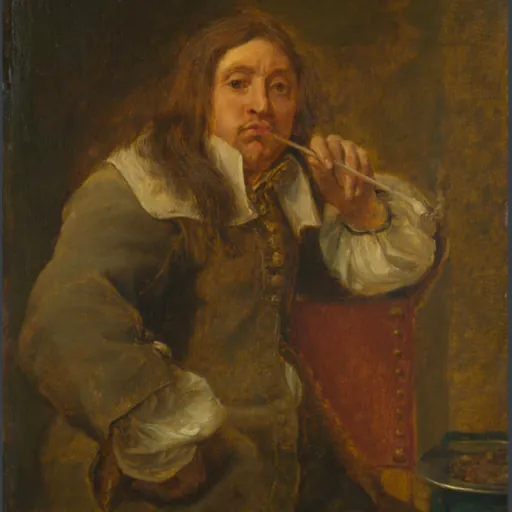
About Lucas Faydherbe
Lived 1617 – 1697 (aged 80). Lucas Faydherbe was a Belgian sculptor and architect.
Lucas Faydherbe (also spelled Lucas Faijdherbe; he signed as Lucas Fayd'herbe; 19 January 1617 – 31 December 1697) was a Flemish architect and sculptor who played a major role in the development of the High Baroque in the Southern Netherlands.
Life Born in Mechelen, Lucas Faydherbe was the first son of Hendrik Faydherbe and his second wife Cornelia Franchoys. His mother came from an artist family: her father was the successful painter Lucas Franchoys the Elder and her brothers Lucas and Peter were also accomplished painters. His father's sister Maria Faydherbe was recognised as a talented sculptor. Faydherbe's father ran a workshop for decorative sculpture and alabaster carving. Here Lucas learned the basics of sculpture. His father died when Lucas was twelve years old. His mother remarried with the sculptor Maximilian Labbé a year later. Lucas continued his training under Labbé.
When he was nineteen years old he was accepted as an apprentice in the workshop of Peter Paul Rubens in Antwerp, an enormous privilege given the hundreds of applicants for a limited number of places. After three years, he unexpectedly left Rubens' workshop to marry Maria Snyers who was expecting his child. He was also forced to abandon his plans to travel to Italy. Faydherbe returned to his hometown Mechelen where, thanks to the intercession of Rubens, he was quickly accepted as a master in the local Guild of St. Luke. Based in Mechelen, he also worked in Brussels, Antwerp and Oudenaarde. Tomb of Archbishop Andreas Creusen, St. Rumbold's Cathedral, Mechelen, 1660
His family expanded to twelve children. His son Jan-Lucas became a sculptor like his father and assisted him on various commissions. His daughther Anna Barbara married on 24 June 1666 the Brussels sculptor Jan van Delen. Problems with the local Guild of St. Luke turned him into one of the most ardent advocates of the establishment of an art academy in Mechelen, following the example of Brussels and Antwerp. His attempts were, however, not successful.
Faydherbe often collaborated with other sculptors in the execution of large-scale religious projects. For instance on the various projects he undertook in the St Rumbold's Cathedral in Mechelen, Rombaut Pauwels assisted him on the funeral monument of Archbishop Andreas Creusen (1660) and an altar (1660–1665) and Mattheus van Beveren assisted him with the painted wood and stone main altar.
Faydherbe's wife died in 1693, and he himself three years after that.
Work Sculpture Faydherbe started his career at a crucial moment in the history of Flemish sculpture. In the first place, there was the religious context. The churches in Flanders had been emptied of their decorations by the iconoclasts in the 16th century and the Roman Catholic Contrareformation demanded that artists created paintings and sculptures in church contexts that would speak to the illiterate rather than to the well-informed. The Contrareformation stressed certain points of religious doctrine, as a result of which certain church furniture, such as the confessional gained an increased importance. These developments caused a sharp increase in the demand for religious sculpture. Secondly, the sculptors Jérôme Duquesnoy the Younger and Artus Quellinus the Elder who had worked in Rome in the workshop of François Duquesnoy had returned to work in Flanders in the 1640s and realized many projects that introduced the classicizing Baroque style developed by François Duquesnoy. They revolutionized the role of the sculptor from that of an ornamentalist to that of an independent creator of art works that replaced the individual architectural elements by an artwork that united sculpture and painting into an harmonic ensemble. Rubens, the leading Baroque painter in Flanders, also subscribed to the idea of the unity of the arts of sculpture and painting and this is the reason of his association with sculptors such as Johannes van Mildert, Georg Petel and Faydherbe. Funeral monument of archbishop Andreas Creusen, St. Rumbold's Cathedral, Mechelen Thanks to his training under Rubens, Faydherbe had learned to assimilate and translate Rubens' style into sculpture.
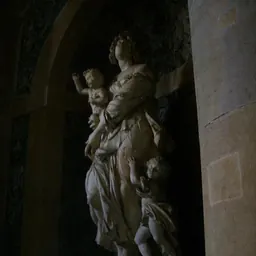
Faydherbe's early work following his return to Mechelen in 1640 showed a strong influence from Rubens. During this early period he created some large sculptures for churches in Mechelen and Brussels. The statues are characterized by a somewhat solemn monumentality: heavy draperies with a few but large folds that completely hide the body, with little detail and almost no differentiation in the representation of the different substances. A typical example is the statue of St. Andrew in Brussels Cathedral.
Altars Between 1648 and 1654 Faydherbe was commissioned to build eight baroque altars and in the 1660s and 1680s he received five more commissions. The altars show an evolution that is fully in line with the development of his sculpture: an increasing austerity, simpler verticality, a clearer and more geometric language and a reduced use of capricious, spiral decorative elements. The tombs demonstrate the ability of Faydherbe to create realistic and precise portraits.
Terracottas Faydherbe's oeuvre includes a number of terracotta pieces comprising eight busts of mythological figures, one portrait bust of Gaspar de Crayer (now in the Rijksmuseum), reliefs depicting mythological scenes and two sculpture groups with putti on dolphins.
Faydherbe remained in his architectural design, as in his sculpture, faithful to the prevailing Baroque rather than follow the trend towards classicism that arose later in the century.
Churches The two principal architectural designs realized by Faydherbe in Mechelen are the churches of Leliëndaal and Hanswijk.
Church of Our Lady of Leliendaal Faydherbe took on the design of the Church of Our Lady of Leliendaal in 1662. It was the first major design commission that he undertook by himself. The design provided for simple solid masonry for the exterior walls, built with brick with bands of white stone. Only the façade on the east side was to have any decoration in the form of figurative sculpture and architectural elements.
The construction work ran into various problems and there were multiple disputes with the client over quality and design issues. This latent conflict reached its peak in May 1664, when it was determined that the facade was slanted. Although the architect formulated various proposals to camouflage this, the client ordered the immediate demolition. The rising costs and the mutual distrust caused delays in the work, so that the construction of the church ultimately lasted five years longer than expected. Despite his lack of technical and financial insight Lucas Faydherbe had managed to create a new architectural language in this church which strongly contrasted with the contemporary, "bombastic" Baroque.
Notable works
Sculpture Funeral monument of archbishop Andreas Creusen in the St. Rumbold's Cathedral, Mechelen Main altar of St. Rumbold's Cathedral, Mechelen Main altar of the Church of the Ascension of Our Lady, Watervliet, East Flanders Mater Dolorosa in the burial chapel of Rubens in the St. James' Church, Antwerp
Architecture Basilica of Our Lady of Hanswijk, Mechelen, a blend of the circular, centrally planned church with a longitudinal nave Church of Our Lady of Leliendaal, Mechelen Church of Our Lady of the Rich Clares (Notre-Dame of the Rich Clares), Brussels St. Ursula Chapel, in the Church of Our Lady of Victories at the Sablon, Brussels Church of St. John the Baptist at the Béguinage, Brussels (attributed)
Don’t just read it —
keep it.
Full-length biographies made to live with: read them, listen on the way to work, watch them tonight.
- E-book
- Audio
- Video
Instant download · yours to keep · every purchase keeps this site free
Important facts
more
Lucas Fayd'herbe, Luc Fiderbe, Lucas Faid'herbePeople in Lucas Faydherbe's life
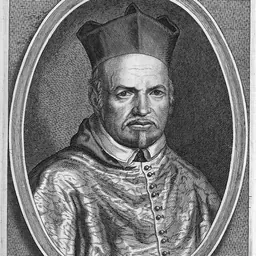
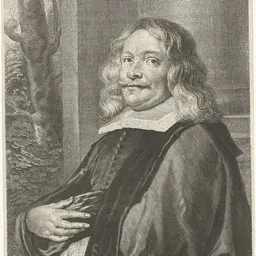
Named in this biography and alive at the same time





Related people
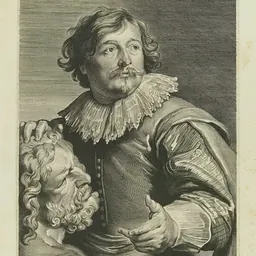
Same field, nearest in time


Contemporaries
People whose lives overlapped Lucas Faydherbe's




Frequently asked questions
Who was Lucas Faydherbe?
Flemish sculptor and architect (1617–1697)
When was Lucas Faydherbe born?
Lucas Faydherbe was born on 19 January 1617 in Mechelen.
When did Lucas Faydherbe die?
Lucas Faydherbe died on 31 December 1697 in Mechelen.
What was Lucas Faydherbe's occupation?
Lucas Faydherbe was a sculptor and architect.
What nationality was Lucas Faydherbe?
Lucas Faydherbe was Belgian.
Sources & further reading
Cite this page
APA: Biography.guide. (2026). Lucas Faydherbe. https://biography.guide/lucas-faydherbe/
MLA: "Lucas Faydherbe." Biography.guide, https://biography.guide/lucas-faydherbe/.
Chicago: "Lucas Faydherbe." Biography.guide. https://biography.guide/lucas-faydherbe/.
Data last updated: 2026-09-21 · Spot an error? Report a correction.
Portrait: Wikimedia Commons · author & licence
Page generated 2026-09-27 05:00 UTC