
About Luca Fancelli
Lived 1430 – 1502 (aged 71–72). Luca Fancelli was an Italian architect and sculptor.
Luca Fancelli (c. 1430 – c. 1502) was an Italian architect and sculptor.
Biography Corte Ghirardina, Motteggiana, constructed by Luca Fancelli. The Torre dell'Orologio of the Palazzo della Ragione, Mantua, constructed by Luca Fancelli in 1473. Fancelli was born in Settignano, a fraction of Florence. Much of his life and work is an enigma; what is known for sure is that he trained as a stonecutter and mason and studied under Brunelleschi.
Giorgio Vasari, the 16th-century Florentine artist and biographer of the artists, is responsible for many doubts pertaining to the authenticity of works attributed to Fancelli. While Fancelli likely designed the Palazzo Pitti, the Florentine residence of the Medici's friend, and supposed rival, Luca Pitti; Vasari attributes the design to Brunelleschi, who had died several years before work began. The palazzo is not in Brunelleschi's style, and considered by many to be by a lesser hand. Fancelli has also been credited also with the design of the tribune of SS. Annunziata in Florence, but this too is disputed.
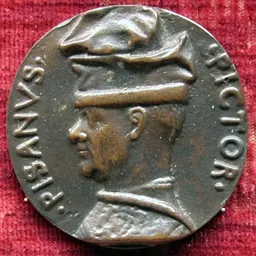
In 1450 Fancelli moved to Mantua, where he was employed in the court of Marquis Ludovico III. Mantua under the Gonzagas was artistic center, employing Pisanello, Mantegna, Perugino, Correggio, Leon Battista Alberti, Giulio Romano, and Rubens.
At Mantua, Fancelli became clerk of works and supervisory architect for the churches of San Sebastiano (1460), and Sant'Andrea (1472) while the plans for both churches were drawn by Alberti himself, Fancelli's input was large, especially at the church of Sant'Andrea, which was begun only shortly before Alberti's death.
The Marquess of Mantua Federico I began work on a new royal palace in the city, and Fancelli received the commission to design a complex of rooms for new palace centred on its clock tower, this wing known as the Domus Nova ("New House"). Fancelli worked on from 1478 to 1484, but the palace itself remained incomplete until the 17th century.
The final years of Fancelli's life are characteristically enigmatic; he disappears from all written references from 1494.
Don’t just read it —
keep it.
Full-length biographies made to live with: read them, listen on the way to work, watch them tonight.
- E-book
- Audio
- Video
Instant download · yours to keep · every purchase keeps this site free
Important facts
People in Luca Fancelli's life
Named in this biography and alive at the same time

Related people
Same field, nearest in time


Contemporaries
People whose lives overlapped Luca Fancelli's
Frequently asked questions
Who was Luca Fancelli?
Italian architect (1430-1502)
When was Luca Fancelli born?
Luca Fancelli was born in 1430 in Settignano.
When did Luca Fancelli die?
Luca Fancelli died in 1502 in Florence.
What was Luca Fancelli's occupation?
Luca Fancelli was an architect and sculptor.
What nationality was Luca Fancelli?
Luca Fancelli was Italian.
Sources & further reading
Cite this page
APA: Biography.guide. (2026). Luca Fancelli. https://biography.guide/luca-fancelli/
MLA: "Luca Fancelli." Biography.guide, https://biography.guide/luca-fancelli/.
Chicago: "Luca Fancelli." Biography.guide. https://biography.guide/luca-fancelli/.
Data last updated: 2026-09-20 · Spot an error? Report a correction.
Page generated 2026-09-27 05:04 UTC