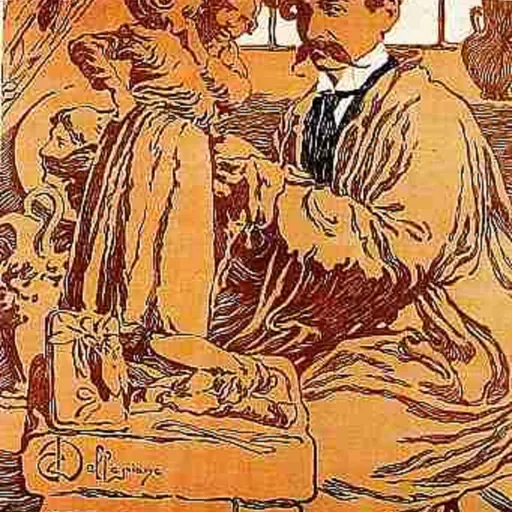
About Louis Sicard
Lived 1871 – 1946 (aged 75). Louis Sicard was a French ceramicist, sculptor, writer and poet.
Louis Sicard was a French ceramist, sculptor and writer, born in Aubagne on January 21, 1871, and died in the same town on June 26, 1946.
A member of the Félibréen movement, he is famous for having created the first earthenware cicada in 1895. He is renowned for his technical knowledge of kiln operation and clay preparation. For many years, he taught modeling and throwing at the Aubagne boys' school (1901–1943) and at the École des Beaux-Arts in Marseille (1924–1943). On several occasions, he lost lawsuits brought against his competitors to protect his cicada models. His two sons, Georges (1904–1989) and Théo (1911–1970) took over his studio on his death. His sister, Thérèse Neveu, was a renowned Provencal santon-maker.
The beginnings Louis Marius Sicard was born on January 21, 1871, in Aubagne, in the workshop of his father, Léon Sicard (1826-circa 1900), who spent most of his working life as a crucible maker. Louis Sicard learned to wheel in 1883, using his father's ceramic techniques. He quickly made a name for himself as a talented turner. Depending on the version, the potter or a comrade would then have remarked: "At twenty francs an eye, if you had plugged them both, they would have given you forty francs". In 1912, he was commissioned to study the Dieulefit clay deposits and investigate the causes of the area's inferior ceramic production. He perfected a clay mix that produced more refractory, less porous pottery, and developed a lead-free glaze to replace alquifoux, a lead sulfide dangerous to workers and consumers alike. By the end of his training, Louis Sicard had already produced several subjects inspired by the Italian Renaissance, as well as a number of commissioned portraits of regional socialites and national figures. The poet Elzéar Rougier described his working methods while the ceramist was working for Atelier Aubert in Aubagne: "Louis Sicard then showed me his clay portraits, which were one of his specialties. Françoise-Albane Beudon notes of this poster: "Louis Sicard is captured in the clutter of his studio, modeling a water carrier with his fingers. On the wall, some of the pieces he excelled at: tambourines, cicadas and medallions.
On his own, the ceramic artist also developed his writing and acting skills. Noted for his storytelling talents, he wrote regularly for the Marseilles Provençal newspaper La Sartan under various pseudonyms or under his real name (150 papers). On a wall in the Aubert workshop in Aubagne, where he worked as a freelancer in the early 1900s, Louis Sicard wrote a couplet that was noticed by Provençal historian, poet and playwright Elzéar Rougier:
L'argiélo es dins lei man de l'ome Ce que l'ome es dins lei man de Dieù (in Occitan). From 1924 to 1943, he was appointed to teach ceramics at the École des Beaux-Arts in Marseille.
His technical and artistic knowledge, his contacts with the art world, his literary output, his membership of the Félibréen movement, the gifts he gave to and visits from celebrities all helped build and enhance his reputation. He knew the actor Raimu – who bought him a table set – the playwright Edmond Rostand, the Provençal historian Marcel Provence, the inventor and patron Dominique Piazza... He acquired the factory in 1926 and set up a Private limited company with his children. Other workers came on a more or less regular basis, depending on requirements and their specialties.
The manufacturing process The production techniques used in the workshop were described by journalist Jean Bazal in a special issue of the November 1941 issue of Sciences et Voyages, who noted that the production process had not changed, and was able to observe the preparation of the paste obtained from red or white clay, Calcium carbonate, dolomite and silica. The resulting clay blocks were dried in plaster buckets, then pressed between large plaster disks, as this material absorbs moisture.
Ceramic production Production at Louis Sicard's workshop was extremely rich. In addition to earthenware portraits, santons were produced in high-fired tin-glazed earthenware, some of them designed by Thérèse Neveu, as well as promotional items such as objects featuring a cicada, a variation on the theme of Mirèio carrying a basket of figs offered by La Figatine liqueur to its concessionaires, and commemorative objects such as portraits of Tsar Nicholas II and his wife to mark the conclusion of the Franco-Russian alliance in 1892. The ceramist quickly developed the insect figure into a wide range of objects: cigale porte-bouquet, vase, plate, ashtray, marmite, bonbonnière with cicada, etc. From 1921 onwards, Louis Sicard filed several of his designs with the clerk's office of the Tribunal de Prud'Homme for registration. These registrations, which were filed much later than the invention of the motif, were cancelled each time. Naturally, the further away from Aubagne, the less accurate the likelihood of cicadas became.
Posterity alt=Black and white photograph of the interior of a workshop with three people at work. Louis Sicard with his two sons, Théo and Georges, at l'Usine, postcard from the 1930s. During World War II, Louis Sicard suffered from left-sided hemiplegia, which made it difficult for him to practice his art. He died on June 28, 1946, shortly before his sister Thérèse Neveu, a renowned Provencal santon maker.
Théo (1911–1970), the youngest son, followed in his father's footsteps in the family workshop, which he took over on his death. He was a talented turner, a highly skilled technician and an excellent decorator. Christian (1930–1993), son of Georges and grandson of Louis, became a decorator at the Usine. His interest in design led him to develop personal products such as farandoles and cloisonné dishes, following in his uncle's footsteps.
Nearly 900 works produced by the Sicard workshop between 1895 and 1972 were presented at an exhibition, Un Été de Faïence : l'atelier Sicard 1895–1972, held in Aubagne from July 6 to September 9, 2012. An exhibition catalog was published for the occasion.
Don’t just read it —
keep it.
Full-length biographies made to live with: read them, listen on the way to work, watch them tonight.
- E-book
- Audio
- Video
Instant download · yours to keep · every purchase keeps this site free
Important facts
People in Louis Sicard's life
Named in this biography and alive at the same time

Related people
Same field, nearest in time

Contemporaries
People whose lives overlapped Louis Sicard's


Frequently asked questions
Who was Louis Sicard?
Ceramist, sculptor and French writer
When was Louis Sicard born?
Louis Sicard was born on 19 January 1871 in Aubagne.
When did Louis Sicard die?
Louis Sicard died on 26 June 1946 in Aubagne.
What was Louis Sicard's occupation?
Louis Sicard was a ceramicist, sculptor, writer and poet.
What nationality was Louis Sicard?
Louis Sicard was French.
Sources & further reading
Cite this page
APA: Biography.guide. (2026). Louis Sicard. https://biography.guide/louis-sicard/
MLA: "Louis Sicard." Biography.guide, https://biography.guide/louis-sicard/.
Chicago: "Louis Sicard." Biography.guide. https://biography.guide/louis-sicard/.
Data last updated: 2026-09-23 · Spot an error? Report a correction.
Portrait: Wikimedia Commons · author & licence
Page generated 2026-09-27 05:06 UTC