
Louis Lambillotte
Belgian composer, Jesuit and palaeographer
About Louis Lambillotte
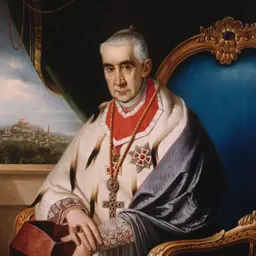
Lived 1797 – 1855 (aged 57). Louis Lambillotte was a Belgian catholic priest, composer, musicologist, organist, bandleader and scientist.
Louis Lambillotte (born La Hamaide, (Hainaut, Belgium), 27 March 1797; died Paris, 27 February 1855) was a Belgian Jesuit, composer and palaeographer of Catholic music, associated with the restoration of Gregorian music, which he inaugurated and promoted by his scientific researches and publications.
Early life Louis Lambillotte was born at La Hamaide, near Charleroi and began studying solfège, piano, and harmony at the age of seven. At the age of fifteen, he became organist in Charleroi; later he went in a similar capacity to Dinant (Belgium). In 1820 he was appointed choirmaster and organist of the Jesuit College of Saint-Acheul, Amiens. While exercising these functions he also studied the classics, and at the end of five years, in August, 1825, he entered the Society of Jesus. The thirty years of his Jesuit life were spent successively in the colleges of Saint-Acheul, Fribourg, Estavayer, Brugelette and Vaugirard (Paris).
While occupied in teaching and directing music, he gave himself up more entirely to composition, with a view to enhance both the religious ceremonies and the academic entertainments in those newly founded colleges. His powers of composition were checked by the limited ability of his performers, his orchestra, like his chorus, being entirely recruited from the ranks of the students; nevertheless he provided new music for almost every occasion, producing in the course of time, besides his volumes of canticles, a large number of motets, short oratorios, masses and secular cantatas, mostly for four-part chorus and orchestra. This music became popular, especially in educational institutions. Late in life Lambillotte regretted having published those written improvisations without taking time to revise them. After his death a revision of the greater part of them was made and published (Paris, 1870) by his pupil, the Jesuit Camille de la Croix, and by Louis Dessane, organist of St. Sulpice, Paris, and afterwards of St. Francis Xavier, New York.
He received some piano lessons from César Franck at Immaculate Conception college, and in turn taught Franck about plainchant.
Work on Gregorian chant Corrupt versions of Gregorian chant had been in use for several centuries. As a practical guide towards a radical restoration the Abbot of Solesmes Prosper Guéranger, in his , had laid down the principle that "when a large number of manuscripts of various epochs and from different countries agree in the version of a chant, it may be affirmed that those MSS. undoubtedly give us the phrase of St. Gregory." Acting upon this principle, Lambillotte for many years gathered and compared all the documents that were to be found in the Jesuit houses. He next undertook to visit and re-visit almost every country of Europe, exploring libraries, secular as well as monastic, in search of the most ancient MSS. and all treatises bearing on the history or the theory of the chant.
The Benedictine Joseph Pothier, also worked on restoring Gregorian restoration. Pothier says of the that it is "filled with precious information". At the same time he calls attention to some serious errors in translation and even in reading, on the subject of rhythm, which, he holds, have been conclusively refuted by Chanoine Gontier, in his , pp. 96 etc. De Monter also speaks of grave errors and numerous assertions contrary to its own method, that have crept into the treatise. He attributes the introduction of the sharp into the Gregorian scales to the editors of this posthumous work.
Lambillotte's "Gradual" and "Vesperal" were adopted by only a small number of French dioceses. Some argue that his work was ahead of its time. Lambillotte made cuts and alterations which had been the chief criticism of former editions. Twenty-five years were still to elapse before the classical work in Gregorian music, the by Pothier, could make its appearance (Tournay, 1880), and another twenty-five before the teaching of Pothier was to receive official sanction and practical application through the Vatican edition. Lambillotte's contemporaries placed the following inscription on his tomb at Vaugirard:
. (Receive, O Christ, into Thy choirs above him who sang the praises of Jesus and Mary, and rescued the music of Gregory from the darkness of ages.)
Hymns Come Holy Ghost Panis angelicus -arrangement of Aquinas On This Day O Beautiful Mother
Works (4 vol.), Paris 1841–1868. , Paris, 1848. , Paris, 1846. , Paris, 1851. , Bruxelles, 1851. (posthumous) , Paris, 1857. (posthumous) , Paris, 1857.
Don’t just read it —
keep it.
Full-length biographies made to live with: read them, listen on the way to work, watch them tonight.
- E-book
- Audio
- Video
Instant download · yours to keep · every purchase keeps this site free
Important facts
People in Louis Lambillotte's life
Named in this biography and alive at the same time


Related people
Same field, nearest in time


Contemporaries
People whose lives overlapped Louis Lambillotte's





Frequently asked questions
Who was Louis Lambillotte?
Belgian composer, Jesuit and palaeographer (1797-1855)
When was Louis Lambillotte born?
Louis Lambillotte was born on 27 March 1797 in Ellezelles.
When did Louis Lambillotte die?
Louis Lambillotte died on 27 February 1855 in Paris.
What was Louis Lambillotte's occupation?
Louis Lambillotte was a catholic priest, composer, musicologist, organist, bandleader and scientist.
What nationality was Louis Lambillotte?
Louis Lambillotte was Belgian.
Sources & further reading
· Wikipedia: Louis Lambillotte
Cite this page
APA: Biography.guide. (2026). Louis Lambillotte. https://biography.guide/louis-lambillotte/
MLA: "Louis Lambillotte." Biography.guide, https://biography.guide/louis-lambillotte/.
Chicago: "Louis Lambillotte." Biography.guide. https://biography.guide/louis-lambillotte/.
Data last updated: 2026-09-20 · Spot an error? Report a correction.
Page generated 2026-09-27 05:09 UTC