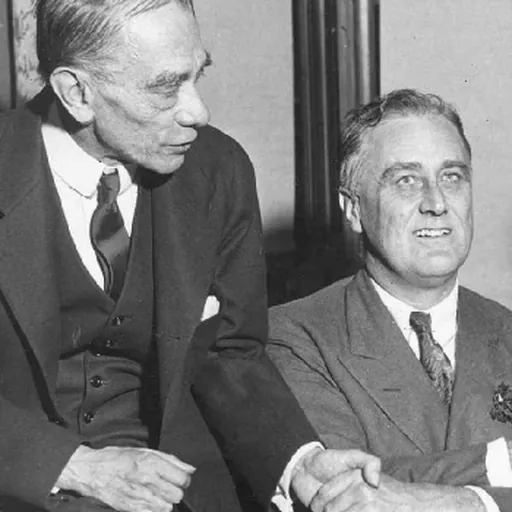
About Louis Howe
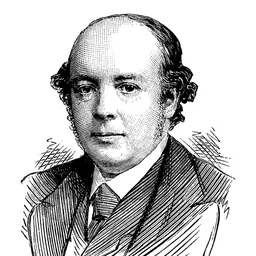
Lived 1871 – 1936 (aged 65). Louis Howe was an American writer, known for Franklin D. Roosevelt.
Louis McHenry Howe (January 14, 1871 – April 18, 1936)
Edward speculated heavily in real estate, and gradually lost the family's wealth in the depression that followed the Panic of 1873. When Louis was seven, the family lost their home, moving to Saratoga Springs, New York, with help from Eliza's family. Edward's health collapsed, but he nonetheless took a job as a reporter for a Saratoga newspaper, later purchasing a small Democratic paper of his own, The Saratoga Sun. Louis's health, in contrast, improved during his teenage years, allowing him to leave the house more often and consider attending Yale University. On his way to a cousin's wedding rehearsal, he suffered a bicycle accident in which he fell into gravel, permanently scarring his face. Ultimately, the dual obstacles of his still-questionable health and finances caused him to abandon his university ambitions and instead take a job with his father's paper.
In 1896, he met Grace Hartley, a well-off 20-year-old who was on vacation with her mother at one of Saratoga's sanitariums. Although she initially was unimpressed with him, Howe courted her assiduously for two years, and the couple became engaged in 1898, marrying the following year. The pair had three children, one of whom died in infancy.
Journalism and early political career
Howe hoped to travel to Cuba to cover the 1898 Spanish–American War for the New York Herald, but the war ended before he could secure the paper's approval. Not long after, the Howes' marriage ran into trouble as the financial difficulties of Howe's father again threatened the family's position. Grace's mother had given the couple a large house for a wedding present, which Louis mortgaged in an attempt to save his father's newspaper from bankruptcy. The Sun was nonetheless sold, and Louis fired in 1901, though he soon after successfully begged to return to his job. Louis continued working as a freelancer for the Herald; one of his most notable stories was to interview Vice President Theodore Roosevelt on his return to Washington, D.C. after the death of President William McKinley. During this period, Grace went to live with her mother, where she gave birth to the couple's first child, Mary.
In 1903, after a failed attempt to make a living writing fiction, Howe worked for a time as a manager for a Saratoga country club. In January 1906, Howe began covering the New York State Legislature in Albany, New York for the Herald. Later that year, Howe was hired by Thomas Mott Osborne, a rich Democrat, as a political operative. Osborne was a member of the "Upstarters", a group opposed to the influence of the Tammany Hall political machine in New York politics. He employed Howe to oppose the gubernatorial candidacy of William Randolph Hearst, the Democratic nominee, newspaper magnate, and ally of Tammany. Howe and Osborne's other operatives successfully spread dissent and chaos among the Democratic campaign, and Hearst lost the election to Charles Evans Hughes.
Howe biographer Julie M. Fenster describes the anti-Hearst campaign as a "personal turning point" for Howe, in which he got his first taste of politics, learned the practical mechanics of party organization, and had an opportunity to make news rather than simply reporting it. He pursued a permanent position with Osborne, declining an opportunity to go to Jamaica as a correspondent for the Herald, and was hired in November 1906. For the next three years, Howe blended his two jobs—reporter and political operative—using information from each in service of the other. Osborne intended eventually to run for governor. However, he was made a nonviable candidate by his unusual propensity to travel in a variety of disguises and his close friendship with a young handyman, with whom Osborne was rumored to have a homosexual relationship. Howe lost interest in Osborne as a patron and began searching for another upcoming name with whom to associate; Osborne fired him in 1909.
Assistant to Roosevelt
Howe first met Franklin D. Roosevelt when Roosevelt was a freshman New York state senator leading a movement to block Tammany Hall nominee William F. Sheehan from the US Senate. Roosevelt was successful, marking him as the new leader of the anti-Tammany "insurgents". Howe interviewed Roosevelt for the Herald, and they began to regularly meet to discuss politics, becoming good friends in the process. In 1912, Roosevelt became ill with typhoid fever during his re-election campaign, and hired Howe to campaign on his behalf. a role equivalent to the current White House Chief of Staff posting. After FDR's inauguration, Howe took up residence in the White House Lincoln Bedroom. Howe described his role in the administration as the president's "no-man", checking Roosevelt's natural enthusiasm and preventing unsound proposals from reaching wider discussion. He was also a strong supporter of the Civilian Conservation Corps, one of the many public works programs of Roosevelt's "New Deal". Howe persuaded the Governor of Kentucky to name him an honorary colonel, echoing the name of President Wilson's famous advisor, Colonel House; later, Howe printed business cards containing all his nicknames, reading: "Colonel Louis Rasputin Voltaire Talleyrand Simon Legree Howe".
Influence on Eleanor Roosevelt Eleanor Roosevelt initially disliked Howe, particularly his chain-smoking, but became friends with him in the course of campaigning. During the long train rides in Franklin's 1920 vice presidential campaign, Howe encouraged her to become interested in politics herself and coached her in how to talk with reporters. Eleanor later wrote that Howe's interest during this campaign sparked a major change in her life:
In later years I learned that he had always liked me and thought I was worth educating, and for that reason he made an effort on this trip to get to know me. He did it cleverly. He knew that I was bewildered by some of the things expected of me as a candidate's wife ... Largely because of Louis' early interpretation of the standards and ethics of the newspaper business, I came to look with interest and confidence on the writing fraternity ... I did receive an intensive education on this trip, and Louis Howe played a great part in this education from that time on.
In the 1920s, Howe introduced her to representatives of women's political organizations, with which she became active, and watched and critiqued her speeches to these groups. The pair even developed a system of hand signals that Howe used while she spoke to warn her if she was lapsing into a bad habit. He encouraged her to express herself in print as well and acted for a time as her literary agent.
After Franklin's 1932 election, Howe told Eleanor that given 10 years, he could make her president as well. He encouraged her to break with her predecessors as First Lady and make the role more active and political. In a 1951 magazine article, Eleanor listed Howe as one of the seven people who had most influenced her life.
Illness and death Howe's health declined in 1934, and he was hospitalized for heart problems and breathing difficulties. He spent the last two years of his life in and out of Bethesda Naval Hospital; in March 1935, he went in to get treated for bronchitis. Though he experienced increasing periods of confusion, he continued to give orders to his staff by telephone; Roosevelt had instructed them to treat Howe's calls with courtesy, but to double-check his instructions with himself and other staff. Howe died in his sleep on April 18, 1936. Roosevelt gave him a state funeral three days later in the White House East Room.
Fictional portrayals Howe was portrayed by Ed Flanders in the 1976 television miniseries Eleanor and Franklin, Walter McGinn in Eleanor and Franklin: The White House Years, the 1977 American television film and a sequel to Eleanor and Franklin (1976), and by Hume Cronyn in the 1960 movie Sunrise at Campobello. David Paymer portrayed Howe in the 2005 movie Warm Springs, with Kenneth Branagh as Roosevelt. Jackie Earle Haley portrayed Louis Howe in three episodes in Season 1 of The First Lady on Showtime.
Don’t just read it —
keep it.
Full-length biographies made to live with: read them, listen on the way to work, watch them tonight.
- E-book
- Audio
- Video
Instant download · yours to keep · every purchase keeps this site free
Important facts
People in Louis Howe's life
Named in this biography and alive at the same time


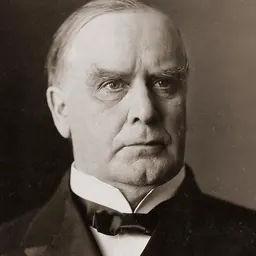

Related people
Same field, nearest in time

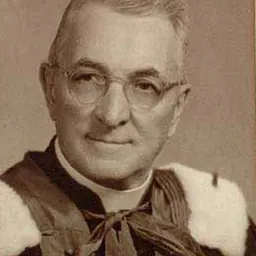

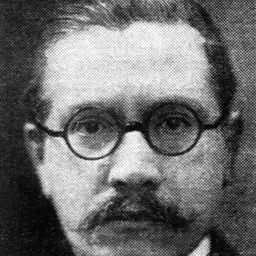
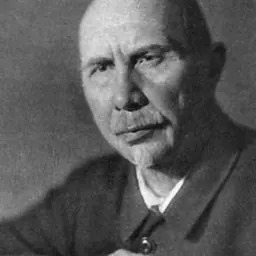
Contemporaries
People whose lives overlapped Louis Howe's

Frequently asked questions
Who was Louis Howe?
American journalist (1871-1936)
When was Louis Howe born?
Louis Howe was born on 14 January 1871 in Indianapolis.
When did Louis Howe die?
Louis Howe died on 18 April 1936 in Bethesda.
What was Louis Howe's occupation?
Louis Howe was a writer.
What was Louis Howe known for?
Louis Howe was known for Franklin D. Roosevelt.
What nationality was Louis Howe?
Louis Howe was American.
Sources & further reading
Cite this page
APA: Biography.guide. (2026). Louis Howe. https://biography.guide/louis-howe/
MLA: "Louis Howe." Biography.guide, https://biography.guide/louis-howe/.
Chicago: "Louis Howe." Biography.guide. https://biography.guide/louis-howe/.
Data last updated: 2026-09-23 · Spot an error? Report a correction.
Portrait: Wikimedia Commons · author & licence
Page generated 2026-09-27 05:08 UTC