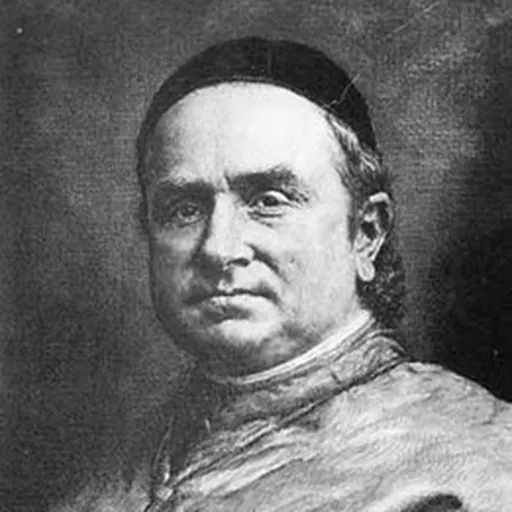
About Louis-Édouard-François-Desiré Pie
Lived 1815 – 1880 (aged 64). Louis-Édouard-François-Desiré Pie was a French catholic priest and catholic bishop.
Louis-Édouard-François-Desiré Pie (26 September 1815 – 18 May 1880), also referred to as Cardinal Pie, was a French Catholic bishop of Poitiers and cardinal, known for his ultramontanism and defence of the social reign of Christ the King.
Early life and seminary Pie was born in Pontgouin in the diocese of Chartres on 26 September 1815, just after the Napoleonic Wars, between the Battle of Waterloo (18 June 1815) and the Treaty of Paris (20 November 1815). In 1835, Pie entered the seminary of St. Sulpice, Abbé Lecomte, who had repeatedly refused episcopal appointment, was an ultramontane defender of papal infallibility, and a great admirer of the thought of Joseph de Maistre. Increasingly taking on the role of protector and spiritual father to Pie, Lecomte's death – which occurred on 31 December 1850 – was a very painful episode for Pie, who had risen at his relatively young age to occupancy of the see of Poitiers. He wrote the same day the brother of his deceased friend, Gabriel Lecomte: "I have no words, sir, and worthy friend, to express my excessive pain (...) I loved as a father, as a brother, as a unique friend, he for whom death came knocking. I can not stop the course of my tears, and yet still they are insufficient to unload my heart." Another man who played a leading role in the life of Abbé Pie was his bishop, Clausel Montale, who knew him as a seminarian and later as a young priest and vicar of Chartres. Bishop Montale had been the chaplain of Madame la Dauphine, Duchesse d'Angoulême, before being named bishop of Chartres.
Pie received the four minor orders in 1837 and was ordained deacon 9 June 1838.
Clerical career
Pie was ordained priest on 25 May 1839.
Legacy
Pie's major biographer was Louis Baunard (in his Histoire du cardinal Pie : évêque de Poitiers, H. Oudin, Poitiers, 1886) He would, years after his death, be favourably cited by Pope Pius X, who knew his writings well. His "Works" (pastoral letters, sermons, homilies, speeches, etc.) fill twelve volumes, and his social teaching has in recent years been enthusiastically promoted by members of the Society of St. Pius X.
Quotations Jesus Christ has been constituted the King of kings. Yes - and the true glory, the true nobility of kings, ever since the preaching of the Gospel, has consisted in being the lieutenants of Jesus Christ on earth. Has the greatness of kings been diminished by the crosses glittering atop their diadems? Have their thrones been less renowned or less secure on account of their kingship being recognised as an emanation of, and participation in, the kingship of Jesus Christ? Jesus Christ is King, and the true dignity, the true liberty, the true emancipation of modern nations lies in their right to be governed in a Christian manner. Have such nations fallen short of their glory? Has their fate been less noble, less happy on account of their ruling sceptres being bound to submit to the sceptre of Jesus? Let it be repeated, brethren: Christianity does not reach its full development, its full maturity, where it does not take on a social character. Such is what Bossuet expressed in this way: 'Christ does not reign if his Church is not mistress, if the peoples cease to pay to Jesus Christ, to his doctrine, to his law, a national homage.' When the Christianity of a country is reduced to the bare proportions of the domestic life, when Christianity is no longer the soul of public life, of public power, of public institutions, then Jesus Christ deals with this country in the manner he is there dealt with. He continues to give his grace and his blessings to the individuals who serve him, but he abandons the institutions, the powers which do not serve him; and the institutions, the kings, the nations become like shifting sand in the desert, they fall away like the autumn leaves which are gone with the wind. (Cardinal Pie, Works, vol. II, pp. 259–60) The main error, the capital crime of this century is the pretension of withdrawing public society from the government and the law of God... The principle laid at the basis of the whole modern social structure is atheism of the law and of the institutions. Let it be disguised under the names of abstention, neutrality, incompetence or even equal protection, let us even go to the length of denying it by some legislative dispositions for details or by accidental and secondary acts: the principle of the emancipation of the human society from the religious order remains at the bottom of things; it is the essence of what is called the new era. (Cardinal Pie, Pastoral Works, vol. VII, pp. 3, 100) The time has not come for Jesus Christ to reign? Well, then the time has not come for governments to last. (Cardinal Pie, meeting with Emperor Napoleon III)
Don’t just read it —
keep it.
Full-length biographies made to live with: read them, listen on the way to work, watch them tonight.
- E-book
- Audio
- Video
Instant download · yours to keep · every purchase keeps this site free
Important facts
People in Louis-Édouard-François-Desiré Pie's life
Named in this biography and alive at the same time


Related people
Same field, nearest in time


Contemporaries
People whose lives overlapped Louis-Édouard-François-Desiré Pie's


Frequently asked questions
Who was Louis-Édouard-François-Desiré Pie?
Catholic cardinal (1815-1880)
When was Louis-Édouard-François-Desiré Pie born?
Louis-Édouard-François-Desiré Pie was born on 26 September 1815 in Pontgouin.
When did Louis-Édouard-François-Desiré Pie die?
Louis-Édouard-François-Desiré Pie died on 18 May 1880 in Angoulême.
What was Louis-Édouard-François-Desiré Pie's occupation?
Louis-Édouard-François-Desiré Pie was a catholic priest and catholic bishop.
What nationality was Louis-Édouard-François-Desiré Pie?
Louis-Édouard-François-Desiré Pie was French.
Sources & further reading
· Wikipedia: Louis-Édouard-François-Desiré Pie
· DBpedia: Louis-Édouard-François-Desiré Pie
Cite this page
APA: Biography.guide. (2026). Louis-Édouard-François-Desiré Pie. https://biography.guide/louis-edouard-francois-desire-pie/
MLA: "Louis-Édouard-François-Desiré Pie." Biography.guide, https://biography.guide/louis-edouard-francois-desire-pie/.
Chicago: "Louis-Édouard-François-Desiré Pie." Biography.guide. https://biography.guide/louis-edouard-francois-desire-pie/.
Data last updated: 2026-09-23 · Spot an error? Report a correction.
Portrait: Wikimedia Commons · author & licence
Page generated 2026-09-27 05:07 UTC