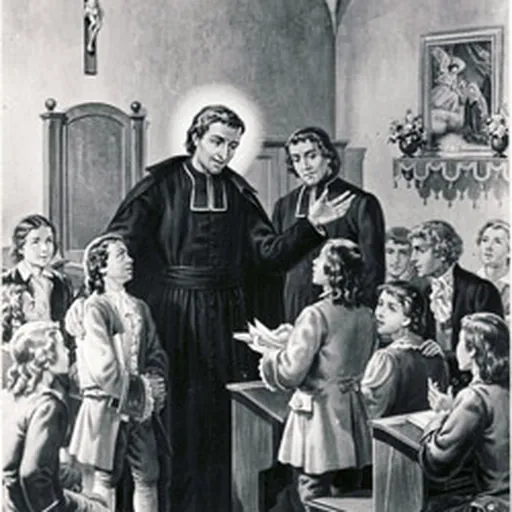
Louis de Montfort
French Catholic saint, priest, and confessor
About Louis de Montfort
Lived 1673 – 1716 (aged 43). Louis de Montfort was a French catholic priest, theologian and missionary.
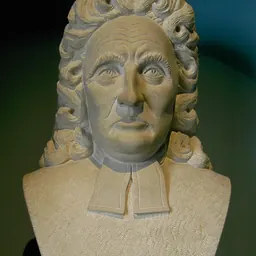
Louis-Marie Grignion de Montfort, SMM (; 31 January 1673 – 28 April 1716) was a French Catholic priest known for his influence on Catholic Mariology. He wrote a number of books that went on to become classic Catholic titles, including Secret of the Rosary and True Devotion to Mary, and influenced several popes. He also founded several religious communities, including the Company of Mary.
Pope Pius XII canonised him on 20 July 1947. A "founder's statue" created by Giacomo Parisini is located in an upper niche of the south nave of St. Peter's Basilica.
Early years
Montfort was born in 1673 in Montfort-sur-Meu, the eldest surviving child of eighteen born to Jean-Baptiste and Jeanne Robert Grignion. His father was a notary. Louis-Marie passed most of his infancy and early childhood in Iffendic, a few kilometers from Montfort, where his father had bought a farm. At the age of 12, he entered the Jesuit College of St. Thomas Becket in Rennes, where his uncle was a parish priest. At the end of his ordinary schooling, he began his studies of philosophy and theology, still at St. Thomas in Rennes.
Listening to the stories of a local priest, the Abbé Julien Bellier, about his life as an itinerant missionary, Montfort was inspired to preach missions among the very poor. Bellier was propagating among his students a consecration and entrustment to Mary. Under the guidance of Bellier and other priests, de Montfort began to develop his strong devotion to the Blessed Virgin Mary.
Through a benefactor, opportunity arose to go to Paris to study at the renowned Seminary of Saint-Sulpice towards the end of 1693. When Montfort arrived in Paris, it was to find that his benefactor had not provided enough money for him, so he lodged in a succession of boarding houses, living among the very poor, in the meantime attending the Sorbonne University for lectures in theology. After less than two years, he became very ill and had to be admitted to hospital. He survived this, despite the blood letting that was common practice at that time.
Leaving hospital, he was surprised to find his place had been kept open for him at the Little Saint-Sulpice, which he entered in July 1695. This seminary had been founded by Jean-Jacques Olier, one of the leading experts of what came to be known as the French school of spirituality.
One reason behind Montfort's showing such devotion to angels is that veneration of the pure spirits was an integral part of his training, and also of his culture. His college teachers, all Jesuits, were known for their zeal in propagating devotion to the angels. Montfort's seminary training under the Sulpicians brought him into contact with the thought of Cardinal de Bérulle and Olier, both of whom had deep veneration for the angels. During the seventeenth and eighteenth centuries, manuals of piety and treatises on the pure spirits abounded. He began to consider forming a small company of priests to preach missions and retreats under the standard and protection of the Blessed Virgin. This was to eventually lead to the founding of the Company of Mary.
Around this time, Louis de Montfort was appointed chaplain of the hospital in Nantes. This was when he was first introduced to Marie Louise Trichet, a meeting that launched her 34 years' service to the poor. During Louis de Montfort's time, France was beginning to face a mounting economic crisis: a rapidly growing population was outpacing the food supply.
Desiring to be a missionary, Montfort made a pilgrimage to Rome to ask the advice of Pope Clement XI. On his return from his long pilgrimage to Rome, Montfort made a retreat at Mont Saint Michel "to pray to this archangel to obtain from him the grace to win souls for God, to confirm those already in God's grace, and to fight Satan and sin". The Secret of Mary and the Secret of the Rosary, rules for the Company of Mary and the Daughters of Wisdom, and many hymns. His missions made a great impact, especially in the Vendée. The heated style of his preaching was regarded by some people as somewhat strange and he was poisoned once.
Death and burial Montfort's 16 years of priesthood include many months of solitude, perhaps as many as a total of four years; at the cave of Mervent, amidst the beauty of the forest, at the hermitage of Saint Lazarus near the village of Montfort, and at the hermitage of Saint Eloi in La Rochelle.
Worn out by hard work and sickness, he finally came in April 1716 to Saint-Laurent-sur-Sèvre to begin the mission which was to be his last. During it, he fell ill and died on 28 April of that year. He was 43 years old, and had been a priest for only 16 years. His last sermon was on the tenderness of Jesus and the Incarnate Wisdom of the Father. Thousands gathered for his burial in the parish church, and very quickly there were stories of miracles performed at his tomb.
Exactly 43 years later, on 28 April 1759, Marie Louise Trichet also died in Saint-Laurent-sur-Sèvre and was buried next to Montfort. On 19 September 1996 Pope John Paul II (who beatified Trichet) came to the same site to meditate and pray at their adjacent tombs.
Spirituality
"God Alone" was the motto of Montfort and is repeated over 150 times in his writings. The Incarnation: "The Incarnation of the Word is for him the absolute central reality." Love of the Blessed Virgin Mary Fidelity to the Cross Missionary Zeal
Total consecration to Jesus through Mary In Montfort's approach to Marian consecration, Jesus and Mary are inseparable. He views "consecration to Jesus in Mary" as a special path to being conformed to, united and consecrated to Christ, given that
According to Montfort, "Mary is the safest, easiest, shortest, and most perfect way of approaching Jesus".
Montfort's process of "total consecration" has seven elements and effects: knowledge of one's unworthiness, sharing in Mary's faith, the gift of pure love, unlimited confidence in God and Mary, communication of the Spirit of Mary, transformation into the likeness of Jesus, and bringing more glory to Christ. His practice of consecration to Mary has both internal and external components. The internal components focus on surrendering oneself as a slave to Mary and to Jesus through her, and performing all actions "with Mary, in Mary, through Mary and for Mary". The suggested exterior practices include enrolment in Marian societies, or joining Marian religious orders, making Marian privileges known and appreciated, and giving alms in honor of Mary.
Louis de Montfort influenced a number of popes. In the 19th century, Pope Pius IX considered it the best and most acceptable form of Marian devotion, while Pope Leo XIII granted indulgences for practicing Montfort's method of Marian consecration. Leo beatified Montfort in 1888, selecting for Montfort's beatification the day of his own Golden jubilee as a priest. In the 20th century Pope Pius X acknowledged the influence of Montfort's writings in the composition of his encyclical Ad diem illum. Pope Pius XI stated that he had practiced Montfort's devotional methods since his early youth. Pope Pius XII declared Montfort a saint and stated that Montfort is the guide "who leads you to Mary and from Mary to Jesus". Pope John Paul II once recalled how as a young seminarian he "read and reread many times and with great spiritual profit" a work of de Montfort and that: "Then I understood that I could not exclude the Lord's Mother from my life without neglecting the will of God-Trinity." According to his Apostolic Letter Rosarium Virginis Mariae, the pontiff's personal motto was "Totus Tuus." The thoughts, writings, and example of Louis de Montfort were also singled out by Pope John Paul II's encyclical Redemptoris Mater as a distinctive witness of Marian spirituality in the Roman Catholic tradition.
Works Saint Louis de Montfort's writings were compiled and published in their entirety in the collection God Alone: The Collected Writings of St. Louis Marie de Montfort (Montfort Publications, 1987). His principal works include:
Letters of St. Louis Marie The Love of Eternal Wisdom Letter to the Friends of the Cross The Admirable Secret of the Rosary Methods for Saying the Rosary The Secret of Mary Treatise on True Devotion to the Blessed Virgin Prayer for Missionaries Manuscript Rule of the Company of Mary Letter to the Members of the Company of Mary The "Wisdom Cross" of Poitiers Original Rule of the Daughters of Wisdom Letter to the Inhabitants of Montbernage Rules for Various Groups The Will of St. Louis Marie Morning and Night Prayers
Priest and poet While Montfort is best known for his spiritual writings, he was also a poet and during his missions managed to compose more than 20,000 verses of hymns. Montfort's hymns and canticles were, for the most part, meant to be sung in village churches and in the homes of the poor. Some authors argue that a reading of Montfort's hymns is essential for an understanding of him as a man and for appreciating his approach to spirituality.
Based on the analysis of Bishop Hendrik Frehen of the Company of Mary, Montfortian hymns fall into two major categories "inspired" and "didactic". The inspired canticles flow spontaneously, on the occasion of a pilgrimage to a Marian shrine, or on the occasion of a joyful celebration. The didactic hymns took more effort and time to compose, and focus on instructional and informative qualities: they teach the audience through the use of a moral and a theme. After Montfort's death, the Company of Mary (which continued his work of preaching parish renewals) made great use of his hymns and used them as instruments of evangelization.
He is also said to have carved at least three statues depicting the Madonna and Child.
Congregations de Montfort
The congregations Montfort left behind, the Company of Mary, the Daughters of Wisdom, and the Brothers of Saint Gabriel (which congregation developed from a group of lay-brothers gathered around him), grew and spread, first in France, then throughout the world.
The Servants of the Lord and the Virgin of Matará follow the spirituality of Louis de Montfort.
The nineteenth century's "romanticized" conception of history influenced hagiography in two main ways: Although a biography should relive the outer events of a saint's past, it was more important to describe the interior drama of his soul. The nineteenth-century biographies of Montfort reflect this historiographic orientation. Two biographies were prepared for the Montfort's beatification, one by Fonteneau and the other by Persiani. The latter is almost a translation of the former (1887). They limited themselves to recounting the events that took place and did not go into Montfort's psychology. On the other hand, Pauvert (1875) published a collection of Montfort's unpublished letters and established a chronology of the first years of his priesthood. A. Crosnier's biography (1927) was also influenced by nineteenth-century romanticism. Just before Montfort's canonization appeared De Luca (1943). The author took into account the literary and spiritual milieu of seventeenth-century France and attempted to introduce his readers to Montfort's spiritual life, pointing out "phases" in Montfort's growth and development.
Of the different genres of biography that purport to describe the events of someone's life, the "realistic" biography is popular with some today. Such a method is apparent in the four works dedicated by Louis Perouas to Grignion de Montfort (1966, 1973, 1989, 1990). The author separated himself from his predecessors by describing Montfort, his life, and his pastoral work using a historical-critical and psycho-sociological approach. Perouas held that the Breton saint's path was a "tormented journey" because he had difficulty dealing with a strained relationship with his father, who was known for his violent temper. His long and arduous journey toward a balanced life came to a "certain maturation for Father de Montfort when he was in his forties". Generally more acceptable than Perouas' Freudian psychological interpretation is his understanding of Montfort's ministry in the context of the sociological and pastoral realities of his times.
Don’t just read it —
keep it.
Full-length biographies made to live with: read them, listen on the way to work, watch them tonight.
- E-book
- Audio
- Video
Instant download · yours to keep · every purchase keeps this site free
Important facts
People in Louis de Montfort's life
Named in this biography and alive at the same time
Related people
Same field, nearest in time



Contemporaries
People whose lives overlapped Louis de Montfort's




Frequently asked questions
Who was Louis de Montfort?
French Catholic saint, priest, and confessor
When was Louis de Montfort born?
Louis de Montfort was born on 31 January 1673 in Montfort-sur-Meu.
When did Louis de Montfort die?
Louis de Montfort died on 28 April 1716 in Saint-Laurent-sur-Sèvre.
What was Louis de Montfort's occupation?
Louis de Montfort was a catholic priest, theologian and missionary.
What nationality was Louis de Montfort?
Louis de Montfort was French.
Sources & further reading
· Wikipedia: Louis de Montfort
Cite this page
APA: Biography.guide. (2026). Louis de Montfort. https://biography.guide/louis-de-montfort/
MLA: "Louis de Montfort." Biography.guide, https://biography.guide/louis-de-montfort/.
Chicago: "Louis de Montfort." Biography.guide. https://biography.guide/louis-de-montfort/.
Data last updated: 2026-09-24 · Spot an error? Report a correction.
Portrait: Wikimedia Commons · author & licence
Page generated 2026-09-27 05:08 UTC