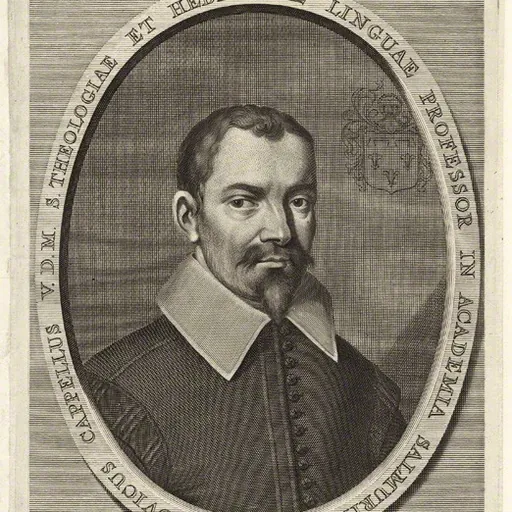
About Louis Cappel
Lived 1585 – 1658 (aged 72). Louis Cappel was a French theologian, university teacher and hebraist.
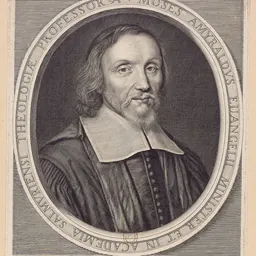
Louis Cappel (15 October 1585 – 18 June 1658) was a French Protestant churchman and scholar. A Huguenot, he was born at St Elier, near Sedan. He studied theology at the Academy of Sedan and the Academy of Saumur, and Arabic at the University of Oxford, where he spent two years. At the age of twenty-eight, he accepted the chair of Hebrew at Saumur and, twenty years later, was appointed professor of theology. Amongst his fellow lecturers were Moses Amyraut and Josué de la Place.
Writings on the Hebrew Biblical text
As a Hebrew scholar Cappel made a special study of the history of the Hebrew Masoretic Text of the Bible, which led him to the conclusion that the vowel points and accents are not an original part of the Hebrew language, but had been inserted by the Masorete Jews, no earlier than the 5th century; he also concluded that the primitive Hebrew characters are those now known as the Samaritan, while the square characters are Aramaic and were substituted for the more ancient at the time of the Babylonian captivity.
Cappel's views were not a complete novelty. Nearly a century earlier, Elias Levita (1469–1549) demonstrated in 1538 that neither Jerome nor the Talmud showed any acquaintance with the vowel points, a comparatively recent Jewish invention. In response to the claim that Protestants, in spite of their claim to follow nothing but Scripture alone (sola scriptura), were thus dependent in reality on Jewish tradition, many Protestants declared that the vowel points were in fact ancient and an essential part of the divinely inspired Scripture. Foremost among the upholders of this view were Johannes Buxtorf senior and his son Johannes Buxtorf II.
In 1634 Cappel had already completed work on a second important work, Critica sacra: sive de variis quae in sacris Veteris Testamenti libris occurrunt lectionibus (Sacred Criticism: Variant Readings in the Books of the Old Testament), but because of the fierce opposition of his co-religionists was able to print it only in 1650, by aid of a son, who had turned Catholic (according to the Encyclopædia Britannica Eleventh Edition) or (according to Michael C. Legaspi in 2010) of the Catholic priest-scholar Jean Morin.
In this book, Cappel not only raised questions about the age of the vowel points in the Hebrew Bible: he denied that even the surviving consonantal Hebrew text preserved the autographs of scripture. He distinguished between the divinely inspired content of Scripture and the wholly human process of its transmission in texts that are produced by human hands with variants due above all to scribal errors and that need emendation with the help of the versions and of conjecture. The variant readings in the text and the differences between the ancient versions and the Masoretic text convinced him that the idea of the integrity of the Hebrew text, as commonly held by Protestants, was untenable. This amounted to an attack on the verbal inspiration of Scripture. Bitter, however, as was the opposition to his views, it was not long before his results were accepted by scholars.
Other writings
Cappel was also the author of Annotationes et commentarii in Vetus Testamentum and other biblical works, as well as of several other treatises on Hebrew, among which are the Diatribe de veris et antiquis Ebraeorum literis (1645). His Commentarius de Capellorum gente, giving an account of the Cappel family to which he belonged, was published by his nephew James Cappel (1639–1722), who, at the age of eighteen, became professor of Hebrew at Saumur, but, on the revocation of the edict of Nantes, fled to England.
Don’t just read it —
keep it.
Full-length biographies made to live with: read them, listen on the way to work, watch them tonight.
- E-book
- Audio
- Video
Instant download · yours to keep · every purchase keeps this site free
Important facts
People in Louis Cappel's life
Named in this biography and alive at the same time

Related people
Same field, nearest in time


Contemporaries
People whose lives overlapped Louis Cappel's



Frequently asked questions
Who was Louis Cappel?
French churchman
When was Louis Cappel born?
Louis Cappel was born on 15 October 1585 in Sedan.
When did Louis Cappel die?
Louis Cappel died on 18 June 1658 in Saumur.
What was Louis Cappel's occupation?
Louis Cappel was a theologian, university teacher and hebraist.
What nationality was Louis Cappel?
Louis Cappel was French.
Sources & further reading
Cite this page
APA: Biography.guide. (2026). Louis Cappel. https://biography.guide/louis-cappel/
MLA: "Louis Cappel." Biography.guide, https://biography.guide/louis-cappel/.
Chicago: "Louis Cappel." Biography.guide. https://biography.guide/louis-cappel/.
Data last updated: 2026-09-23 · Spot an error? Report a correction.
Portrait: Wikimedia Commons · author & licence
Page generated 2026-09-27 05:04 UTC