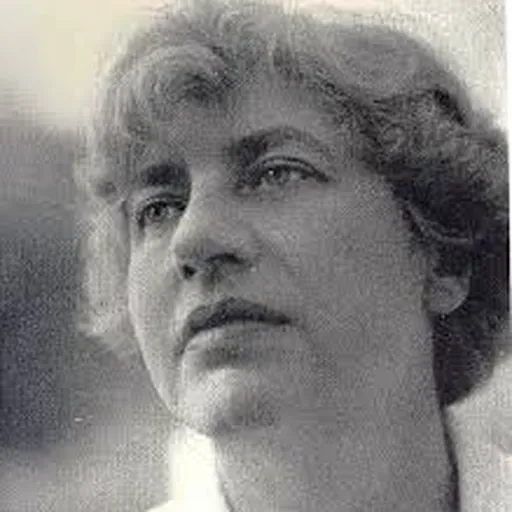
About Lotte Brand Philip
Lived 1910 – 1986 (aged 75–76). Lotte Brand Philip was a German art historian.
Lotte Brand Philip (May 27, 1910 – May 2, 1986) was a German art historian, professor and expert on Netherlandish art, one of the most notable and incisive experts on 14th- and 15th-century art to have studied under Erwin Panofsky. Born a Christian of Jewish descent, she resisted state intimidation to leave Germany, only moving to the United States in 1941. She studied at the Technische Hochschule in Munich and at the University of Heidelberg. As a doctoral student at the University of Hamburg, Brand studied under Erwin Panofsky. She wrote her doctoral thesis in 1937 at the University of Freiburg under Kurt Bauch, on the topic of Stefan Lochner's altarpiece Altar of the City Patrons. She returned to academia full-time in 1960 when H. W. Janson, another classmate from her Panofsky days, offered her a position at New York University. The following year she accepted a professorship at Queens College, where she taught art history for the next 25 years. Brand Philip was selected to give the 1967–1968 Benjamin West Memorial Lecture on art history at Swarthmore College, on the topic "The Ghent Altarpiece: A New Solution to an Old Problem".
Ghent Altarpiece
The reliquary of Mary at Aachen Cathedral. Its shape and lines inspired Brand Philip to imagine the Ghent Altarpiece panels as the centerpiece of a soaring, house-shaped structure. In 1932 Brand Philip attended a Panofsky lecture on the Ghent Altarpiece. Panofsky, an acknowledged expert in early Netherlandish art and symbolism, addressed several uncertainties including the curious variations in scale of the figures, the lack of a unified religious message and the unclear attribution of the work between the van Eyck brothers. Panofsky was of the opinion that the panels had originally been intended for three separate works of art, and that after Hubert's death, they were hastily finished by Jan and combined into a single piece.
Brand Philip felt there was another explanation, but inspiration did not strike until some 30 years later. During a walk down Madison Avenue, a chance encounter with an image of the large, house-shaped reliquary of Mary at Aachen helped her picture a solution.
In 1964 she identified several contemporary retables that included sculptural frameworks similar to that she envisioned had originally existed for the Ghent piece. She presented her findings at the College Art Association's annual conference in January 1965, and subsequently lectured on the topic at nearly 40 colleges and museums. During a research trip to Ghent and Brussels in 1966, Brand Philip discovered an 1829 painting by Pierre-François de Noter which depicted the Ghent Altarpiece panels in place beneath a large sculptured stone canopy very similar to that which she had envisioned. Brand Philip believed that the stone canopy was a remnant which had survived to de Noter's time, and felt this supported her theory of a grand, unifying framework. She published her research in The Ghent Altarpiece and the Art of Jan van Eyck in 1971.
Portrait Diptych of Dürer's Parents
In the 1970s Brand Philip tackled questions surrounding Albrecht Dürer the Elder with a Rosary, a painting by Albrecht Dürer in the Uffizi Gallery in Florence. The portrait of the artist's father was recorded in several art inventories alongside a portrait of his mother Barbara Holper and the two were presumed to have originally formed a diptych, but the paintings had become separated sometime between 1588 and 1628, and the location of Barbara's portrait was unknown. Dürer expert Matthias Mende described this as "among the most severe losses in the Dürer oeuvre".
Brand Philip recalled seeing a portrait of a married woman which she had strongly felt was by Dürer. The painting, held by the Germanisches Nationalmuseum in Nuremberg under the name Unknown Woman in a Coif, had variously been attributed to Master W. B., a "Nuremberg painter, circle of Wolgemut" (Dürer's mentor), and Master of the Salem Altarpiece, but was at that time unattributed. Brand Philip observed that the Nuremberg painting bore a strong compositional likeness to the father's portrait: they were of similar size and color scheme, and the sitters were painted against a green background in the same prayerful position, each holding a rosary. Brand Philip's identification was confirmed in 1977 by Dürer scholar Fedja Anzelewsky, who found that the reverse side of both the Nuremberg and Florence portraits showed patterns of dark clouds and the faded mark "No. 19", which matched the inventory number of the presumed diptych from the 1573 and 1580 inventories. Brand Philip's findings were published in the 1978–1979 issue of Simiolus: Netherlands Quarterly for the History of Art in a paper titled "The Portrait Diptych of Dürer's Parents." Her identification of the Nuremberg portrait as the missing diptych image of Barbara Holper was not universally accepted for some time, The portraits were reunited in the Germanisches Nationalmuseum's 2012 exhibition "The Early Dürer".
Selected works 1938. "Stephan Lochners Hochaltar von St. Katharinen zu Köln." University of Freiburg. 1953. Heironymus Bosch. Abrams Art Books. New York: Harry N. Abrams. (1956: Portfolio edition, 1970: Expanded edition) 1955. "The Prado 'Epiphany' by Jerome Bosch." Art Bulletin, XXXV 1958. "The Peddler by Hieronymus Bosch, a Study in Detection." Nederlands Kunsthistorisch Jaarboek 9, p. 1–81 1959. "Eine kölnische Kreuzigung im Historischen Museum Basel." Wallraf-Richartz Jahrbuch, XXI, p. 223–226 1967. "Raum und Zeit in der Verkündigung des Genter Altares." Wallraf-Richartz Jahrbuch, XXIX, p. 62–104 1971. The Ghent Altarpiece and the Art of Jan van Eyck. Princeton, NJ: Princeton University Press 1978–1979 with Fedja Anzelewsky. "The Portrait Diptych of Dürer's Parents." Simiolus: Netherlands Quarterly for the History of Art, Vol. 10, No. 1, p. 5–18 1981. "Das neu entdeckte Bildnis von Dürers Mutter." Renaissance Vorträge (Stadt Nürnberg Stadtgeschichtliche Museen), VII, p. 3–33.
Personal life In 1970, she married , director of the Wallraf-Richartz Museum in Cologne. Brand Philip died of a stroke in New York City on May 2, 1986.
Recognition Brand Philip was an acknowledged expert in the fields of Gothic and Renaissance art in northern Europe. She received fellowship awards from the Fulbright Program, Bollinger, the National Endowment for the Humanities, the American Association of University Women, and the Belgian American Educational Foundation.
Don’t just read it —
keep it.
Full-length biographies made to live with: read them, listen on the way to work, watch them tonight.
- E-book
- Audio
- Video
Instant download · yours to keep · every purchase keeps this site free
Important facts
People in Lotte Brand Philip's life
Named in this biography and alive at the same time





Related people
Same field, nearest in time

Contemporaries
People whose lives overlapped Lotte Brand Philip's




Frequently asked questions
Who was Lotte Brand Philip?
German art historian (1910–1986)
When was Lotte Brand Philip born?
Lotte Brand Philip was born on 27 May 1910 in Altona.
When did Lotte Brand Philip die?
Lotte Brand Philip died in 1986 in New York City.
What was Lotte Brand Philip's occupation?
Lotte Brand Philip was an art historian.
What nationality was Lotte Brand Philip?
Lotte Brand Philip was German.
Sources & further reading
· Wikipedia: Lotte Brand Philip
Cite this page
APA: Biography.guide. (2026). Lotte Brand Philip. https://biography.guide/lotte-brand-philip/
MLA: "Lotte Brand Philip." Biography.guide, https://biography.guide/lotte-brand-philip/.
Chicago: "Lotte Brand Philip." Biography.guide. https://biography.guide/lotte-brand-philip/.
Data last updated: 2026-09-20 · Spot an error? Report a correction.
Page generated 2026-09-27 05:10 UTC