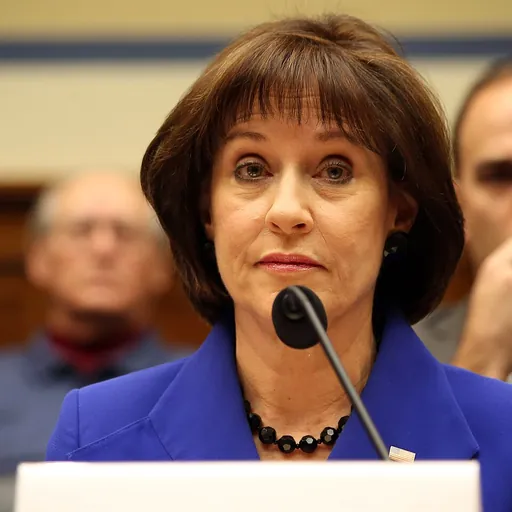
About Lois Lerner
Born 1950. Lois Lerner is a lawyer and internal Revenue Service.
Lois Gail Lerner (born October 12, 1950) is an American attorney and former United States federal civil service employee. She served as director of the Exempt Organizations Unit of the Internal Revenue Service (IRS) in 2005, and subsequently became the central figure in the 2013 IRS targeting controversy in the targeting of politically aligned groups, either denying them tax-exempt status outright or delaying that status until they could no longer take effective part in the 2012 election.
On May 10, 2013, in a conference call with reporters, Lerner apologized that Tea Party groups and other groups had been targeted for audits of their applications for tax-exemption. Lerner resigned over the controversy. An investigation by the U.S. Department of Justice and Federal Bureau of Investigation, completed in 2015, found "substantial evidence of mismanagement, poor judgment and institutional inertia" but "found no evidence that any IRS official acted based on political, discriminatory, corrupt, or other inappropriate motives that would support a criminal prosecution".
Early life Lerner graduated from Northeastern University. She earned her J.D. from the Western New England College of Law.
Career before the IRS After graduating from law school, Lerner became a staff attorney in the U.S. Department of Justice Criminal Division.
In January 2006, she was appointed Director Exempt Organizations. In that capacity, Lerner led an organization of 900 IRS tax law enforcement officials responsible for a broad range of compliance activities, including examining the operational and financial activities of exempt organizations, processing applications for tax exemption, providing direction through private letter rulings and technical guidance, and providing customer education and outreach to the exempt community.
2013 IRS controversy
On May 10, 2013, in advance of a public release of the audit findings, Lerner answered a planted question at a meeting of the American Bar Association (ABA) by stating that the IRS was "apologetic" for what she termed "absolutely inappropriate" actions. Lerner said that the extra scrutiny had not been centrally planned and had been done by low-level "front-line people" in the Cincinnati office. The Washington Post subsequently reported that documents showed that "IRS officials at the agency's Washington headquarters sent queries to conservative groups asking about their donors and other aspects of their operations, while officials in the El Monte and Laguna Niguel offices in California sent similar questionnaires to tea-party-affiliated groups." Lerner's superior, then-acting IRS Commissioner Steven Miller, later testified to Congress that he had discussed with Lerner how she was to make the revelation and apology using a planted question at the ABA meeting, rather than at her appearance two days earlier before the House Ways and Means Committee.
On May 10, 2013, in a conference call with reporters, Lerner apologized that Tea Party groups and other groups had been targeted for audits of their applications for tax-exemption. Lerner told those on the conference call that, in an attempt to manage the large number of tax-exemption applications between 2010 and 2012, the agency had identified some applicants using "shortcuts" such as targeting those applications containing terms like "Tea Party" or "patriots" in their titles. Lerner said, however, that such actions were not driven by any political agenda, but added, "We made some mistakes. Some people didn't use good judgment.... For that we're apologetic." Lerner also said that only about 25 percent of the flagged applications were Tea Party related, but admitted that any singling out of the groups was "absolutely inappropriate and not the way we should do things."
2014 Contempt of Congress citation In May 2014, Lerner was declared in contempt of Congress in connection with her invocation of her Fifth Amendment right not to testify on the matter before a congressional committee. The contempt resolution, H.Res. 574, was introduced in the United States House of Representatives on May 7, 2014, by Representative Darrell Issa, Republican of California.
On May 7, 2014, the resolution passed on a 231–187 vote, with all Republicans and six Democrats voting in favor, and every other Democrat opposed. Representative Steve Stockman introduced a measure (never taken up by the House) that, had it been adopted, would have directed Speaker John Boehner to instruct the House sergeant at arms to arrest Lerner for contempt of Congress.
In a seven-page letter to Speaker Boehner dated March 31, 2015, United States Attorney for the District of Columbia Ronald Machen said that the Justice Department would not pursue criminal contempt charges against Lerner. Machen disagreed with Issa's assertion that Lerner had waived her constitutional right against self-incrimination by making an opening statement at a May 2013 hearing in which she made a brief opening remark proclaiming her innocence, before invoking her Fifth Amendment privilege. One subpoena directed FEC chairman Lee E. Goodman to turn over all emails sent to or from Lerner, or copied to Lerner, from the past 28 years, stretching back to January 1, 1986, a time before commercialized email existed.
The House Oversight Committee also subpoenaed the IRS for all e-mails to and from Lerner and various other employees, such as Lerner subordinate Holly Paz, General Counsel William Wilkins and chief of staff Jonathan Davis. At a hearing in March 2014, IRS commissioner John Koskinen said that the IRS had by that time provided 690,000 pages of documents to the House Ways and Means Committee and the Senate Finance Committee and 420,000 of redacted documents to the House and Senate oversight committees.
Hard drive crash and back-up tape erasure of Lerner's emails
Testifying in June 2015, the IRS Deputy Inspector General Timothy P. Camus said that 424 back-up tapes, most likely to have contained the missing emails, were erased in March 2014—a month after the IRS said it realized it was missing some of Lerner's emails because of a hard-drive crash, and although the emails were then under subpoena from the Oversight Committee. He stated, however, that their investigation "did not uncover evidence that the erasure was done ... to destroy evidence or conceal information from Congress", and noted that there was a "remote possibility" that additional emails might still be found. He said that officials were examining the possibility, however, of criminal activity.
In a statement released June 25, 2015, the IRS said it has "fully cooperated with the investigation", but acknowledged the backup tapes should not have been erased. "The IRS recognizes there was a clear breakdown of communication in one part of the organization regarding the need to preserve and retain the back-up tapes and information," the statement said, noting that an internal review found the erasure wasn't intentional.
FBI finds no evidence to support criminal prosecution
The U.S. Department of Justice and the FBI began an investigation into the IRS controversy in May 2013. In October 2015, the DOJ announced it was closing the investigation and would not seek criminal charges. The determination came after an investigation of almost two years, in which the DOJ and FBI interviewed more than 100 witnesses and reviewed more than a million pages of IRS documents. Kadzik stated that the investigation specifically absolved Lerner of criminal liability, and determined that Lerner was in fact the first official to recognize a problem and try and correct it.
Reactions to the investigation's conclusions were split along partisan lines. Representative Darrell Issa, Republican of California, the chairman of the House Oversight and Government Reform Committee, said that decision not to prosecute ignored "volumes of evidence in the public record and efforts to obstruct legitimate inquires", and that "giving Lois Lerner a free pass only reinforces the idea that government officials are above the law and that there is no consequence for wrongdoing".
Personal life Lerner is a past president of the Council on Governmental Ethics Laws (COGEL).
Lerner has stated she is "not a political person" but is a registered Democrat and has voted for candidates from both parties.
Don’t just read it —
keep it.
Full-length biographies made to live with: read them, listen on the way to work, watch them tonight.
- E-book
- Audio
- Video
Instant download · yours to keep · every purchase keeps this site free
Important facts
People in Lois Lerner's life
Named in this biography and alive at the same time







Related people
Same field, nearest in time


Contemporaries
People whose lives overlapped Lois Lerner's




Frequently asked questions
Who is Lois Lerner?
American attorney
When was Lois Lerner born?
Lois Lerner was born on 12 October 1950.
What is Lois Lerner's occupation?
Lois Lerner is a lawyer and internal Revenue Service.
Sources & further reading
Cite this page
APA: Biography.guide. (2026). Lois Lerner. https://biography.guide/lois-lerner/
MLA: "Lois Lerner." Biography.guide, https://biography.guide/lois-lerner/.
Chicago: "Lois Lerner." Biography.guide. https://biography.guide/lois-lerner/.
Data last updated: 2026-09-23 · Spot an error? Report a correction.
Portrait: Wikimedia Commons · author & licence
Page generated 2026-09-27 05:06 UTC