
About Lofty England
Lived 1911 – 1995 (aged 83). Lofty England was a British engineer and businessperson.
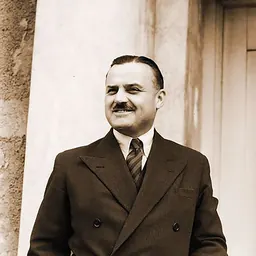
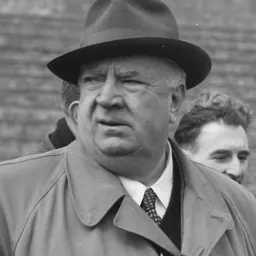
Frank Raymond Wilton "Lofty" England (24 August 1911, Finchley, Middlesex – 30 May 1995, Austria) was an engineer and motor company manager from Britain. He rose to fame as the manager of the Jaguar Cars sports car racing team in the 1950s, during which time Jaguar cars won the prestigious 24 Hours of Le Mans race on five occasions. After the company's withdrawal from racing England moved into the mainstream management of Jaguar Cars, later succeeding Sir William Lyons as its chairman and Chief Executive, before retiring in 1974.
Early life Frank England was born in Finchley, Middlesex, and found an aptitude and interest in motor engineering during his schooling at Christ's College. At the age of 14 the England family moved to Edgware. Here the young Frank was able to watch Bentley chassis, built in nearby Cricklewood, being tested along the long, straight A5 road, formerly part of the Roman road of Watling Street.
England was apprenticed as an engineer to the Daimler Company in 1927 where, owing to his height, he quickly acquired the nickname, "Lofty", which would stick with him for the rest of his life. Daimler had not been England's first choice; his early experiences had led him originally to apply to Bentley, but without success. During his five-year apprenticeship Lofty England also made his first appearances in motorsport. In 1932, his final year as an apprentice, England finished second in the inaugural RAC Rally, driving one of Laurence Pomeroy's Daimler Double Six cars. Works-prepared XK120s won numerous other events including the Tulip Rally in 1950 and the Alpine Rally in 1950, 1951 and 1952.
In 1952 Lofty England and several factory mechanics supported a high-speed endurance run at Linas-Montlhéry, where Johnson, Moss, Hadley and Jack Fairman drove a works-modified XK120 coupé, the personal car of William Heynes, at an average of just over 100 mph for seven days and nights to break nine speed and endurance records.
1951–1953: The C-Type era
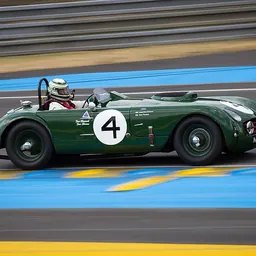
While results continued to come with the production XK120 model, England and Heynes realised that it was too overweight and aerodynamically compromised to have a serious chance of winning the Le Mans race. Their solution was to take the drivetrain from the XK120 and to install it in a lightweight chassis. William Heynes developed a new design with a new frame chassis and new bodywork with air flow shape developed by aerodynamist Malcolm Sayer. The XK120C (for competition), later known as the C-Type, made its debut at the Le Mans race.
Lofty England's racing experience and sharp strategic thinking required that Moss and co-driver Jack Fairman act as a "hare", driving hard from the start to draw other cars into chasing it in the hope that their cars would fail. The strategy worked almost entirely as planned. Moss posted a new lap record of 105.232 mph England and Rolt both later denied that the drivers had been drunk at the time.
1954–1957: The D-Type era
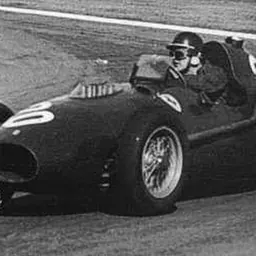
For 1954 Lofty England decided that Jaguar had taken the C-Type as far is they could, and a new car was designed around the successful XK engine. Appropriately, the iconic D-Type made its debut at the 1954 24 Hours of Le Mans race, where Hamilton and Rolt were beaten into second place by only one lap, by the Ferrari 375 of Formula One stars José Froilán González and Maurice Trintignant. The event was poised to be a direct contest between England's Jaguars, and the Mercedes team of Alfred Neubauer. an accident triggered by the D-Type of Mike Hawthorn caused the deaths of Mercedes driver Pierre Levegh and 83 spectators, plus injuring 120 others. Neubauer's team were withdrawn from the race some hours later and invited Jaguar to share the gesture, but England decided to keep the Jaguars running.
Lofty England attracted some criticism for his decision to continue the race. However, England maintained for the rest of his life that he did not regard Hawthorn as being responsible for the tragedy, and therefore the team had no reason to withdraw.
Jaguar management career Immediately following Jaguar's withdrawal from racing Lofty England returned to his role as director of the Jaguar service department. In 1958 Tony Vandervell offered to sell England the Vanwall Formula One team, after the death of Vandervell's protégé Stuart Lewis-Evans during the 1958 Moroccan Grand Prix. and William Heynes succeeded him as joint managing directors of the company. In turn, BMH merged with Leyland Motors in 1968 to form the British Leyland Motor Corporation.
In between the management upheaval, Lofty England invited back old friend Walter Hassan to develop Jaguar's XJ V12 engine. The engine made its debut in the Series III version of Jaguar's ageing E-Type in 1971, one year before Lofty England succeeded William Lyons as chairman and Chief Executive of Jaguar Cars. It was during his time as CEO that England had to negotiate with the unions to ensure that the car the V12 was built for, the V12 version of the Jaguar XJ saloon, was not delayed into production. Reflecting his own previous success and the Daimler company history, England decided that the Daimler version of the V12 should be called the Double Six. With increasing industrial tensions and centralised decision making within British Leyland, England felt that his position was untenable
Don’t just read it —
keep it.
Full-length biographies made to live with: read them, listen on the way to work, watch them tonight.
- E-book
- Audio
- Video
Instant download · yours to keep · every purchase keeps this site free
Important facts
People in Lofty England's life
Named in this biography and alive at the same time


Related people
Same field, nearest in time



Contemporaries
People whose lives overlapped Lofty England's






Frequently asked questions
Who was Lofty England?
British motorsport engineer (1911-1995)
When was Lofty England born?
Lofty England was born on 24 August 1911.
When did Lofty England die?
Lofty England died on 30 May 1995.
What was Lofty England's occupation?
Lofty England was an engineer and businessperson.
What nationality was Lofty England?
Lofty England was British.
Sources & further reading
Cite this page
APA: Biography.guide. (2026). Lofty England. https://biography.guide/lofty-england/
MLA: "Lofty England." Biography.guide, https://biography.guide/lofty-england/.
Chicago: "Lofty England." Biography.guide. https://biography.guide/lofty-england/.
Data last updated: 2026-09-20 · Spot an error? Report a correction.
Page generated 2026-09-27 05:12 UTC