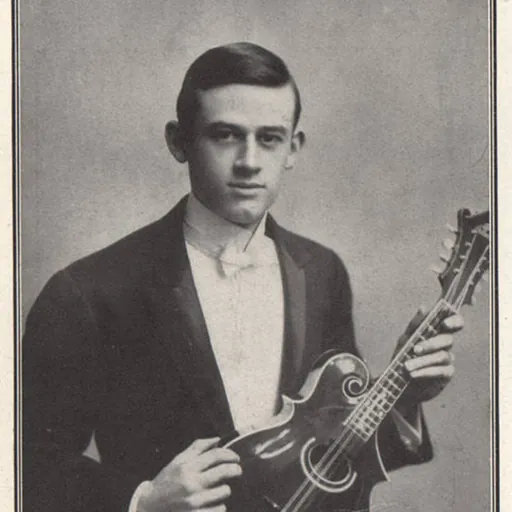
About Lloyd Loar
Lived 1886 – 1943 (aged 57). Lloyd Loar was an American musical instrument maker, composer and luthier.
History
Loar worked for Gibson from 1919 to 1924. His contributions include building the instrument top with F-shaped holes, like a violin; introducing a longer neck, thus moving the bridge closer to the center of the body; and floating the fingerboard over the top, a change from prior Gibson instruments that had fingerboards fused to the top. He also pioneered the use of the Virzi Tone Producer, a spruce disc suspended from the instrument top that acts as a supplemental soundboard.
It is not entirely clear why Loar was no longer employed by Gibson after 1924, although it may have had something to do with the 1923 departure of the man who hired Loar, Lewis Williams. As Vintage Guitar Magazine reported in a 2019 retrospective: "A great deal of speculation surrounds Lloyd’s departure from Gibson in December, 1924. There is nothing in the minutes from meetings of the board of directors to indicate strong disagreement. In fact, over his five years with the company, Loar is hardly mentioned. Evidence suggests he left quietly, and nobody really cared. Williams’ departure was followed by the hiring of Harry Ferris as general manager in 1923. He was fired in ’24. At the time, the company was dedicating more resources to banjo production, so the value of Loar’s presence ended with Williams. Loar’s attitude may have soured or he simply saw no reason to remain with Gibson."
According to A. R. Duchossoir, Loar designed experimental electric instruments while at Gibson. Loar's views on the importance of the development of electric instruments were supported by Lewis A Williams, one of the founders and major stockholders of Gibson as well as its secretary and general manager.
None of Loar's original electric instruments appear to have been preserved—but Walter A Fuller, who joined Gibson in 1933 and later became Gibson's chief electronic engineer, found some of Loar's original devices when he first set up his R&D lab in the mid-1930s. He claimed that Loar's electrics had electrostatic pickups, but because they exhibited very high impedance they were extremely susceptible to humidity. According to Fuller, the pickups were round, about the size of a silver dollar and had a piece of cork on the back, by which they were glued to the underside of the top of the instrument.
Duchossoir's book, Gibson Electrics, The Classic Years, features a photo of a Gibson L5, serial number 88258 of 1929 (after Loar left Gibson), one of the original Loar-designed L5s, with fitted electrostatic pickup and factory-fitted jack socket in the tailpiece.
Duchossoir also claims that Loar spent time at Gibson working on a 'quasi-solid body' electric double bass, and that according to this instrument and several patents filed by Loar between the mid-1920s and the mid-1930s, he worked on pickups that were electromagnetic in nature.
According to Duchossoir, Lewis Williams was replaced as general manager, and a lack of amicable relations with the new manager—an accountant named Guy Hart—led to the termination of Loar's contract. After leaving Gibson, Loar created and patented an electric instrument with a coil pickup, and co-founded the Acousti-Lectric company with Lewis Williams in 1934. The company was renamed the Vivi-Tone company in 1936. Loar died in 1943.
Famous Loar mandolins
The F5 model was made famous by the founder of bluegrass, Bill Monroe. Monroe played a Gibson F5 model serial number 73987 signed by Loar on July 9, 1923, for most of his career. This mandolin can be viewed in the Country Music Hall of Fame in Nashville, where it now resides in their collections.
Loar also signed a rare subset of F5 mandolins called Ferns, of which approximately twenty are known to exist. The name refers to the distinctive fern inlay design of the peghead. The earliest documented Fern bears the serial number 73755, dated July 9, 1923, the same signing date as Bill Monroe's famous Loar. This is the only known Fern built without the "Virzi" Tone Producer, a secondary sound board suspended underneath the mandolin's top inside the sound chamber. This particular instrument is the only known Fern dated on 9 July.
In 2007, mandolinist Chris Thile acquired a 1924 Loar-signed F5 serial # 75316 that was an exceedingly rare find, as it was in virtually new condition. It reportedly cost him around $200,000. Thile also owns serial # 75318, while John Paul Jones of Led Zeppelin owns the mandolin between the two, serial # 75317. Other well-known musicians who have owned Loar-signed F5's include Mike Marshall, David McLaughlin, Herschel Sizemore, Alan Bibey, Tony Williamson, David Grisman, John Reischman, Tom Rozum, Frank Wakefield, Ricky Skaggs and the late Joe Val serial #72207.
Only one A-style mandolin, a Gibson A5, is known to have been signed by Loar. It has been widely copied, originally by mandolin maker Bob Givens. The Loar A5 was found by Tut Taylor and sold to a Southern California bluegrass musician in 1974.
Mr. Taylor originally acquired the A5 from the sister of Dr. William B. Griffith, of the Griffith School of Music in Atlanta, Georgia. Dr. Griffith's wife, also a teacher at the school, reportedly requested an F5 in a body style without points. Her request resulted in the production of the Loar A5 in 1923.
Collectability
Loar expert Darryl Wolfe maintains an F5 historical journal. As of January, 2010 he has documented 228 Loar-signed F5 mandolins of the 326 that are believed to have been made. In 2023 the value of a Loar-signed mandolin was estimated at $100,000 to $175,000 depending on condition.
L-5 Guitar
width1 = 150 caption1 = Gibson L-5 guitar , "the most important single guitar in the entire history of country music," according to George Gruhn. There is controversy about its date. Commonly said to be a 1928 instrument, but researcher Joe Spann concluded, it couldn't have left the factory earlier than April 1929, and was shipped January, 1930.
Don’t just read it —
keep it.
Full-length biographies made to live with: read them, listen on the way to work, watch them tonight.
- E-book
- Audio
- Video
Instant download · yours to keep · every purchase keeps this site free
Important facts
People in Lloyd Loar's life
Named in this biography and alive at the same time





Related people
Same field, nearest in time



Contemporaries
People whose lives overlapped Lloyd Loar's



Frequently asked questions
Who was Lloyd Loar?
American luthier (1886–1943)
When was Lloyd Loar born?
Lloyd Loar was born on 9 January 1886 in Cropsey.
When did Lloyd Loar die?
Lloyd Loar died on 14 September 1943 in Chicago.
What was Lloyd Loar's occupation?
Lloyd Loar was a musical instrument maker, composer and luthier.
What nationality was Lloyd Loar?
Lloyd Loar was American.
Sources & further reading
Cite this page
APA: Biography.guide. (2026). Lloyd Loar. https://biography.guide/lloyd-loar/
MLA: "Lloyd Loar." Biography.guide, https://biography.guide/lloyd-loar/.
Chicago: "Lloyd Loar." Biography.guide. https://biography.guide/lloyd-loar/.
Data last updated: 2026-09-22 · Spot an error? Report a correction.
Portrait: Wikimedia Commons · author & licence
Page generated 2026-09-27 05:03 UTC