
About Ljuba Monastirskaja
Lived 1906 – 1941 (aged 35). Ljuba Monastirskaja was a Latvian textile designer and designer.
Ljuba Monastirskaja (25 September 1906 – 30 November 1941) was a Latvian textile artist. She was a victim of the Rumbula massacre in 1941.
Biography Monastirskaja was born into a secular Jewish family. Her father was a merchant who had moved to Riga from Chernihiv, Russian Empire (today Ukraine) to escape the 1903–1906 wave of pogroms.
Her upbringing in Riga during the late 1910s was affected by dramatic events related to World War I. As a teenager, Monastirskaja studied at the Jewish secular school in Riga, where she graduated in 1924.
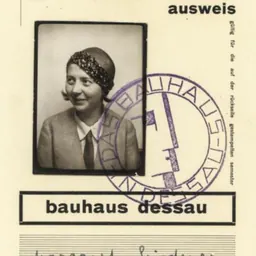
Like most other female students at Bauhaus, she was put in the weaving workshop. There she could develop both her craft skills as well as new industrial weaving techniques developed for mass production, largely inspired by constructivism. A few of her creations are still in existence, such as three work samples held by the Textile Museum in Tilburg, Netherlands.
Once she had completed her education, Monastirskaja started working for two well known German textile producers, first in Mössingen and then in Sagan. A certificate of 18 April 1932 stated that her job responsibilities included the preparation of the artistic designs of "decorative and padding fabrics in formal and technical terms".
A short time after returning to Latvia, she married architect Natan Kirsh in 1934, who also had a Jewish upbringing. Following the Ulmanis coup d'état, Monastirskaja had trouble establishing her practice as a textile producer. Her modern designs were not high in demand as the new nationalist regime promoted Latvian specific designs based on folkloristic traditions. Furthermore, she belonged to two minorities which were marginalised in 1930s Latvia: both Russian-speaking and Jewish.
In 1941, once Nazi Germany had invaded Latvia, the persecution of Latvian Jews begun. Monastirskaja was placed along with over 40,000 Jews in the specially built Riga Ghetto. Her husband had earlier been abducted and taken to Biķernieki.
Death On 30 November 1941, Monastirskaja, along with 12,000 others, was moved from the ghetto to a forest ten kilometres southeast of Riga. Here she was forced into a mass grave and shot dead in an atrocity that would later become known as the Rumbula massacre. The massacre was carried out by the Nazi Einsatzgruppe A with the help of local collaborators of the Arajs Kommando. All of her belongings and artistic works were destroyed or lost.
Don’t just read it —
keep it.
Full-length biographies made to live with: read them, listen on the way to work, watch them tonight.
- E-book
- Audio
- Video
Instant download · yours to keep · every purchase keeps this site free
Important facts
Related people
Same field, nearest in time



Contemporaries
People whose lives overlapped Ljuba Monastirskaja's

Frequently asked questions
Who was Ljuba Monastirskaja?
Latvian textile artist (1906–1941)
When was Ljuba Monastirskaja born?
Ljuba Monastirskaja was born on 25 September 1906 in Riga.
When did Ljuba Monastirskaja die?
Ljuba Monastirskaja died on 30 November 1941 in Rumbula.
What was Ljuba Monastirskaja's occupation?
Ljuba Monastirskaja was a textile designer and designer.
What nationality was Ljuba Monastirskaja?
Ljuba Monastirskaja was Latvian.
Sources & further reading
· Wikipedia: Ljuba Monastirskaja
· DBpedia: Ljuba Monastirskaja
Cite this page
APA: Biography.guide. (2026). Ljuba Monastirskaja. https://biography.guide/ljuba-monastirskaja/
MLA: "Ljuba Monastirskaja." Biography.guide, https://biography.guide/ljuba-monastirskaja/.
Chicago: "Ljuba Monastirskaja." Biography.guide. https://biography.guide/ljuba-monastirskaja/.
Data last updated: 2026-09-20 · Spot an error? Report a correction.
Page generated 2026-09-27 05:28 UTC