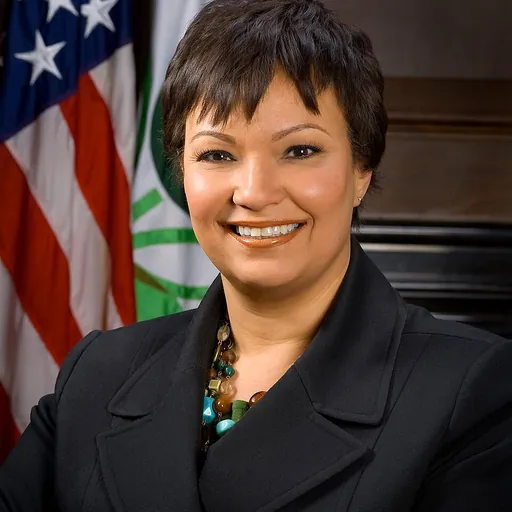
About Lisa P. Jackson
Born 1962. Lisa P. Jackson is an American engineer, politician and chemist.
Lisa Perez Jackson She grew up in Pontchartrain Park, a predominantly African-American middle-class neighborhood of New Orleans, Louisiana. In 1979, Jackson graduated as valedictorian from St. Mary's Dominican High School in New Orleans. Due to her exceptional performance in mathematics, she received a scholarship from the National Consortium for Graduate Degrees for Minorities in Engineering & Science, which allowed her to gain early exposure to a college environment.
She attended Tulane University with a scholarship from Shell Oil Company. Jackson is married to Kenneth Jackson and is the mother of two children.
On July 13, 2013, she was initiated into Delta Sigma Theta sorority as an honorary member during the organization's Centennial Celebration in Washington, DC.
Early EPA and DEP career As a child, Jackson did not feel any particular affinity for the outdoors, but she became interested in environmental matters following the national and international coverage of the Love Canal Disaster. She then moved to the agency's regional office in New York City. During her tenure at EPA, Jackson worked in the federal Superfund site remediation program, developing numerous hazardous waste cleanup regulations and directing multi-million dollar hazardous waste cleanup projects throughout central New Jersey. She later served as deputy director and acting director of the region's enforcement division.
Chief of staff to the governor of New Jersey On October 24, 2008, Corzine announced that Jackson would take over as his chief of staff, effective December 1, 2008, succeeding Bradley Abelow. As Chief of Staff Jackson would have served as Corzine's top advisor and chief political liaison to the State Legislature. However, Jackson was tapped by President Barack Obama to become administrator of the EPA just days after she became Corzine's chief of staff and resigned on December 15, 2008.
EPA administrator
On December 15, 2008, then President-elect Barack Obama officially designated Jackson as the nominee for Administrator of the Environmental Protection Agency. She was confirmed by voice vote in the U.S. Senate on January 22, 2009. Jackson is the first African American to serve as EPA administrator, along with being the fourth woman and second New Jerseyan to hold the position. Her deputy administrator was Bob Perciasepe, and additionally she had three associate, twelve assistant, and ten regional administrators overseeing some 17,000 agency employees.
By the EPA's own statements, Administrator Jackson pledged to focus on core issues of protecting air and water quality, preventing exposure to toxic contamination in U.S. communities, and reducing greenhouse gases. She pledged that all of the agency's efforts would follow the best science, adhere to the rule of law, and be implemented with unparalleled transparency. By the same statements, she made it a priority to focus on vulnerable groups – including children, the elderly, and low-income communities – that are particularly susceptible to environmental and health threats. She promised that all stakeholders will be heard in the decision-making process.
She became the first EPA administrator to focus on reforming the Toxic Substances Control Act of 1976, which regulates the introduction of new or already existing chemicals.
After the Deepwater Horizon drilling rig explosion, the Obama administration ordered the EPA, the Department of Homeland Security and the Department of Interior to coordinate federal emergency response efforts. Jackson's agency oversaw environmental and public health concerns during the Deepwater Horizon oil spill, including air and water monitoring and assessing aquatic life and other environmental destruction. Jackson authorized and defended BP's choice to use the dispersant Corexit to combat the 210 million gallons of oil spilled in the Gulf of Mexico. The use of Corexit was criticized because it's more toxic and less effective than other EPA approved dispersants, which later studies showed that Corexit had major effects on the aquatic life's food chain in the Gulf of Mexico. While testifying before the Senate Appropriations Subcommittee, Jackson called the use of dispersants an "environmental tradeoff", and that "We know dispersants are generally less toxic than the oils they break down." Jackson's agency faced a lawsuit in response of the spill from health and environmental groups for not setting adequate guidelines on how and where dispersants can be used safely. Jackson was designated by President Obama to serve as chair on the Gulf Coast Ecosystem Restoration Task Force, a federal effort to restore damages and preserve the ecosystem in the Gulf of Mexico.
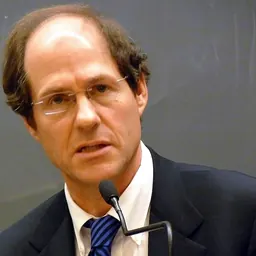
In 2011, Jackson laid out a plan for stricter limits on the National Ambient Air Quality Standards. The plan was based on adopting a 2007 recommendation from the EPA's science advisory board to set the NAAQS no higher than 70 parts per billion and no lower than 64 parts per billion, though it was later set to 75 parts per billion in 2008. Jackson met opposition to the smog standards proposal from economic advisors within Obama's administration, along with his chief of staff William Daley and regulatory affairs administrator Cass Sunstein. After recommending the plan to President Obama, he conclusively rejected the proposal saying that "Ultimately, I did not support asking state and local governments to begin implementing a new standard that will soon be reconsidered." His decision was met with anger from environmentalists and a lawsuit from environmental and health associations, with calls and speculation on whether Administrator Jackson would resign in protest. Jackson later announced that she would stay with the EPA, "respected President Obama's decision" and that her Agency would "aggressively implement" the curtailed version of the ozone standards.
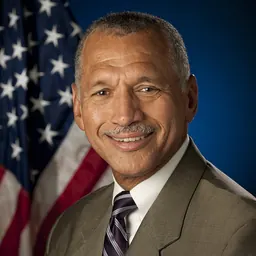
NASA administrator Charles Bolden and Jackson sign an agreement in 2010 to continue collaboration between the two agencies.
Media outlets and industry figures often refer to Jackson's testimony during a May 2011 Senate Hearing Committee that she is not aware of any cases where hydraulic fracturing itself has contaminated water. A 1987 EPA report and reports released since May 2011, however, have identified hydraulic fracturing as the likely source of water contamination in several cases.
During an event with youth environmental leaders at Howard University, Jackson was asked by students about the controversial proposed Keystone Pipeline, she said that "To me, it's awesome; it's awesome that we're having this conversation in this country. This should be a moment where we're having a big conversation." She also urged caution on the proposed project saying that "This isn't a little tiny pipeline; this is a pipeline that cuts our country literally in half."
Jackson spoke out against the Senate Joint Resolution 26 (the Murkowski Amendment), which would take away the EPA's authority to regulate greenhouse gas emissions under the Clean Air Act, which was expanded by the 2007 Supreme Court decision in Massachusetts v. Environmental Protection Agency. In an op-ed in the Huffington Post on the Murkowski Amendment, Jackson said that "now is not the time to take a big step backward, by doubling down on the kinds of energy and environmental policies that keep America addicted to oil." Jackson has argued against claims by lobbying groups and members of congress that the EPA is responsible for a "train wreck" of new clean air regulations and the effect of existing EPA regulations on the economy. Jackson said that "Big polluters are lobbying Congress for loopholes to use our air and water as dumping grounds. The result won't be more jobs; it will be more mercury in our air and water and more health threats to our kids." (For her part, Senator Lisa Murkowski, the author of the amendment, argued that the regulations risked damaging the American economy.)
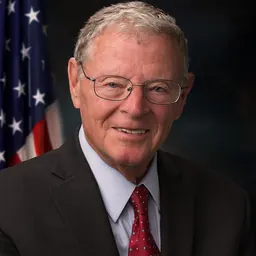
During her tenure as head of the EPA, Jackson received criticism from the coal industry and Republican members of the House and Senate, most notably Oklahoma senator Jim Inhofe, for claims of the EPA overreaching on regulating toxins released from coal ash and power plant mercury emissions. Senator Inhofe, at the time a ranking member on the Senate Committee on the Environment who did not believe that human activity causes global climate change, called on Jackson to reconsider new greenhouse gas regulations after the Climatic Research Unit email controversy. With Jackson responding saying that "The science behind climate change is settled, and human activity is responsible for global warming," and that "That conclusion is not a partisan one." Though Jackson and Inhofe have conflicted views on Environmental issues, in an interview he called her "One of my favorite Liberals."
On December 13, 2012, the assistant inspector general notified the EPA they would be conducting an audit into recordkeeping practices associated with the use of private email accounts by Jackson under the name of "Richard Windsor." The Justice Department agreed to release 12,000 emails at a rate of 3,000 per week from this account beginning January 14, 2013, in response to a lawsuit brought by a Washington attorney.
On December 27, 2012, Jackson announced that she would be stepping down from her position as EPA administrator. According to the New York Post, Jackson submitted her resignation because she believed that the Obama administration would move to support the Keystone pipeline and she did not want this to occur on her watch. Jackson left office on February 15, 2013, and was succeeded by Deputy Administrator Bob Perciasepe.
At a House hearing in September 2013, Jackson denied knowledge of any government secrecy and denied that she tried to evade federal recordkeeping laws.
Tenure at Apple In 2013, Jackson became Apple Inc.'s vice president of environment, policy and social initiatives, reporting to CEO Tim Cook. Apple announced in December 2025 that she would retire in January 2026. In February 2026, Conservation International named Jackson interim chair of its board of directors.
Awards and honors
Member of the American Academy of Arts and Sciences, elected 2021
Don’t just read it —
keep it.
Full-length biographies made to live with: read them, listen on the way to work, watch them tonight.
- E-book
- Audio
- Video
Instant download · yours to keep · every purchase keeps this site free
Important facts
People in Lisa P. Jackson's life
Named in this biography and alive at the same time




Related people
Same field, nearest in time




Contemporaries
People whose lives overlapped Lisa P. Jackson's





Frequently asked questions
Who is Lisa P. Jackson?
American politician: EPA administrator
When was Lisa P. Jackson born?
Lisa P. Jackson was born on 8 February 1962 in Philadelphia.
What is Lisa P. Jackson's occupation?
Lisa P. Jackson is an engineer, politician and chemist.
What nationality is Lisa P. Jackson?
Lisa P. Jackson is American.
Sources & further reading
Cite this page
APA: Biography.guide. (2026). Lisa P. Jackson. https://biography.guide/lisa-p-jackson/
MLA: "Lisa P. Jackson." Biography.guide, https://biography.guide/lisa-p-jackson/.
Chicago: "Lisa P. Jackson." Biography.guide. https://biography.guide/lisa-p-jackson/.
Data last updated: 2026-09-23 · Spot an error? Report a correction.
Portrait: Wikimedia Commons · author & licence
Page generated 2026-09-27 05:06 UTC