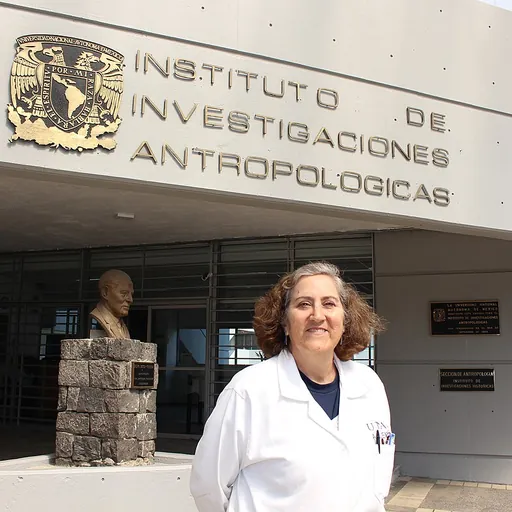
About Linda Manzanilla
Born 1951. Linda Manzanilla is a Mexican archaeologist, egyptologist and university teacher.
Linda Rosa Manzanilla Naim (born January 25, 1951) is a Mexican archaeologist, Egyptologist, researcher and academic.
Manzanilla is an important figure in the field of archaeology, particularly for her work in Mesoamerican studies. She is well known for her contributions to the understanding of the ancient civilizations of Mexico, especially the pre-Columbian cultures such as the Teotihuacan, Olmec and the Maya. Manzanilla has conducted extensive research on the social, political, and ritual practices of ancient societies and how they evolved over time.
Her research uses an interdisciplinary approach and mainly focuses on Teotihuacan.
Life and academics Manzanilla was born in Manhattan, New York City, on January 25, 1951. Her father was Víctor Manzanilla Schaffer, a diplomat and politician who later became Governor of Yucatán of German, Spanish and Indigenous origins whilst her mother, Roby Naim, was a translator for the United Nations of Egyptian, French ancestors who lived in Africa and spoke Arabic.
In 1970 she entered the National School of Anthropology and History where she received a degree in archaeology. She worked as a research assistant in the Department of Prehistory of the National Institute of Anthropology and History from 1972 to 1977. In 1979 she obtained a master's degree in anthropological sciences and graduated magna cum laude. She traveled to Paris to pursue a third-cycle doctorate in Egyptology from 1979 to 1982, at Paris-Sorbonne University.
She is a researcher at the Anthropological Research Institute of the National Autonomous University of Mexico.
Manzanilla has excavated in Mexico, particularly at Teotihuacan and Cobá (1983 y 1984); in Xalasco, Tlaxcala (2008); Monte Albán, Oaxaca (1973); Abasolo, Guanajuato (1973); Lake Texcoco (1972) and Santa Marta, Chiapas (1973). Internationally she has excavated in Tiwanaku (Bolivia) as part of a project of the University of Chicago (1988–1989); Medinet Madi (Egypt) as part of the Italian Archaeological Missions of the University of Rome (1978), Arslantepe (Eastern Anatolia) as part of the Italian Archaeological Missions of the University of Rome (1976, 1984, 1989, 1996 and 2013) and Magdala (Israel) as consultant of the Project Magdala (2010 and 2012). On April 9, 2007, she joined El Colegio Nacional with the speech 'Teotihuacan: la gran anomalía de Mesoamérica', which was answered by Miguel León-Portilla and Octavio Novaro. Since 2006 she belongs to the American Philosophical Society and to the Academy of Sciences of Latin America (ACAL). She is a member of the National System of Researchers since 1985, and Emeritus National Researcher of the National System of Researchers since 2021. She has served as a member of the Committee for Research and Exploration of the National Geographic Society.
Publications
Author or editor of 32 books, 220 articles and chapters, 9 reviews and 73 technical reports on the emergence and transformations of early urban societies in Mesoamerica, Mesopotamia, Egypt and the Andean region.
Some of her more notable works are the Alfonso Caso Award winners 'Anatomía de un conjunto residencial teotihuacano en Oztoyahualco' from 1993 (as editor) and 'Estudios arqueométricos del centro de barrio de Teopancazco en Teotihuacan' from 2012.
Other works are 'La constitución de la sociedad urbana en Mesopotamia: un proceso en la historia' (1986), 'Akapana. Una pirámide en el centro del mundo' (1992), 'Teotihuacan: ciudad excepcional de Mesoamérica' (2017), 'El uso de los recursos naturales en un centro de barrio de Teotihuacan: Teopancazco' (2017), 'El Palacio de Xalla en Teotihuacan: primer acercamiento' (2019), 'Las sedes del poder en Mesoamérica' (as editor) (2021), 'El inframundo de Teotihuacan' (2023) and 'Teotihuacan in Central Mexico: an exceptional megalopolis' (2023).
Awards 1990: Mexican Academy of Sciences Award 1994 and 2013: Alfonso Caso Award (Instituto Nacional de Antropología e Historia) for best research in Archeology for the book 'Estudios arqueométricos del centro de barrio de Teopancazco en Teotihuacan' 2010: Honorary doctor degree by the National Autonomous University of Mexico 2011: Juchimán de Plata Award 2013: Coatlicue Award 2015: Shanghai Archaeology Forum Award for her interdisciplinary research on the multiethnic population of the neighborhood center of Teopancazco in Teotihuacan. 2017: Anahuac Medal in Social Sciences, Philosophy and Literature 2018: Lifetime career recognition from the Autonomous University of Campeche at the XXVIII Meeting of Mayan Culture researchers. 2019: Honorary doctor degree by the San Cristóbal of Huamanga University
Don’t just read it —
keep it.
Full-length biographies made to live with: read them, listen on the way to work, watch them tonight.
- E-book
- Audio
- Video
Instant download · yours to keep · every purchase keeps this site free
Important facts
more
Linda R. ManzanillaPeople in Linda Manzanilla's life
Named in this biography and alive at the same time




Related people
Same field, nearest in time

Contemporaries
People whose lives overlapped Linda Manzanilla's


Frequently asked questions
Who is Linda Manzanilla?
Mexican archaeologist
When was Linda Manzanilla born?
Linda Manzanilla was born on 25 January 1951 in New York City.
What is Linda Manzanilla's occupation?
Linda Manzanilla is an archaeologist, egyptologist and university teacher.
What nationality is Linda Manzanilla?
Linda Manzanilla is Mexican.
Sources & further reading
Cite this page
APA: Biography.guide. (2026). Linda Manzanilla. https://biography.guide/linda-manzanilla/
MLA: "Linda Manzanilla." Biography.guide, https://biography.guide/linda-manzanilla/.
Chicago: "Linda Manzanilla." Biography.guide. https://biography.guide/linda-manzanilla/.
Data last updated: 2026-09-22 · Spot an error? Report a correction.
Portrait: Wikimedia Commons · author & licence
Page generated 2026-09-27 05:03 UTC