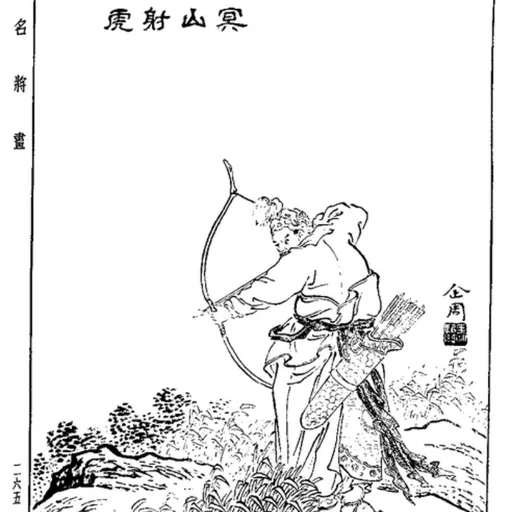
About Li Guang
Lived 184 BC – 119 BC (aged 64–65). Li Guang was a Chinese military personnel.
Li Guang (184–119 BCE) was a Chinese military general of the Western Han dynasty. Nicknamed the "Flying General" by the Xiongnu, he fought primarily in the campaigns against the nomadic Xiongnu tribes to the north of the Western Han. He was known to the Xiongnu as a tough opponent when it came to fortress defense, and his presence was sometimes enough for the Xiongnu to abort a siege.
Li Guang committed suicide shortly after the Battle of Mobei in 119 BC. He was blamed for failing to arrive at the battlefield in time (after getting lost in the desert), creating a gap in the encirclement and allowing the Xiongnu chanyu Yizhixie to escape after a confrontation between Wei Qing and Yizhixie's main force, which the Han army narrowly managed to defeat. Refusing to accept the humiliation of a court martial, Li Guang killed himself.
Li Guang belonged to the Longxi branch of the Li clan (隴西李氏). Li Guang was a descendant of Laozi and the Qin general Li Xin, as well as an ancestor of the Western Liang dynasty and Tang dynasty monarchs. Li Guang was the grandfather of the Western Han general Li Ling who defected to the Xiongnu.
Biography In 166 BC (the fourteenth year of Emperor Wen of Han), Xiongnu launched a large-scale invasion of Xiaoguan. Li Guang joined the army to fight against Xiongnu. Because he was skilled in horsemanship and archery, he killed many Xiongnu leaders. Li Guang also had accompanied the emperor on several hunts and personally killed wild beasts. Emperor Wen of Han impressed with him and E claimed that if Li Guang born during the time of Liu Bang, he would reach high position without much difficulty.
Li Guang further distinguished himself during the Rebellion of the Seven Kingdoms, where he served under the Grand General Zhou Yafu. However, Emperor Jing was unhappy that he had accepted a seal given by Liu Wu, Prince of Liang, Emperor Jing's brother; Emperor Jing had been wary of the Prince of Liang, as Liu Wu had ambitions to place himself as Emperor Jing's successor, over Emperor Jing's sons. This stance was also supported by Empress Dowager Dou, their mother. Thus, Li did not get promoted to a marquisate despite his anti-rebellion achievement.
In 129 BC, Li Guang himself narrowly escaped capture after his army was annihilated during an offensive campaign at Yanmen. Due to this accident, Li Guang was stripped of official titles and demoted to commoner status with fellow defeated general Gongsun Ao (公孫敖) after paying parole. The rules of the Han army dictated a commander's achievement was measured only according to his number of enemy kills minus the casualties of his own side. In the Imperial Japanese gunka Teki wa Ikuman, the song's lyrics reference Li Guang's ability to pierce a stone with an arrow as an example of determination regardless of difficulty. According to the "Treatise on Arts and Letters," a work titled General Li's Art of Archery (Li Jiangjun Shefa) was authored by Li Guang.
Similar to his contemporaries Wei Qing and Huo Qubing, he was a caring and well-respected general who earned the respect of his soldiers. He also earned the favor of Emperor Wen, who said of him: "If he had been born in the time of Emperor Gaozu, he would have been given a fief of ten thousand households (Chinese:万户侯) without any difficulty".
However, Li Guang's late military career was constantly haunted by repeated incidents of what would be regarded as jinxed with "bad luck" by later scholars. He had a nasty tendency of losing direction during mobilisations; in field battles, he was often outnumbered and surrounded by superior enemies. While Li Guang's fame attracted much of his enemies' attention, Li Guang's troops relative lack of discipline and his lack of strategic planning often put him and his regiments in awkward situations. These, together with Li Guang's political naivety (as shown in the Prince of Liang incident), denied him of any chance of promotion to a marquisate, his lifelong dream. Emperor Wu even secretly ordered Wei Qing not to assign Li Guang to important missions (such as the vanguard position), on the grounds of Li Guang's famed "terrible fortune". According to Sima Qian's record, one day Li Guang seeking consultation with Wang Shuo, an astrologer and physiognomist, about why his career was unfortunate and never being able to achieve marquis rank. Wang Shuo pointed out that it is due to Li Guang's past sin of massacring the surrendered 800 enemy Qiang people soldiers in the past.
Li Guang is mentioned by his nickname in Wang Changling's seven-character quatrain "On the Frontier" (出塞). Wang comments on how war has been taking its toll on the troops stationed at the frontier, particularly given the lack of a brilliant and charismatic military commander like Li Guang.
Don’t just read it —
keep it.
Full-length biographies made to live with: read them, listen on the way to work, watch them tonight.
- E-book
- Audio
- Video
Instant download · yours to keep · every purchase keeps this site free
Important facts
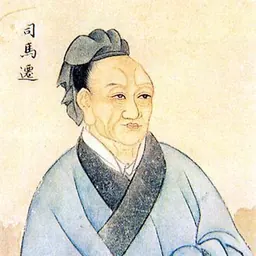
People in Li Guang's life
Named in this biography and alive at the same time




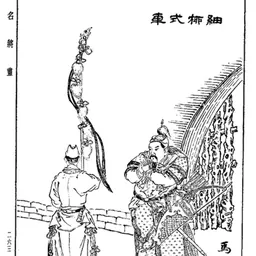
Related people
Same field, nearest in time


Contemporaries
People whose lives overlapped Li Guang's


Frequently asked questions
Who was Li Guang?
general of the Western Han dynasty
When was Li Guang born?
Li Guang was born in 184 BC in Tianshui.
When did Li Guang die?
Li Guang died in 119 BC.
What was Li Guang's occupation?
Li Guang was a military personnel.
What nationality was Li Guang?
Li Guang was Chinese.
Sources & further reading
Cite this page
APA: Biography.guide. (2026). Li Guang. https://biography.guide/li-guang/
MLA: "Li Guang." Biography.guide, https://biography.guide/li-guang/.
Chicago: "Li Guang." Biography.guide. https://biography.guide/li-guang/.
Data last updated: 2026-09-21 · Spot an error? Report a correction.
Portrait: Wikimedia Commons · author & licence
Page generated 2026-09-27 04:59 UTC