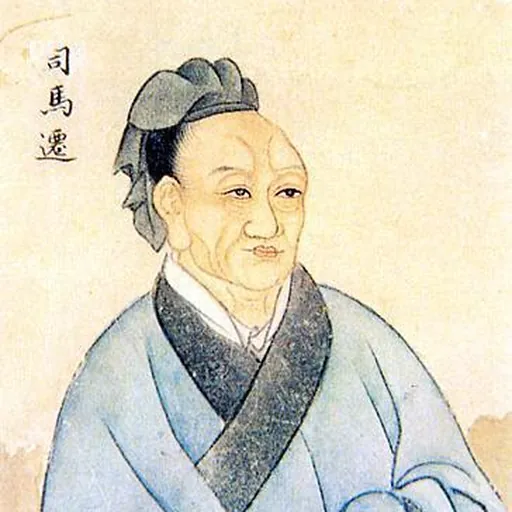
About Sima Qian
Lived 145 BC – 86 BC (aged 58–59). Sima Qian was a Chinese historian, poet, writer, astrologer, philosopher and mathematician, known for Records of the Grand Historian.
Sima Qian was a Chinese historian during the early Han dynasty. He is considered the father of Chinese historiography for the Shiji (sometimes translated into English as Records of the Grand Historian), a general history of China covering more than two thousand years from the rise of the legendary Yellow Emperor and formation of the first Chinese polity to the reign of Emperor Wu of Han, during which Sima wrote. As the first universal history of the world as it was known to the ancient Chinese, the Shiji served as a model for official histories for subsequent dynasties across the Sinosphere until the 20th century. As Sima Qian himself explained in his Letter to Ren An:
Later years and death Upon his release from prison in 97/96 BC, Sima Qian continued to serve in the Han court as zhongshuling (中書令), a court archivist position reserved for eunuchs with considerable status and with higher pay than his previous position of historian.
The Letter to Ren An was written by Sima Qian in reply to Ren An in response to the latter's involvement in Crown Prince Liu Ju's rebellion in 91 BC. This is the last record of Sima Qian in contemporary documents. The letter is a reply to a lost letter by Ren An to Sima Qian, perhaps asking Sima Qian to intercede on his behalf as Ren An was facing execution for accusations of being an opportunist and displaying equivocal loyalty to the emperor during the rebellion. In his reply, Sima Qian stated that he is a mutilated man with no influence at court. Some later historians claimed that Sima Qian himself became implicated in the rebellion as a result of his friendship with Ren An and was executed as part of the purge of the crown prince's supporters in court; however, the earliest-attested record of this account dates from the 4th century. Moreover, it has also been pointed out that Sima Qian would have been reluctant to render substantive aid to Ren An, given the severe consequences that he suffered for supporting General Li Ling, as well as Ren An's failure to act on his behalf during the Li Ling affair. Although there are many theories regarding the exact dating as well as the true nature and purpose of the Letter to Ren An, one common interpretation suggests that the letter, in part, tacitly expressed a refusal to play an active role in securing a reduced punishment for Ren An. The Letter to Ren An contains the quote, "Men have always had but one death. For some it is as weighty as Mount Tai; for others it is as insignificant as a goose down. The difference is what they use it for." This quote has become one of the most well known in all of Chinese literature. In modern times, Chairman Mao paraphrased this quote in a speech in which he paid tribute to a fallen PLA soldier.
Sima Qian wrote eight rhapsodies (fu), which are listed in the bibliographic treatise of the Book of Han. All but one, the "Rhapsody in Lament for Gentlemen who do not Meet their Time" have been lost, and even the surviving example is probably not complete.
Astronomer/astrologer Sima and his father both served as the taishi (太史) of the Former Han dynasty, a position which includes aspects of being a historian, a court scribe, calendarist, and court astronomer/astrologer. At that time, the astrologer had an important role, responsible for interpreting and predicting the course of government according to the influence of the Sun, Moon, and stars, as well as other astronomical and geological phenomena such as solar eclipses and earthquakes, which depended on revising and upholding an accurate calendar.
Before compiling Shiji, Sima Qian was involved in the creation of the 104 BC Taichu Calendar 太初暦 (太初 became the new era name for Emperor Wu and means "supreme beginning"), a modification of the Qin calendar. This is the first Chinese calendar whose full method of calculation (暦法) has been preserved.
The minor planet "12620 Simaqian" is named in his honour.
Family The tomb and ancestral temple of Sima Qian, located in Hancheng, Shaanxi. Sima Qian was the son of court astrologer Sima Tan, who was a descendant of Qin general Sima Cuo , the commander of Qin army in the state's conquest of Ba and Shu.
Before his castration, Sima Qian was recorded to have two sons and a daughter. While little is recorded of his sons, his daughter later married Yang Chang of the Yang clan of Hongnong, and had sons Yang Zhong and Yang Yun (; died February 55 BC) It was Yang Yun who hid his grandfather's great work, and decided to release it during the reign of Emperor Xuan.
Unsubstantiated descendants According to local legend, Sima Qian had two sons, the older named Sima Lin and younger named Sima Guan , who fled the capital to Xu Village in what is now Shanxi province during the Li Ling affair, for fear of falling victim to familial extermination. They changed their surnames to Tong and Féng , respectively, to hide their origins while continuing to secretly offer sacrifices to the Sima ancestors. To this day, people living in the village with surnames Feng and Tong are forbidden from intermarrying on the grounds that the relationship would be incestuous.
According to the Book of Han, Wang Mang sent an expedition to search for and ennoble a male-line descent of Sima Qian as ("Viscount of Historical Mastery"), although it was not recorded who received this title of nobility. A Qing dynasty stele Records of the Renovation of the Temple of the Grand Historian erected in the nearby county seat Han City claims that the title was given to the grandson of Sima Lin.
Don’t just read it —
keep it.
Full-length biographies made to live with: read them, listen on the way to work, watch them tonight.
- E-book
- Audio
- Video
Instant download · yours to keep · every purchase keeps this site free
Important facts
more
Sze-ma Tsien, Se-ma-tsien, Se-ma Tsien, Tai-se-kong, Taishigong, Dasima, Da Sima, Ta-ssu-ma, Ta Ssu-ma, Sima Zichang, Ssu-ma Tzu-ch'ang, Ssu-ma Tzu-chang, T'ai-shih-kung, Tai-shih-kung, T'ai Shih Kung, Tai Shih Kung, Ssé-ma-tsiene, Sse-ma-tsiene, Sze-ma Khien, Sze-mâ KhienPeople in Sima Qian's life
Named in this biography and alive at the same time



Related people
Same field, nearest in time



Contemporaries
People whose lives overlapped Sima Qian's



Frequently asked questions
Who was Sima Qian?
Chinese historian (c. 145 – c. 86 BCE)
When was Sima Qian born?
Sima Qian was born in 145 BC in Hejin.
When did Sima Qian die?
Sima Qian died in 86 BC in People's Republic of China.
What was Sima Qian's occupation?
Sima Qian was a historian, poet, writer, astrologer, philosopher and mathematician.
What was Sima Qian known for?
Sima Qian was known for Records of the Grand Historian.
What nationality was Sima Qian?
Sima Qian was Chinese.
Sources & further reading
Cite this page
APA: Biography.guide. (2026). Sima Qian. https://biography.guide/sima-qian/
MLA: "Sima Qian." Biography.guide, https://biography.guide/sima-qian/.
Chicago: "Sima Qian." Biography.guide. https://biography.guide/sima-qian/.
Data last updated: 2026-09-20 · Spot an error? Report a correction.
Portrait: Wikimedia Commons · author & licence
Page generated 2026-09-27 05:22 UTC