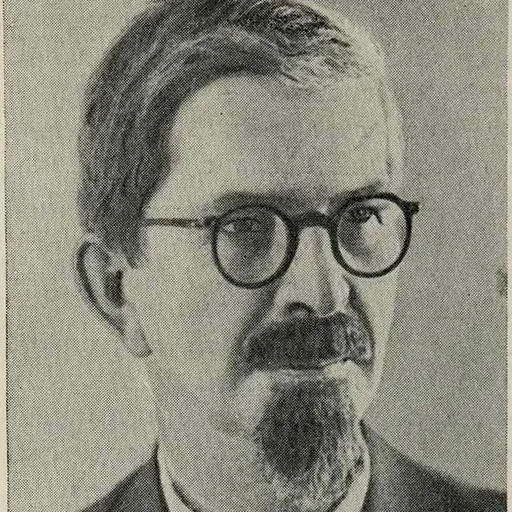
About Lev Rudnev
Lived 1885 – 1956 (aged 71). Lev Rudnev was a Russian architect and university teacher.
Lev Vladimirovich Rudnev (; – 19 November 1956) was a Soviet architect, and a leading practitioner of Stalinist architecture.
Biography Rudnev was born to the family of a school teacher in Novgorod. He graduated from the Riga Realschule (now the Riga 1st State Grammar School) and entered the Imperial Academy of Arts in Saint Petersburg (1906). At the Academy he studied painting under Leon Benois and architecture under Ivan Fomin. From 1911 Rudnev was a success in various architectural competitions, and in 1915 he became a certified specialist in the art of architecture.
After the February Revolution Rudnev won the competition for the Monument to the Fighters of the Revolution on the Field of Mars in Petrograd (March 1917). The avant-garde monument there was built according to his design.
After the end of the Second World War, Lev Rudnev took active part in reconstructing the ruined cities of Voronezh, Stalingrad, Riga and Moscow. In 1922–1948 Rudnev was a professor at the Academy of Arts (former Imperial Academy of Arts) in Leningrad; in 1948–1952 he was a professor at the Moscow Architectural Institute. Rudnev was also a member of Academy of Architecture of the USSR.
Rudnev's most remarkable architectural work is the ensemble of the Lomonosov Moscow State University on Sparrow Hills, then known as Lenin Hills (1948–1953, co-designed with S. Chernyshyov, P. Abrosimov, A. Khryakov, and engineer V. Nasonov). His Palace of Culture and Science in Warsaw, Poland (1952–1955) resembles the markedly sculptural style of the MSU ensemble.
Projects
He was the author of many large scale Soviet projects, including: M. V. Frunze Military Academy in Moscow (1939) Administrative building on Shaposhnikov street (1934–1938) Administrative building on Frunze embankment (1938–1955) Main building of Moscow State University (1949–1953). This is probably the best known of his buildings, for which he was awarded the Stalin Prize in 1949 House of the Government of the Azerbaijan Soviet Socialist Republic in Baku (finished in 1952) Palace of Culture and Science in Warsaw, Poland (1952–1955) Buildings of Latvian Academy of Sciences in Riga (1953–1956)
Gallery
Don’t just read it —
keep it.
Full-length biographies made to live with: read them, listen on the way to work, watch them tonight.
- E-book
- Audio
- Video
Instant download · yours to keep · every purchase keeps this site free
Important facts
People in Lev Rudnev's life
Named in this biography and alive at the same time

Related people
Same field, nearest in time


Contemporaries
People whose lives overlapped Lev Rudnev's




Frequently asked questions
Who was Lev Rudnev?
Soviet architect (1885–1956)
When was Lev Rudnev born?
Lev Rudnev was born on 1 March 1885 in Veliky Novgorod.
When did Lev Rudnev die?
Lev Rudnev died on 19 November 1956 in Moscow.
What was Lev Rudnev's occupation?
Lev Rudnev was an architect and university teacher.
What nationality was Lev Rudnev?
Lev Rudnev was Russian.
Sources & further reading
Cite this page
APA: Biography.guide. (2026). Lev Rudnev. https://biography.guide/lev-rudnev/
MLA: "Lev Rudnev." Biography.guide, https://biography.guide/lev-rudnev/.
Chicago: "Lev Rudnev." Biography.guide. https://biography.guide/lev-rudnev/.
Data last updated: 2026-09-20 · Spot an error? Report a correction.
Portrait: Wikimedia Commons · author & licence
Page generated 2026-09-27 04:57 UTC