
About Leonardo Salviati
Lived 1539 – 1589 (aged 50). Leonardo Salviati was a writer, romanist, humanist and philologist.
Lionardo Salviati (1539–1589) was a leading Italian philologist of the sixteenth century. He came from an illustrious Florentine family closely linked with the Medici. Salviati became consul of the Florentine Academy in 1566, and played a key role in the founding of the Accademia della Crusca, with its project of creating a dictionary, which was completed after his death.
Salviati immersed himself in philological and linguistic research from a young age and produced a number of works. Some of these were published during his lifetime, such as the Oration in Praise of Florentine Speech (1564) and Remarks on the Language of the Decameron (2 vols, 1584–1586). Salviati also published two comedies, The Crab (1566) and The Thorn (1592), lessons, treatises, and editions of texts by other authors. He also wrote numerous polemical pamphlets against Torquato Tasso under different pseudonyms, mostly using the nickname he adopted on joining the Accademia della Crusca, 'Infarinato' ('covered in flour').
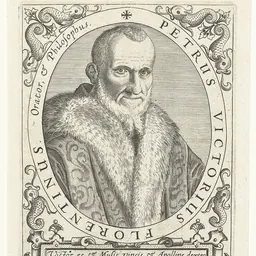
Salviati was recognized by his contemporaries as a master of oratory and many of his speeches were published both as one-off pamphlets and in a larger anthology: The first book of the Speeches of Cavalier Lionardo Salviati (Florence 1575). Particularly noteworthy are his speeches delivered at important events, in particular at the funerals of Benedetto Varchi, Michelangelo Buonarroti, Piero Vettori and the Grand Duke Cosimo de 'Medici.
He first came to public attention with the composition in 1583 of three memorial orations ('confortatorie') for Garzia de' Medici, Later in 1563 he went to Pisa for several months for unknown reasons, where he fell seriously ill for a time. Salviati's tutor Vettori was also a literary advisor to (it) Baccio Valori, consul of the Florentine Academy, and through this connection Salviati was invited to deliver his famous Oration in Praise of Tuscan Speech on April 30, 1564. Two days later, on 1 May 1564, he published a discourse on poetry dedicated to Francesco de' Medici, the oldest son of Grand Duke Cosimo, who had just assumed the regency for his ailing father. His services to the Medici were not however rewarded by the favours he desired: in 1564 Salviati was passed over for the position of canon of Prato. Until this work could be undertaken, Salviati persuaded Cosimo to block a Venetian project to issue a revised edition. In the archive of the Accademia della Crusca there is a hand-written document by Piero de 'Bardi that provides the minutes (autumn 1582) of the memorable foundation meeting and the speech by Salviati. The Vocabolario was not completed and published until after Salviati's death, but in the foreword, the academicians announced that they intended to adhere to Salviati's views on grammar and spelling. They also followed him above all in the philological approach of their work and in the choice of texts they cited as authorities; the table of authors referred to in the Vocabulario closely matched the list provided by Salviati in his work Warnings. By then his energies were absorbed by a work of another tenor, the Remarks on the Language of the Decameron ; in March 1584 he went to Rome to give a copy of the first volume to its dedicatee Buoncompagni, from whose service he then took leave.
From the (it) hospital of S. Anna in Ferrara, where he was imprisoned, Tasso responded with an Apologia for his poem. In this, after speaking up for his fathers work, he meticulously defended his own. After a number of other writers intervened in the controversy, Salviati, using his Accademia Della Crusca name ‘Infarinato’, published a forceful and polemical response to Tasso's Apologia on 10 September 1585, dedicated to the Grand Duke. This emphasized the superiority of the invention over imitation, and of fantasy over history, denying that the poet's task was to express the truth. At the same time Salviati reiterated criticism of both L’Amadigi and Gerusalemme Liberata, extolling the excellence of the poems of Matteo Maria Boiardo and Ariosto and, for the purity of its language, the Morgante of Luigi Pulci. The Church then sponsored a number of revised editions which Catholics could be allowed to read. The first of these, in 1573, (known as the "Deputies' edition") produced by Vincenzo Borghini, simply excised entire characters and sections of stories in a most unsatisfactory way. Although the Church authorised the printing of the Deputies' edition in 1793, it soon came to the view that it was not satisfactory after all, and the Deputies' edition was itself placed on the Index. Grand Duke Cosimo then intervened and in 1580, with the Church's sanction, he entrusted the prestigious task of producing a new edition, acceptable to the Inquisition, to Salviati.
Salviati examined a number of manuscript versions of the Decameron but relied principally on the Mannelli Codex. Not only were there significant linguistic differences between manuscripts, but there were inconsistencies and variations within the Mannelli Codex itself (for example pray=prego/priego; money=denari/danari; without=senza/sanza). Salviati decided for the most part to follow the variations within the Mannelli Codex because of their phonetic authenticity "since it is likely that they are not merely different but arise from the same common form, and we cannot simply prefer one of them". He was less conservative in other aspects of his editing; inserting punctuation, eliminating latinisms (choosing 'astratto' rather than 'abstracto' for 'abstract'), removing the letter 'h' within words ('allora' rather than 'allhora' for 'now'), preferring 'zi' to 'ti' ('notizia' instead of 'notitia') and standardising forms such as 'bacio' rather than 'bascio' (kiss) and 'camicia', not 'camiscia' (shirt). His approach to spelling was in effect a middle way between classical writing and modern speech, without tending towards the radical proposals for a completely new writing system put forward by Gian Giorgio Trissino, Claudio Tolomei and Giorgio Bartoli.
Rules of Tuscan Speech and Remarks on the Decameron The Rules of Tuscan Speech (1576–77) was a grammar guide that Salviati wrote for Ercole Cortile, the d'Este ambassador to the Medici court, in the hope that it would smooth his path to an appointment at the court of Ferrara. Although much briefer than the later and more mature Remarks, this work is more comprehensive, dealing with all of the parts of speech, focusing particularly on the verb. Following his teacher Benedetto Varchi, Salviati considered the verb in terms of tense, mood and aspect.
The Remarks on the Decameron takes the new edition of the Decameron as its starting point and deals with many important aspects of the debate around language. It was published in two volumes, the first in Venice (printed by Guerra in 1584) and the second in Florence (Giunti 1586). The first volume is divided into three books, dealing respectively with the philological issues involved in the 1582 edition, the rules of grammar, and pronunciation and spelling. In this volume, dedicated to his protector Jacopo Buoncompagni, Duke of Sora, Salviati set out his main principle: "the rules of our common speech should be taken from our old authors, that is, from those who wrote from the thirteenth century to the fourteenth century: because before this the language had not yet reached the high point of its beautiful florescence, and after this it undoubtedly faded suddenly." The first volume concludes with the text of Decameron I, 9, followed by twelve renditions of the same text in twelve different Italian dialects, in order to show the superiority of Boccaccio's language. One of the twelve versions was in common Florentine speech, attributed to an illiterate person: this version does not vary much from Boccaccio, thus demonstrating the 'natural' primacy of Florentine.
Salviati thought it was necessary to use as many words as possible from fourteenth-century Florentine, but nevertheless to rely on modern speech as a guide for pronunciation (and therefore for the spelling). He adopted a "naturalistic" perspective, which led him to support "popular sovereignty in linguistic use, [...] the priority of speech [i.e. over the written form] in the use of language, [...] linguistic purity as a natural endowment of the Florentine". His hostility to the fifteenth-century tendency towards latinism, which he considered artificial and degrading to the original purity of the language, prompted him to criticize Tasso. The second volume, dedicated to Francesco Panigarola, deals with grammatical questions, in particular of nouns, adjectives, articles and prepositions, in more detail than he had set out in the Rules of Tuscan Speech.
Don’t just read it —
keep it.
Full-length biographies made to live with: read them, listen on the way to work, watch them tonight.
- E-book
- Audio
- Video
Instant download · yours to keep · every purchase keeps this site free
Important facts
People in Leonardo Salviati's life
Named in this biography and alive at the same time



Related people
Same field, nearest in time

Contemporaries
People whose lives overlapped Leonardo Salviati's




Frequently asked questions
Who was Leonardo Salviati?
Italian writer
When was Leonardo Salviati born?
Leonardo Salviati was born on 27 June 1539 in Florence.
When did Leonardo Salviati die?
Leonardo Salviati died on 12 July 1589 in Florence.
What was Leonardo Salviati's occupation?
Leonardo Salviati was a writer, romanist, humanist and philologist.
Sources & further reading
· Wikipedia: Leonardo Salviati
Cite this page
APA: Biography.guide. (2026). Leonardo Salviati. https://biography.guide/leonardo-salviati/
MLA: "Leonardo Salviati." Biography.guide, https://biography.guide/leonardo-salviati/.
Chicago: "Leonardo Salviati." Biography.guide. https://biography.guide/leonardo-salviati/.
Data last updated: 2026-09-27 · Spot an error? Report a correction.
Page generated 2026-09-27 05:17 UTC