
About Leonard Parrington
Lived 1890 – 1979 (aged 88–89). Leonard Parrington was a military personnel.
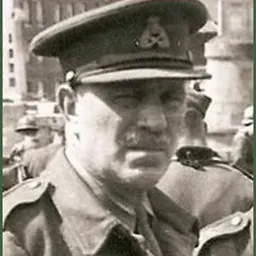
Brigadier Leonard Parrington (24 February 1890 – 1979) was a British Army officer. He joined the Royal Garrison Artillery in 1911 and served with them in the First World War in which he was mentioned in despatches four times and was awarded the Military Cross. In the inter-war period he was seconded as an adjutant to the Territorial Army in the East of England, as an instructor at the Indian Artillery School and as part of the British military mission to the Egyptian Army. Upon the outbreak of the Second World War Parrington was promoted to colonel; he became an acting brigadier in 1941 and was posted to Greece. Allied forces were pushed back during the German invasion and Parrington, in charge of the evacuation of remaining troops, was forced to surrender on 29 April 1941. In captivity he inspected German holiday camps set up for prisoners of war. He was mistakenly thought to be pro-Nazi and was recommended, without his knowledge, for command of the British Free Corps, a collaborationist unit of the German SS. Parrington retired from the army in 1946.
Early life and First World War Parrington was born on 24 February 1890. On 4 January 1911 he joined the British Army as a probationary second lieutenant in the Royal Garrison Artillery (RGA). His commission was confirmed and he was granted the substantive rank of second lieutenant on 3 September 1912.
Parrington served with the RGA in the First World War and was appointed to the acting rank of captain on 20 October 1914. He took part in the May 1915 Battle of Aubers and was promoted to the permanent rank of lieutenant on 9 June 1915. Parrington served as aide-de-camp to General Herbert Plumer, commander of the Second Army between February and April 1916.
In October 1916 Parrington was appointed to command a howitzer battery. Parrington took part in the 1917 Battles of Arras and Passchendaele. Parrington fought against the German spring offensive of 1918. Parrington was seconded for service with the Territorial Army reserve force on 18 April 1923, serving as adjutant of the 58 (Essex and Suffolk) Medium Brigade RGA. He attended the Gunnery Staff Course from 31 August 1926. Parrington left that role on 31 August 1926 and returned to the regular army on 26 September 1927, joining the Royal Artillery as the RGA had since been merged with the Field Artillery.
Parrington was seconded to the Indian Artillery School on 29 December 1927. He left that post on 29 December 1931 and returned to the British Army on 24 February 1932. Parrington was promoted to major on 9 July 1933. He was appointed an assistant instructor at the Royal School of Artillery on 19 June 1937 and was immediately seconded to the British military mission to the Egyptian Army. Parrington was granted the local rank of lieutenant-colonel on 1 December 1938, to be held whilst serving with the mission.
Second World War and later Shortly after the start of the Second World War Parrington was promoted, on 2 October 1939, to the substantive rank of colonel. He was promoted to the acting rank of brigadier in March 1941.
New Zealand Sergeant Jack Hinton reported to Parrington's headquarters on 28 April, as the Germans were entering the port, cutting off the evacuation route. Parrington told Hinton to surrender, to which he replied "Surrender? Go and jump in the bloody lake!".
In captivity Parrington was ordered by Major-General Victor Fortune to visit a number of "holiday camps" set up by the Germans for prisoners of war, to ascertain what the purpose of the camps was. This included a site at Genshagen, Brandenburg, which was being used by the Schutzstaffel (SS), to seek recruits for their British Free Corps. Parrington left the Reserve of Officers on 24 February 1948, upon reaching the age limit of 58 years. In 1963 Parrington won a libel case against history writers Anthony Heckstall-Smith and Vice-Admiral Harold Baillie-Grohman and publisher Anthony Blond who he said had cast doubts on his courage and ability at Kalamata in their book Greek Tragedy '41. Parrington died in 1979. His seven-volume diary covering the period 1915 to 1941 is in the collection of the Imperial War Museums.
Don’t just read it —
keep it.
Full-length biographies made to live with: read them, listen on the way to work, watch them tonight.
- E-book
- Audio
- Video
Instant download · yours to keep · every purchase keeps this site free
Important facts
People in Leonard Parrington's life
Named in this biography and alive at the same time

Related people
Same field, nearest in time





Contemporaries
People whose lives overlapped Leonard Parrington's




Frequently asked questions
Who was Leonard Parrington?
British Army officer (1890–1979)
When was Leonard Parrington born?
Leonard Parrington was born on 24 February 1890.
When did Leonard Parrington die?
Leonard Parrington died in 1979.
What was Leonard Parrington's occupation?
Leonard Parrington was a military personnel.
Sources & further reading
· Wikipedia: Leonard Parrington
Cite this page
APA: Biography.guide. (2026). Leonard Parrington. https://biography.guide/leonard-parrington/
MLA: "Leonard Parrington." Biography.guide, https://biography.guide/leonard-parrington/.
Chicago: "Leonard Parrington." Biography.guide. https://biography.guide/leonard-parrington/.
Data last updated: 2026-09-20 · Spot an error? Report a correction.
Page generated 2026-09-27 05:17 UTC