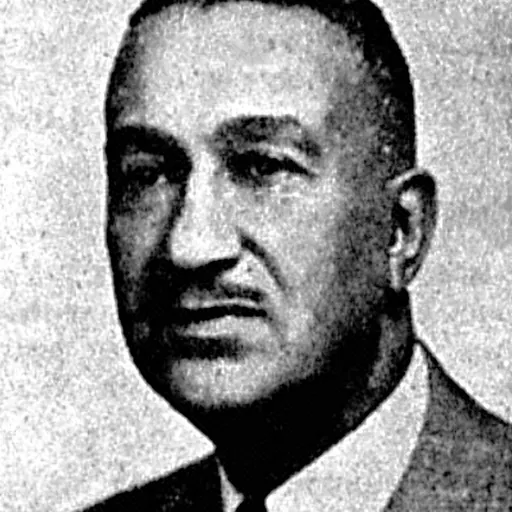
Leon P. Miller
American lawyer, politician, and judge
About Leon P. Miller
Lived 1899 – 1980 (aged 80).
Leon Parker Miller (April 27, 1899 – February 4, 1980) was an American lawyer, politician, and judge, in the U.S. state of West Virginia. Miller served as U.S. Attorney for the District of the Virgin Islands from 1954 to 1962. He was appointed the first African-American judge in West Virginia in April 1968, and became the state's first elected African-American judge in November 1968.
Born in Knoxville, Tennessee, in 1899, Miller was raised in Roanoke, Virginia. He attended North Carolina A&T State College, and in 1922, he graduated from University of Pennsylvania Law School with a Bachelor of Laws. Miller commenced his career in law in Williamson, West Virginia, in 1922, and in 1924, he relocated to Welch, West Virginia, and established a law firm with former West Virginia House of Delegates member Harry J. Capehart and Recorder of Deeds for the District of Columbia, Arthur G. Froe. He served as assistant prosecuting attorney for McDowell County from 1928 to 1936, and as a member of the Welch city council from 1944 to 1948.
Miller was appointed by President Dwight D. Eisenhower as the United States Attorney for the District of the Virgin Islands in 1954, and he was reappointed to the position in 1958. He served as U.S. attorney until 1962, and then returned to his law practice in Welch. In 1968, he was elected as a write-in candidate as judge of the criminal court, becoming the first elected African-American judge in West Virginia, and the first Republican elected to major office in McDowell County since the 1930s. He retired from the bench in 1972 and continued the practice of law until his death in Welch in 1980.
Early life and education Leon Parker Miller was born on April 27, 1899, in Knoxville, Tennessee. He had three sisters: Georgia, Eunice, and Grace. He began attending college at the age of 14, and paid his tuition by working as a waiter and bellhop. He then attended the University of Pennsylvania Law School, where he received a Bachelor of Laws degree in 1922.
Early law and political careers alt=Black and white photograph view of buildings in downtown Welch, West Virginia, in 1915. Miller commenced his career in law in 1922 in Williamson, West Virginia, where he remained for two years. Following the death of Froe in 1932, he and Capehart continued their practice under the name of Capehart and Miller. From 1928 to 1936, Miller served as an assistant prosecuting attorney for McDowell County. He had been appointed to the position following a recommendation from county prosecuting attorney, Wilson Anderson. According to the Charleston Daily Mail in 1932, Miller was believed to be the only African-American assistant prosecuting attorney in the state. In 1934, Miller campaigned for the Republican nomination for a seat on the McDowell County board of education, and in August of that year, he was elected as the Republican candidate for the board. In October 1934, Miller was named chairman of the McDowell County Colored Republican Organization advisory committee. He also served as a member of the Welch city council from 1944 to 1948.
Miller was a contributor to various periodicals to include The Crisis and Opportunity: A Journal of Negro Life. In his 1935 article, "The Negro and the 'Closed Shop'", Miller wrote about African-American strikebreakers and the discrimination against African-American workers by organized labor. In his 1936 article, "A Greater N.A.A.C.P.", Miller discussed the need for the NAACP to play an expanded, centralized role in organizing and improving the lives of African-Americans. In March 1941, Miller was a guest speaker on the CBS national radio program, Wings Over Jordan, in commemoration of the 50th anniversary of the North Carolina A&T State College.
By 1938, Miller was the president of the McDowell County branch of the NAACP, in which capacity, he and the county NAACP sought to retain the African-American Civilian Conservation Corps camp in the county's Big Creek district. Miller also later served on the West Virginia Bar Association legal ethics committee for West Virginia's 5th congressional district in 1947. Miller served as the assistant committee chairperson for arrangements for the 1948 Republican National Convention in Philadelphia. In addition, he was an alternate delegate representing the 5th congressional district at the 1952 Republican National Convention in Chicago.
United States attorney In 1954, President Dwight D. Eisenhower appointed Miller to a four-year term as the United States Attorney for the District of the Virgin Islands to replace Cyril Michael. Miller's appointment was referred to the United States Senate Committee on the Judiciary on November 8, 1954, his appointment was reported by the committee on December 1, and he was confirmed by the U.S. Senate on December 2. When Miller arrived on Saint Thomas, Virgin Islands District Court Judge Herman E. Moore had not yet been notified of Miller's appointment. In 1961, at the end of Miller's term, the position of the Attorney General of the United States Virgin Islands was created, which relieved the office of the U.S. Attorney from trying all cases within the territorial boundaries of the U.S. Virgin Islands. President John F. Kennedy appointed Almeric L. Christian to succeed Miller. Miller's speech was praised by columnists in the Beckley Post-Herald and the Charleston Daily Mail. In his speech, he noted that while he believed the Republican Party had something to offer all groups, he warned the party against making separate appeals to different groups and to prejudices. On April 9, 1968, Miller was elected and appointed by the McDowell County Bar Association to serve as special judge of the criminal court for the April term until Governor Hulett C. Smith appointed Morgan's successor. Neither the Democratic or Republican parties held primary elections for nominees to the seat, and therefore, neither party entered a candidate for the November ballot. His election was certified in November, and on December 12, 1968, Governor Smith proclaimed Miller as the duly elected judge of the criminal court, with a total of 2,526 votes. Miller became the first African-American judge elected in West Virginia. He also became the first Republican elected to a major office in McDowell County since the 1930s.
In 1971, an act of the West Virginia Legislature changed the name of the Criminal Court of McDowell County to the Intermediate Court of McDowell County. In November 1972, he announced he would not run for reelection, and he retired from the bench at the end of his term in December. Following his retirement, Miller took a six-month vacation in the U.S. Virgin Islands, where he formerly served as U.S. attorney.
While reflecting on his tenure on the bench, Miller remarked that he was sometimes criticized for being too lenient. In May 1933, he gave the main address for the graduation commencement ceremony at Northfork Colored High School in Northfork. In February 1936, Miller delivered an address on "Race Planning" at Bluefield State College in Bluefield. In May 1949, Miller delivered the main address at the Conley High School graduation in Mullens. In March 1969, he gave a presentation on "Law and Order" at Mullens High School in which he stated, "Our greatest asset is our young people." He further told the students, "The youth of today are courageous, determined, and admirable."
Later life and death Following a long illness, Miller was declared dead on arrival at a hospital in Welch on February 4, 1980. At his funeral service, Miller's successor on the intermediate court bench, Rudolph Murensky, remarked of Miller, "He was one of the most outstanding lawyers to ever practice in this area. No one had greater compassion."
Selected works
Don’t just read it —
keep it.
Full-length biographies made to live with: read them, listen on the way to work, watch them tonight.
- E-book
- Audio
- Video
Instant download · yours to keep · every purchase keeps this site free
Important facts
People in Leon P. Miller's life
Named in this biography and alive at the same time



Contemporaries
People whose lives overlapped Leon P. Miller's




Frequently asked questions
Who was Leon P. Miller?
American lawyer, politician, and judge
When was Leon P. Miller born?
Leon P. Miller was born on 27 April 1899 in Knoxville.
When did Leon P. Miller die?
Leon P. Miller died on 4 February 1980 in Welch, West Virginia.
Sources & further reading
Cite this page
APA: Biography.guide. (2026). Leon P. Miller. https://biography.guide/leon-p-miller/
MLA: "Leon P. Miller." Biography.guide, https://biography.guide/leon-p-miller/.
Chicago: "Leon P. Miller." Biography.guide. https://biography.guide/leon-p-miller/.
Data last updated: 2026-09-23 · Spot an error? Report a correction.
Portrait: Wikimedia Commons · author & licence
Page generated 2026-09-27 05:06 UTC