
Lee Soo-man
South Korean businessman and record producer (born 1952)
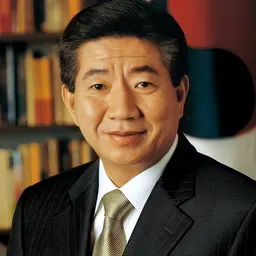
About Lee Soo-man
Born 1952. Lee Soo-man is a South Korean singer, record producer, entrepreneur and composer.
Lee Soo-man (, born 18 June 1952) is a South Korean business executive and record producer who is best known for being the founder of SM Entertainment, a multinational entertainment company based in Seoul. He has also been referred to as the "president of culture", as one of the pioneers of the Korean Wave. Lee debuted as a singer in 1971 while he was a student at Seoul National University. In 1989, he founded SM Entertainment, which has since become one of the largest entertainment companies in the country.
Biography
1952–1980: Early years and singing career Lee was born in Jeonju, South Korea, on 18 June 1952, and attended Seoul National University on and off between 1971 and 1979. Lee debuted as a member of the band April and May (사월과 오월, alternatively 4월과 5월) in 1972 (he had joined the band in 1971), but he later departed from it for health reasons. He gained spotlight for his "good boy" image, supported by the fact that he was one of the few people who were not involved in the weed scandal among Korean celebrities in 1975, and his high academic credentials in Seoul National University. He became known for hit songs such as "행복 (Happiness)", released in 1978, and "한송이 꿈 (A Piece of Dream)" released in 1976. In 1977, he was a member of the Korean indie band . In addition to his career as a musician and his studies in university, he worked as a radio DJ and TV host during this time. In 1980, he formed the band 이수만과 365일 (Lee Soo-man and The 365 Days). However, media censorship policies under the Chun Doo-hwan government discouraged him from a career in the Korean music industry.
1980–1985: Studies in the United States In the early 1980s, Lee decided to leave the entertainment world in order to pursue a career in computer engineering. He went abroad to work on a master's degree at California State University, Northridge, where he witnessed the rise of "superstars of the MTV generation" such as Michael Jackson. The company was renamed SM Entertainment in 1995. In 1997, he founded the music production company Like Planning.
In February 2010, Lee resigned from his position as a member of SM's board of directors, but maintained a role in the company's "management and artist development" divisions. He continued to exert influence over SM through his production company, Like Planning, taking 6% of their revenue as a consultancy fee for his involvement in the music production process. controlling the company's management rights. He founded the music publishing company Culture Technology Group Asia in May 2015 and drone company LeePollux in February 2019.
In 2019, KB Asset Management, SM's third-largest shareholder, sent an open letter to the company complaining that Like Planning was taking 46% of SM's operating profit each year. They demanded a merger between Like Planning and SM, which the company rejected. He worked on South Korean girl group Loona's 2020 EP [#], which was his first ever project away from his namesake SM Entertainment.
2022–present: Departure from SM Entertainment In October 2022, SM announced that they would terminate their production contract with Lee's Like Planning by the end of the year. On 3 February 2023, SM said that they would restructure the company without the help of Lee, adopting a multi-production center system to replace his role as chief producer. Kakao purchased a 9.05% stake in SM, making them the second-largest shareholder, and signed a business agreement with SM to fund their plans. Lee, objecting to this, filed an injunction against the issuance of new shares and convertible bonds, which was upheld by the court. He sold his stake in SM to Hybe Corporation, making them the biggest shareholder. Hybe announced their intention to acquire the company with Lee's support. This sparked a battle for SM's management rights, putting Lee and Hybe against the SM executives and Kakao.
Lee Sung-soo, SM's co-CEO and Lee's nephew by marriage, uploaded a video to YouTube in which he levelled a series of accusations at Lee. In the video, he claimed that Lee had founded a company called CT Planning Limited in Hong Kong in 2019 to evade taxes, through which he was taking 6% of earnings from artists' overseas activities. The company had been established using SM's assets but was owned solely by Lee, and was the foreign equivalent of Like Planning. He also said that Lee wanted to force artists to publicly declare his importance to the company and attempted to insert environmental references into songs to promote his business interests. The National Tax Service said they would investigate the claims of tax evasion. Lacking the funds of their competitor, Hybe eventually withdrew from the takeover battle, enabling Kakao to become the largest shareholder and obtain management rights. Lee released a statement saying he was "moving toward the future".
After stepping down from SM, he has continued his vigorous activities, such as carrying out tree-planting efforts that had drawn great interest in his later years.
Upon leaving SM, Lee established a company called Blooming Grace, which will focus "on the fusion of culture and technology". He acquired part of the Chinese autonomous aerial vehicle company EHang.
Personal life Lee's wife, Kim Eun-jin, died from cancer on 30 September 2014.
Lee is the paternal uncle of Sunny, one of the members of the popular SM group Girls' Generation.
Philanthropy In 2014, Lee donated million to the Korean Red Cross to help the victims of the Sewol ferry disaster. He directed the Asia performance of Global Citizen's charity concert, Global Goal Live: The Possible Dream. On 8 March 2022, he donated million to the Hope Bridge Disaster Relief Association to help those affected by the massive wildfires that started in Uljin, Gyeongbuk. and also spread to Samcheok, Gangwon.
Controversies
Embezzlement case and conviction In 2002, the Supreme Prosecutors' Office of the Republic of Korea found evidence of Lee earning tens of billions of won worth of illegal market profits in August 1999 by acquiring 1.1 billion won worth of stocks when listing stocks of SM Entertainment at KOSDAQ by a paid-in capital increase. The Supreme Prosecutors' Office of the Republic of Korea also investigated Lee regarding circumstantial evidence of lobbying to producers in broadcasting stations and keeping a tremendous amount of cash in his personal office and vaults.
Lee tried to escape prosecution by staying overseas from June 2002, and was found in a golf course in Los Angeles on 2 August in the same year. While on the run, Lee's passport was nullified and Lee was chased by Interpol. Lee eventually came back to Korea to be investigated on 22 May 2003. A pre-arrest warrant was issued on 7 October, and Lee was arrested on 8 October. On 14 October, Lee was approved of bail after paying 30 million won. On 19 October, Lee was prosecuted without detention.
In September 2004, the Supreme Court of Korea sentenced Lee to two years of imprisonment along with three years of probation. Lee was released in a special exemption in 2007 commemorating the fourth year of Roh Moo-hyun's presidency.
Slave contract In 2009, three members of the boy band TVXQ took their management agency SM Entertainment owned by Lee to court, claiming that the agency's 13-year-contract (often nicknamed a slave contract) was too long, too restrictive, and gave them almost none of the profits from their success. The following year, in 2010, South Korea's Fair Trade Commission (KFTC) created a rule that limited entertainment contracts to seven years.
Other controversies In 2015, Lee Soo-man was alleged to have violated foreign exchange rules, having failed to report real estate purchased in Los Angeles, as mandated by the Foreign Exchange Law. His company responded that it was a "mistake" made by their American subsidiary. In 2021, he was included in the names of figures in the Pandora Papers. He was mentioned 399 times across 280 documents, tying him to eight paper companies in Hong Kong, five of which used a nominee service to conceal the source of their funds. SM Entertainment denied the allegations and said the companies had been founded using his father's assets. Lee and SM were investigated by the National Tax Service following suspicions that he had omitted financial information and leaked company money in corporate transactions. As a result, SM was ordered to pay the government 20.2 billion won.
Discography
Albums Lee Soo-man (Jigu Records, 1977) Lee Soo-man (Shinsegae, 1978) 애창곡집 (Jigu Records, 1978) Greatest (Universal Record Co., 1980) Lee Soo-man (Shinsegae, 1983) Lee Soo-man (Han Kook Record, 1985) 끝이 없는 순간 (Asia Record Co., 1986) NEW AGE 2 (Han Kook Record, January 1989) NEW AGE (Asia Record Co., November 1989)
Accolades
Awards
State and cultural honors
Listicles
Don’t just read it —
keep it.
Full-length biographies made to live with: read them, listen on the way to work, watch them tonight.
- E-book
- Audio
- Video
Instant download · yours to keep · every purchase keeps this site free
Important facts
People in Lee Soo-man's life
Named in this biography and alive at the same time






Related people
Same field, nearest in time





Contemporaries
People whose lives overlapped Lee Soo-man's





Frequently asked questions
Who is Lee Soo-man?
South Korean businessman and record producer (born 1952)
When was Lee Soo-man born?
Lee Soo-man was born on 18 June 1952 in Seoul.
What is Lee Soo-man's occupation?
Lee Soo-man is a singer, record producer, entrepreneur and composer.
What nationality is Lee Soo-man?
Lee Soo-man is South Korean.
Sources & further reading
Cite this page
APA: Biography.guide. (2026). Lee Soo-man. https://biography.guide/lee-soo-man/
MLA: "Lee Soo-man." Biography.guide, https://biography.guide/lee-soo-man/.
Chicago: "Lee Soo-man." Biography.guide. https://biography.guide/lee-soo-man/.
Data last updated: 2026-09-22 · Spot an error? Report a correction.
Page generated 2026-09-27 05:18 UTC