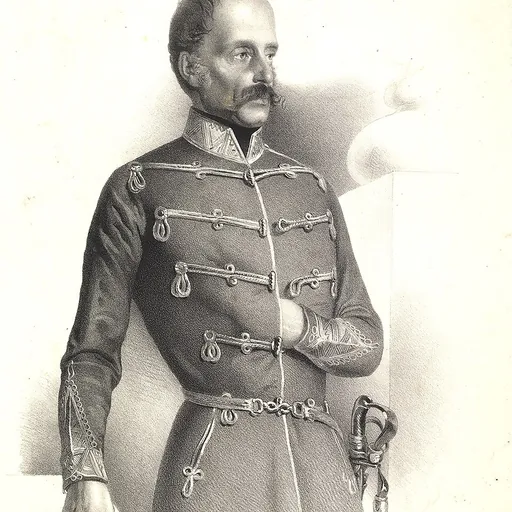
About Lázár Mészáros
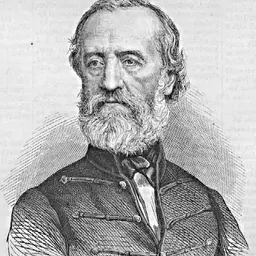
Lived 1796 – 1858 (aged 62). Lázár Mészáros was a Hungarian politician and military officer.
General Lázár Mészáros (English: Lazarus Mészáros) (20 February 1796 in Baja – 16 November 1858 in Eywood), was the Minister of War during the 1848 Hungarian Revolution.
Biography He was born into a noble family of landowners. His parents died when he was four; as a child he was moved from one relative to another. He had his schooling in Baja, Szabadka (today Subotica), Pest and Pécs. Mészáros dropped out of his studies of law and joined the military.
Military career In 1813, he became Lieutenant in a cavalry regiment in Bács-Bodrog County. He took part in the war against Napoleon. He was an officer of the 7th regiment of hussars from 1816 to 1837; then he was put in charge of the 5th regiment of hussars. He spent 18 years in Italy with his regiment. Field marshal Radetzky discovered the talented hussar officer, and, based on Radetzky's suggestion, he was promoted to be a colonel (1845). He also became his regiment's commandant.
Lázár Mészáros was a highly cultivated officer. He spoke seven languages. He was well versed in military matters, but he was also knowledgeable about society and the economy. In 1837, he started to correspond by mail with István Széchenyi. Mészáros was elected to be a mailing member of the Magyar Tudós Társaság (English: Hungarian Erudite Association, today: Hungarian Academy of Sciences). He chose the theme "Armed forces in modern bourgeois societies" for his inaugural.
Minister of War On Lajos Kossuth's suggestion Lajos Batthyány appointed Mészáros to be Minister of War in the first responsible Hungarian government (22 March 1848). He took up his office after returning from Italy, where his regiment was posted (23 May). Some time later he became Major general of the Imperial and Royal forces and the commander of Imperial troops stationed on Hungarian territory.
As Minister of War, Lázár Mészáros was the intellectual founder of Hungary's defensive army. In July 1848, he became parliamentary delegate of his hometown, Baja, as well.
From the end of August, Mészáros decided to take personal control of the southern army. He travelled to Vajdaság (today Vojvodina, Serbia). On 30 September, he returned to the capital. Mészáros was the only member of Batthyány's government who did not resign. He became the member of the Territorial Defence Committee as the Minister of War. On 13 December, he took command of the northern army with 10,000 men. On 19 January 1849, he was discharged from his command, but he retained his post as Minister until the declaration of the Independence Statement. On 26 July, Mészáros resigned from all his remaining military functions, because he did not agree with the way Mór Perczel commanded the parts of the army under his control. After the Battle of Temesvár, and the ensuing failure of the war of independence, he left Hungary on 14 August 1849 for Turkey.
Exile He left Turkey in May 1851. He settled at first in France, which he left upon Napoleon III's coup d'état in December 1851. He went to the Isle of Jersey. In the summer of 1853, he moved to the United States, where he tried farming in Iowa, and eventually settled in Flushing, New York. In October 1858, a short time before his death, Mészáros returned to England.
Last will In his will, he requested that his remains not be returned to Hungary "until the last foreign soldier has left". He was reburied in Baja 133 years after his death, on 15 March 1991. The last Soviet soldiers – always seen by Hungarians as the successors of the Imperial Russian Army that crushed the Revolution 1848 – had left Hungary just months before.
The caption of his grave in Titley, England To the memory of General Lázár Mészáros Minister of war And Commander in Chief Of the Hungarian Army in 1848–1849. Who was born at Baja in the county of Bács 1796 and died at Eywood 6-th November 1858 in the 63 year of his age and 10-th of his exile. This stone is inscribed by his sorrowing friend J. E. H. Lady Langdale
Mészáros Lázár Tábornoknak, A jó Hazafinak, A vitéz Katonának A nemes Barátnak.
(The last sentence is in Hungarian. It means: To General Lázár Mészáros, the good Patriot, the valiant Soldier, the noble Friend.)
Don’t just read it —
keep it.
Full-length biographies made to live with: read them, listen on the way to work, watch them tonight.
- E-book
- Audio
- Video
Instant download · yours to keep · every purchase keeps this site free
Important facts
People in Lázár Mészáros's life
Named in this biography and alive at the same time

Related people
Same field, nearest in time




Contemporaries
People whose lives overlapped Lázár Mészáros's






Frequently asked questions
Who was Lázár Mészáros?
Hungarian military figure (1796-1858)
When was Lázár Mészáros born?
Lázár Mészáros was born on 20 February 1796 in Baja.
When did Lázár Mészáros die?
Lázár Mészáros died on 16 November 1858 in Titley.
What was Lázár Mészáros's occupation?
Lázár Mészáros was a politician and military officer.
What nationality was Lázár Mészáros?
Lázár Mészáros was Hungarian.
Sources & further reading
Cite this page
APA: Biography.guide. (2026). Lázár Mészáros. https://biography.guide/lazar-meszaros/
MLA: "Lázár Mészáros." Biography.guide, https://biography.guide/lazar-meszaros/.
Chicago: "Lázár Mészáros." Biography.guide. https://biography.guide/lazar-meszaros/.
Data last updated: 2026-09-21 · Spot an error? Report a correction.
Portrait: Wikimedia Commons · author & licence
Page generated 2026-09-27 04:59 UTC