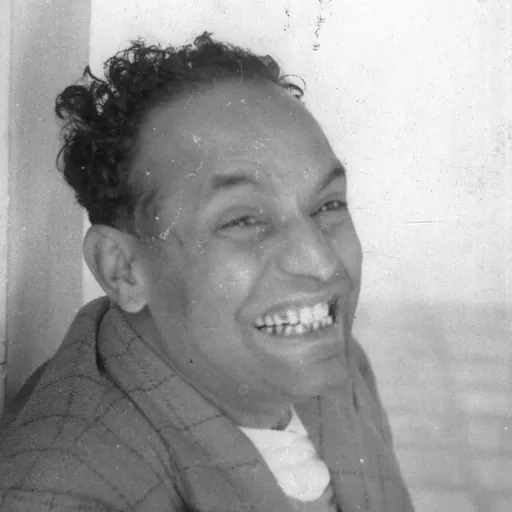
About Laxmi Prasad Devkota
Lived 1909 – 1959 (aged 49). Laxmi Prasad Devkota was a Nepali poet, essayist, playwright, novelist, lyricist and short story writer.
Laxmi Prasad Devkota (12 November 1909 – 14 September 1959), was a Nepalese poet, novelist, playwright, scholar, lawyer, lecturer, and politician. Honored with the title of Mahakavi in Nepalese literature. He is regarded as one of the greatest literary figures in Nepal, and often described as a poet with a golden heart. Devkota is best known for works such as Muna Madan, Sulochana, Kunjini, Bhikhari, and Shakuntala.
Early life and education
Laxmi Prasad Devkota was born on the night of Lakshmi Puja on 12 November 1909 (27 Kartik 1966 BS) to Til Madhav Devkota and Amar Rajya Lakshmi Devi in Dhobidhara, Kathmandu. His father was a Sanskrit scholar, who taught him in his childhood. He started his formal education at Durbar High college, where he studied both Sanskrit grammar and English. After finishing his matriculation exams from Patna at the age of 17, he pursued a Bachelor of Arts along with a Bachelor of Laws at Tri-Chandra College and graduated from Patna University as a private examinee. His desire to complete his master's degree was left incomplete due to his family's financial conditions. The work received immediate recognition from the Ranas—the country's ministers at the time. Muna Madan tells the story of Madan, a traveling merchant, who departs for Tibet in a bid to earn some money leaving behind his wife, Muna. The poem describes the thematic hardships of the journey: the grief of separation, the itching of longing, and the torment of death.
The ballad Ji Waya La Lachhi Maduni is a tragic song based on a Newa merchant, his mother, and his wife. The merchant is about to leave Kathmandu for Tibet on a work. The song starts with the wife pleading with her mother-in-law to stop him, saying that it's not even been a month since she came to their home and he wants to go away. Being raised in Kathmandu, Devkota had heard this song from locals singing it at a local Pati . He was highly fascinated by the song and decided to re-write it in Nepali. Since the Rana rulers had put a ban on the Newa trade, language and literature, he changed the main character from a Newa merchant as in the original song to a Kshatriya (warrior class) character. Although Kshatriya people did not practice trade for their living during those days, he had to depict it as such in order to lure the Rana rulers. the book was also translated into Mandarin; it was well received by China and considered successful.
Devkota, inspired by his five-month stay in a mental asylum in 1939, wrote a free-verse poem, Pagal . The poem deals with his usual mental ability and is considered one of the best Nepali language poems.
"जरुर साथी म पागल ! यस्तै छ मेरो हाल । म शब्दलाई देख्दछु ! दृश्यलाई सुन्दछु ! बासनालाई स्वाद लिन्छु । आकाशभन्दा पातालका कुरालाई छुन्छु । ती कुरा, जसको अस्तित्व लोक मान्दैंन जसको आकार संसार जान्दैन !"
Surely, my friend, I am mad, That’s exactly what I am! I see a word, Hear sights, Taste smells, I touch things thinner than air, Those things, Whose existence the world denies, Whose shapes the world does not know.
Devkota had the ability to compose long epics and poems with literary complexity and philosophical density in very short periods of time. He wrote Shakuntala, his first epic poem, and also the first Mahakavya written in the Nepali language, in a mere three months. Published in 1945, Shakuntala is a voluminous work in 24 cantos based on Kālidāsa's famous Sanskrit play Abhijñānaśākuntalam. Shakuntala demonstrates Devkota's mastery of Sanskrit meter and diction, which he incorporated heavily while working primarily in Nepali. According to the late scholar and translator of Devkota, David Rubin, Shakuntala is among his greatest accomplishments. "It is, without doubt, a remarkable work, a masterpiece of a particular kind, harmonizing various elements of a classical tradition with a modern point of view, a pastoral with a cosmic allegory, Kālidāsa's romantic comedy of earthly love with a symbolic structure that points to redemption through the coinciding of sensual and sacred love."
Devkota also published several collections of short lyric poems set in various traditional and non-traditional forms and meters. Most of his poetry shows the influence of English Romantic poets like Wordsworth and Coleridge. The title poem in the collection Bhikhari is reminiscent of Wordsworth's "The Old Cumberland Beggar". In this poem, Devkota describes the beggar going about his ways in dire poverty and desolation, deprived of human love and material comforts. On the other hand, the beggar is also seen as the source of compassion placed at the core of suffering and destitution. Devkota connects the beggar with the divine as the ultimate fount of kindness and empathy:
"कालो बादलबाट खसेको अन्धकारमा भित्र पसेको, ईश्वर हो कि भिखारी ? बोल्दछ ईश्वर हृदय घुसेका घर, घर आँगन चारी बोल्दछ, आर्तध्वनिमा बोल्दछ करूणामृत दिल भारी ।"
Fallen from the blackest clouds To enter into darker shrouds, Is he deity or beggar? Buddha speaks – his words pierce the heart, Wandering from house to house, yard to yard, Now speaking with a voice of pain: His heart in sorrow cowed.
Many of his poems focus on mundane elements of the human and the natural world. The titles of his poems like Ban , Kisaan , Baadal shows that he sought his poetic inspiration in the commonplace and proximal aspects of the world. What resonates throughout most of his poetry is his profound faith in humanity. For instance, in the poem Ban, the speaker goes through a series of interrogations, rejecting all forms of comfort and solace that could be offered solely to him as an individual. Instead, he embraces his responsibility and concern for his fellow beings. The poem ends with the following quatrain that highlights the speaker's humanistic inclinations:
"दोस्त कहाँ छन्? साथ छ को को? घर हो तिम्रो कुन देश? जान्छौ कुन पुर भवन मुसाफिर, ल्यायौ कुन सन्देश? दोस्त मेरो शुभ उद्योगी, साथ छ साहस बेश । विश्व सबै घर, हृदय-पुरीतिर ल्याउछु सेवा सन्देश ।।"
Where are your friends? Who goes with you? Which land is your home? What place do you seek, Traveller? With what news do you roam? My friend is decent diligence. Courage comes with me. The whole world is my home. To heartland I roam, with hues of humanity.
Besides poetry, Devkota also made significant contributions to the essay genre. He is considered the father of modern Nepali essay writing. He defied the conventional form of essays and broke the traditional rules of essay writing and embraced a more fluid and colloquial style which had more clarity in meaning, expressive in feelings, and eloquent in terms of language. His essays are generally satirical in tone and are characterized by their trenchant humour and ruthless criticism of the modernizing influences from the West on Nepali society. An essay titled Bhaladmi or criticizes a decadent trend in Nepali society to respect people based on their outward appearances and outfit rather than their actual inner worth and personality. In another essay titled Ke Nepal Sano Cha? , he expresses deeply nationalistic sentiments inveighing against the colonial forces from British India which, he felt, were encroaching all aspects of Nepali culture. His essays are published in an essays book entitled Laxmi Nibhandha Sanghraha .
Politics
Laxmi Prasad Devkota was not active within any well-established political party, but his poetry consistently embodied an attitude of rebellion against the oppressive Rana dynasty. During his self-exile in Varanasi, he started working as an editor of Yugvani newspaper of the Nepali Congress, leading to the confiscation of all his property in Nepal by the Rana Government. After the introduction of democracy through Revolution of 1951, Devkota was appointed member of the Nepal Salahkar Samiti in 1952 by King Tribhuvan. Later in 1957, he was appointed as Minister of Education and Autonomous Governance under the premiership of Kunwar Inderjit Singh.
Personal life Devkota's son, Padma Devkota, is also a poet and writer and served for many years as a professor at the English Department, Tribhuvan University, Kathmandu.
Health In the late 1930s, Devkota suffered from nervous breakdowns, probably due to the deaths of his parents and his two-month old daughter. Eventually, in 1939, he was admitted to the Mental Asylum of Ranchi, India, for five months. Devkota claimed in an interview that he hadn't received pay for the previous eight months and that as a result, he had been unable to purchase the medication he needed to treat his disease; moreover, he was struggling to even buy food. Devkota's personality was vibrant and assertive despite the fact that he was battling cancer, but his room was disorganized.
Publications
Epics + Epics of Laxmi Prasad Devkota Title Year of firstpublication First edition publisher(Kathmandu, unless otherwise stated) Notes Shakuntala Sajha Epic Sulochana 2002 Epic Bana Kusum Epic Maharana Pratap Epic Prithviraj Chauhan 1992-1993 Epic Prometheus Epic
Poetry / short novels / essays / novel
Don’t just read it —
keep it.
Full-length biographies made to live with: read them, listen on the way to work, watch them tonight.
- E-book
- Audio
- Video
Instant download · yours to keep · every purchase keeps this site free
Important facts
People in Laxmi Prasad Devkota's life
Named in this biography and alive at the same time


Related people
Same field, nearest in time


Contemporaries
People whose lives overlapped Laxmi Prasad Devkota's




Frequently asked questions
Who was Laxmi Prasad Devkota?
Nepali poet (1909-1959)
When was Laxmi Prasad Devkota born?
Laxmi Prasad Devkota was born on 12 November 1909 in Kathmandu.
When did Laxmi Prasad Devkota die?
Laxmi Prasad Devkota died on 14 September 1959 in Kathmandu.
What was Laxmi Prasad Devkota's occupation?
Laxmi Prasad Devkota was a poet, essayist, playwright, novelist, lyricist and short story writer.
What nationality was Laxmi Prasad Devkota?
Laxmi Prasad Devkota was Nepali.
Sources & further reading
· Wikipedia: Laxmi Prasad Devkota
· DBpedia: Laxmi Prasad Devkota
Cite this page
APA: Biography.guide. (2026). Laxmi Prasad Devkota. https://biography.guide/laxmi-prasad-devkota/
MLA: "Laxmi Prasad Devkota." Biography.guide, https://biography.guide/laxmi-prasad-devkota/.
Chicago: "Laxmi Prasad Devkota." Biography.guide. https://biography.guide/laxmi-prasad-devkota/.
Data last updated: 2026-09-23 · Spot an error? Report a correction.
Portrait: Wikimedia Commons · author & licence
Page generated 2026-09-27 05:07 UTC