
Laurens de Graaf
Dutch pirate
About Laurens de Graaf
Lived 1653 – 1704 (aged 50–51). Laurens de Graaf was a Dutch and French privateer, pirate and mercenary.
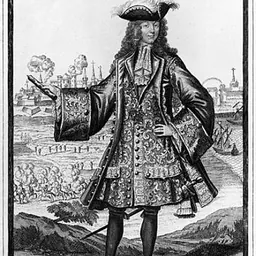
Laurens Cornelis Boudewijn de Graaf ( 1653 – 24 May 1704) was a Dutch pirate, mercenary, and naval officer in the service of the French colony of Saint-Domingue during the late 17th and early 18th century.
De Graaf was also known as Laurencillo or Lorencillo or simply El Griffe (Spanish), Sieur de Baldran or simply Laurent de Graff (French) and Gesel van de West (Dutch; "Scourge of the West"). Henry Morgan, the governor of Jamaica, characterized him as "a great and mischievous pirate". De Graaf was described as tall, blond, mustached and handsome. Some Spanish thought he was the Devil in person.
Early life He was reportedly enslaved by Spanish slave traders when captured in what is now the Netherlands and transported to the Canary Islands to work on a plantation, prior to 1674.
During the early 1670s, de Graaf either escaped or was freed, and French historian Pierre de Vaissière recorded that he married his first wife (Francois) Petronilla de Guzmán in 1674 in the Canary Islands before moving on to the Caribbean. The Spanish governor of St. Augustine, Florida attested to his marriage in a letter written to Charles II of Spain in 1682, by referring to de Graaf as a "stranger who was married in the Canaries".
Early pirate career According to sources, Laurens de Graaf used a plain blue flag when attacking vessels. De Graaf began his pirate career not long after marrying de Guzmán, though no records of his activity were made until 1682 when Sieur de Pouancay, the governor of Saint-Domingue, recorded that de Graaf had been sailing "on the account" since approximately 1675 or 1676 as the captain of a French privateer crew.
There are some later records of his involvement, in March 1672, in a raid on Campeche by a band of pirates who attacked and torched a partially built frigate and captured the town. The next day, the same pirates captured a merchant ship loaded with over 120,000 pesos in silver and cargo, when it sailed unknowingly into the harbor.
During the late 1670s, de Graaf is reported to have captured a number of vessels, converting each in turn to piracy. Starting with a small vessel he would capture a larger one, then use that vessel to capture a larger one again. Finally, in the autumn of 1679, de Graaf attacked the Spanish Armada de Barlovento and captured a frigate of 24-28 guns, which he renamed the Tigre (Tiger).
The Armada de Barlovento
At the same time, the Spanish saw their chance to get revenge for the loss of their frigate and the Armada de Barlovento was also sent to hunt de Graaf down. During a brief stop in Cuba, de Graaf was made aware of the plan to seek him out. Rather than waiting for the Armada, de Graaf sailed immediately in search of it. After a running gun battle that lasted several hours, the Princesa struck her colors (surrendered), having lost 50 men to de Graaf's eight or nine. In an act of kindness, de Graaf put the seriously wounded captain of the Princesa ashore with his own surgeon and a servant. He rounded up over six thousand local citizens, held them inside churches and denied them food and water for three days and nights. Many were tortured, and a large number of the women were raped. Ultimately, de Graaf was instrumental in the mass kidnapping of over 1,400 people of African descent from Veracruz. The majority of these women, children, and men were sold into slavery in Saint-Domingue (modern-day Haiti), Jamaica, and Carolina.
The pirates arrived off Veracruz on 17 May 1683, leading with van Hoorn's two captured Spanish ships to mislead the town. Meanwhile, de Graaf and Yankey Willems slipped ashore with a small force of men. They proceeded to remove town's fortifications and incapacitate the town's defensive militia. Van Hoorn, marching overland, joined with de Graaf and attacked the town.
On the second day of plundering, the Spanish plate fleet, composed of numerous warships, appeared on the horizon. The pirates retreated with hostages to the nearby Isla de Sacrificios and waited for ransoms. A quarrel erupted between van Hoorn and de Graaf over the treatment of the hostages and the division of spoils. According to some sources the two fought a duel on a nearby beach to settle the dispute. 800 Spanish, led by a 26-year-old commander, set out to meet the pirates on Christmas Eve but immediately struggled against De Graaf's more experienced pirates. 90 Spaniards were killed compared to only 20 pirates. The San Francisco was grounded and the other two ships were captured. De Graaf re-floated the San Francisco as his new flagship and renamed it the Fortune, later the Neptune. Andrieszoon took the Paz and renamed it the Mutine ("Rascal") and Willems was given command of the Francesca.
The pirates split up and de Graaf fled from a superior fleet off the Yucatán. After a day-long battle with two larger Spanish ships, he escaped by dumping all cargo and cannons overboard to lighten his ship.
Later career In 1687, de Graaf engaged in a battle off southern Cuba with a Biscayan frigate and the Cuban Guarda del Costa (Coast Guard). He sank several piraguas and took a small ship as prize. De Graaf returned to Saint Domingue, where he defended the harbor at Petit-Goâve against Cuban invaders. In December 1689, he took ships off Jamaica. He went on to blockade the Jamaican coast for more than six months before leaving. Proceeding to the Cayman Islands, de Graaf there captured an English sloop.
In January 1691, de Graaf attacked near Santo Domingo but was soundly defeated by a Spanish force three times the size of his French forces. He narrowly escaped with his life.
In March 1693, de Graaf met and married his second wife, Anne Dieu-le-Veut. He agreed to marry her after she threatened to shoot him for insulting her. De Graaf spent the summer of 1693 leading buccaneers against Jamaica in several raids; fellow buccaneer Captain Francois Le Sage, who had sailed alongside de Graaf since before Veracruz, was killed in one of the attacks on Jamaica. The English retaliated in May 1695 with an attack on Port-de-Paix at Saint Domingue, where they sacked the town and captured de Graaf's family. while others maintain that his appearance in Louisiana and Alabama was fictional and that in fact he died in Santo Domingo in 1704.
Don’t just read it —
keep it.
Full-length biographies made to live with: read them, listen on the way to work, watch them tonight.
- E-book
- Audio
- Video
Instant download · yours to keep · every purchase keeps this site free
Important facts
Family & relationships
People in Laurens de Graaf's life
Named in this biography and alive at the same time

Related people
Same field, nearest in time




Contemporaries
People whose lives overlapped Laurens de Graaf's






Frequently asked questions
Who was Laurens de Graaf?
Dutch pirate
When was Laurens de Graaf born?
Laurens de Graaf was born in 1653 in Dordrecht.
When did Laurens de Graaf die?
Laurens de Graaf died on 24 May 1704 in Cap-Haïtien.
What was Laurens de Graaf's occupation?
Laurens de Graaf was a privateer, pirate and mercenary.
What nationality was Laurens de Graaf?
Laurens de Graaf was Dutch and French.
Sources & further reading
Cite this page
APA: Biography.guide. (2026). Laurens de Graaf. https://biography.guide/laurens-de-graaf/
MLA: "Laurens de Graaf." Biography.guide, https://biography.guide/laurens-de-graaf/.
Chicago: "Laurens de Graaf." Biography.guide. https://biography.guide/laurens-de-graaf/.
Data last updated: 2026-09-25 · Spot an error? Report a correction.
Page generated 2026-09-27 05:11 UTC