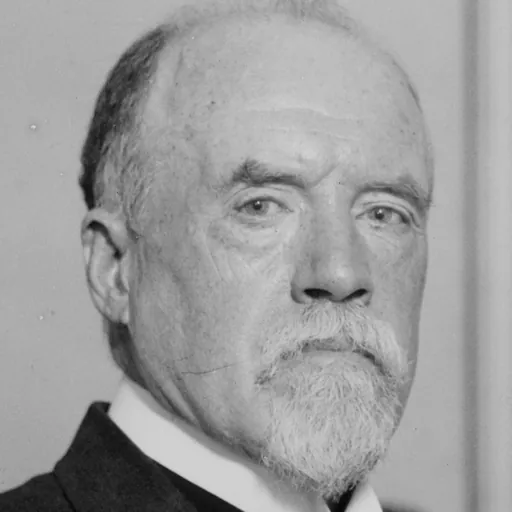
About Laurence Ginnell
Lived 1852 – 1923 (aged 71). Laurence Ginnell was an Irish and British politician and barrister.
Laurence Ginnell (baptised 9 April 1852 – 17 April 1923) was an Irish nationalist politician, lawyer and Member of Parliament (MP) of the House of Commons of the United Kingdom of Great Britain and Ireland as member of the Irish Parliamentary Party for North Westmeath at the 1906 UK general election. From 1910 he sat as an Independent Nationalist and at the 1918 general election he was elected for Sinn Féin.
Early life Ginnell was born in Delvin, County Westmeath, in 1852, the son of Laurence Ginnell and Mary Monaghan and twin to Michael Ginnell. He was self-educated and was called to the Irish bar as well as the Bar of England and Wales. In his youth, he was involved with the Land War and acted as private secretary to John Dillon.
The last great social and agrarian campaign of the home rule movement, the Ranch War (1906 and 1909), was largely led and organised by Ginnell from the central office of the United Irish League. Ginnell was elected an MP in 1906, took his seat at Westminster and swore allegiance to Edward VII. On 14 October 1906, he launched the "war" at Downs, County Westmeath:
The purpose of the war was to bring relief to the large numbers of landless and smallholders, particularly in the West, who were relatively untouched by the Wyndham Land Purchase Act (1903) and by the larger policy of purchase. The strategy that Ginnell pursued was the Down's Policy, or cattle driving, a proceeding designed to harass the prosperous grazier interests, whose 'ranches' occupied large, under populated and under worked tracts. The 'Down's Policy' was also meant to draw public attention to the scandalous inequalities that survived in the Irish countryside. The conservatives within the Home rule leadership were understandably suspicious about the revival of agrarian disturbances, but the mood of the party organisation was hardening in the aftermath of a disappointing devolution bill in May 1907, from the new Liberal government, so that it seemed logical to turn to the traditional mechanism for reactivating the national question: agrarian agitation.
Ginnell's cattle drives began to tail off after the summer of 1908, and the agitation was finally dissolved with the passage of a 1909 Act by the Liberal Chief Secretary Augustine Birrell that allowed the transfer to the Land Commission of farmland by compulsory purchase, which was hailed by the national movement as an historic victory. In reality, the Ranch War involved an implosion within sectors of the Irish Party, as its leadership had not facilitated the working of the Wyndham Land Purchase Act in the first place because John Dillon and his like wanted conflict above victory.
In 1909, Ginnell was expelled from the Irish Parliamentary Party (IPP) for the offence of asking to see the party accounts after which he sat as an Independent Nationalist. During that time, he was addressed frequently as "The MP for Ireland". At Westminster, he was highly critical of the British government's war policy and its holding of executions of certain participants in the Easter Rising of 1916. On 9 May, he accused British Prime Minister H. H. Asquith, of "Murder" and was forcibly ejected from the Chamber. He visited many of the prisoners who were interned in various prisons in Wales and England. After spending a year as a republican campaigner in Chicago, he was appointed the Representative of the Irish Republic in Argentina and South America by de Valera. He carried out his propaganda work here to distribute copies of the Irish Bulletin and to provide the Sinn Féin version of the conflict during the War of Independence. On 16 August 1921 he returned home to attend the first meeting of the Second Dáil. He travelled back to Argentina some months later to serve as the Representative of the Republic there.
Anti-Treaty opinion He opposed the Anglo-Irish Treaty that was ratified by the Dáil in January 1922, and was elected as an anti-Treaty Sinn Féin TD at the 1922 general election on the eve of the Irish Civil War.
On 9 September 1922, Ginnell was the only anti-Treaty TD to attend the inaugural meeting of the Provisional Parliament or 3rd Dáil. Before signing the roll, Ginnell said: "I want some explanation before I sign. I have been elected in pursuance of a decree by Dáil Éireann, which decree embodies the decree of 20 May 1922. I have heard nothing read in reference to that decree, nothing but an Act of a foreign Parliament. I have been elected as a member of Dáil Éireann. I have not been elected to attend any such Parliament. Will anyone tell me with authority whether it is...". He was at that point interrupted but resumed by saying that he would sign the roll and take his seat in the Assembly if the Assembly were Dáil Éireann. He was informed he was not allowed raise any such question until a Ceann Comhairle had been elected. He continued to ask questions regardless to which he got no answer including his question: "Will any member of the Six Counties be allowed to sit in this Dáil?" W. T. Cosgrave moved at this point that he be excluded from the House. Ginnell protested, and he was dragged out by force.
De Valera later appointed him a member of his "Council of State", a twelve-member body set up to advise him on the deteriorating situation in the civil war. Ginnell returned to the United States soon afterwards to serve as the Republic's envoy in the country. He ordered Robert Briscoe and some of his friends to take possession of the Consular Offices in Nassau Street, New York City, then in the hands of the Free State Government, to obtain the list of the subscribers to the bond drive organized to aid the struggle in the War of Independence. At the time, a court case was ongoing to decide on who had the right to the funds: the newly installed Provisional Government or de Valera, as one of the three trustees among the anti-Treatyites. Ginnell died in the United States on 17 April 1923, aged 71, still campaigning against the Anglo-Irish Treaty.
Don’t just read it —
keep it.
Full-length biographies made to live with: read them, listen on the way to work, watch them tonight.
- E-book
- Audio
- Video
Instant download · yours to keep · every purchase keeps this site free
Important facts
Family & relationships
People in Laurence Ginnell's life
Named in this biography and alive at the same time


Related people
Same field, nearest in time





Contemporaries
People whose lives overlapped Laurence Ginnell's

Frequently asked questions
Who was Laurence Ginnell?
Irish politician and writer (1852-1923)
When was Laurence Ginnell born?
Laurence Ginnell was born on 9 April 1852 in Delvin.
When did Laurence Ginnell die?
Laurence Ginnell died on 17 April 1923 in Washington, D.C..
What was Laurence Ginnell's occupation?
Laurence Ginnell was a politician and barrister.
What nationality was Laurence Ginnell?
Laurence Ginnell was Irish and British.
Sources & further reading
Cite this page
APA: Biography.guide. (2026). Laurence Ginnell. https://biography.guide/laurence-ginnell/
MLA: "Laurence Ginnell." Biography.guide, https://biography.guide/laurence-ginnell/.
Chicago: "Laurence Ginnell." Biography.guide. https://biography.guide/laurence-ginnell/.
Data last updated: 2026-09-21 · Spot an error? Report a correction.
Portrait: Wikimedia Commons · author & licence
Page generated 2026-09-27 05:01 UTC